US 110 V mains

  • Thread starter Deleted member 115935
  • Start date

Thread Starter

Deleted member 115935

Joined Dec 31, 1969
0
Purely for interest,
I know the US has 110V mains,
I have heard that its received at the house as +- 55 V ? effectively centre tapped, so you can never get more than 55V above earth,

i.e. the US system is safer than the European 240V , where we effectively strap one side down to ground..

Just what does the US system deliver to houses.

Thank you
 

Papabravo

Joined Feb 24, 2006
22,082
±120 VAC(rms) with respect to the neutral center tap. Hot to Hot is 240 VAC(rms). I don't know about safer, I'll leave that for others more knowledgeable
 

MaxHeadRoom

Joined Jul 18, 2013
30,658
The N.A. residential power is derived from a high voltage primary, 1ph transformer fed from two phases of a 3ph version.
The secondary is a centre tapped at 120v-0-120v, the low voltage 120v circuits are for low power plug circuits and lighting, the higher, 240v is for power appliances, stoves, HVAC, dryers etc.
The 0v point of the secondary is taken to earth ground at the transformer and also at the distribution panel, effectively creating a 'Neutral'. conductor..
Max.
 
Last edited:

ThePanMan

Joined Mar 13, 2020
918
I know the US has 110V mains,
I have heard that its received at the house as +- 55 V ?
Not exactly. There's a center tapped transformer supplying 240 VAC to the house and the center tap derives the 120 VAC. Line 1 to Line 2 = 240 VAC. Line 1 to Neutral = 120 VAC. Line 2 to Neutral = 120 VAC. It's not ±55V.

DL324 beat me by a few minutes.
 

MaxHeadRoom

Joined Jul 18, 2013
30,658
i.e. the US system is safer than the European 240V , where we effectively strap one side down to ground..
If you are in the UK, then Your 240v source is from one phase and a neutral of a 3ph transformer, compared to the N.A. split phase secondary.
.Essentially the same result, except the N.A. L.V. of 120v.
Max.
 

jpanhalt

Joined Jan 18, 2008
11,087
Purely for interest,
I know the US has 110V mains,
I have heard that its received at the house as +- 55 V ? effectively centre tapped, so you can never get more than 55V above earth,

i.e. the US system is safer than the European 240V , where we effectively strap one side down to ground..

Just what does the US system deliver to houses.

Thank you
If one looks at much older homes (pre 1950) that have not been updated, you may see just 2 wires enter. One is one leg of 220 center tapped; the other is the center tap (i.e., the grounded wire, not ground wire).

As commented above, three wire installations are both legs of the 220V service and the center tap (grounded wire).

At a commercial installation with which I am familiar (a long distance from the transformer), there was no "grounded" wire. Only 2 wires (both legs of the 220 V) were brought to the site. The electrician who did the wiring created the grounded and ground wire at the service entrance.
 

Thread Starter

Deleted member 115935

Joined Dec 31, 1969
0
Thank you chaps,
Its been bugging me all day what really happens in the US power system.
Have a good day .
 

MaxHeadRoom

Joined Jul 18, 2013
30,658
If one looks at much older homes (pre 1950) that have not been updated, you may see just 2 wires enter. One is one leg of 220 center tapped; the other is the center tap (i.e., the grounded wire, not ground wire).
At a commercial installation with which I am familiar (a long distance from the transformer), there was no "grounded" wire. Only 2 wires (both legs of the 220 V) were brought to the site. The electrician who did the wiring created the grounded and ground wire at the service entrance.
That is similar to what I experienced in the UK back during my initial training, at that time the power company only brought 2 conductors, one had been earth grounded at the source transformer, even if they delivered a ground conductor, you could not use it, at that time you were required to supply a earth grounded conductor at the installation, and measure the ground resistance back to the source transformers grounded conductor by way of this neutral and the actual earth resistance, this was done using a earth resistance megger. The neutral could not contact the earth GND conductor in the panel, as it is done now in N.A.
Max.
 

crutschow

Joined Mar 14, 2008
38,504
the US system is safer than the European 240V
I would expect the US system to be somewhat safer since a lower voltage would always be safer from an electrocution standpoint.
That being said, I don't know if there are statistics on electrocution deaths to verify that statement.
 

MaxHeadRoom

Joined Jul 18, 2013
30,658
Virtually the whole world now uses 220v-240v residential power, there are some that use 110v and 220 such as parts of Taiwan, Saudi Arabia etc. But they are mostly in a minority, most of these due partly to US influence.
Max..
 

nsaspook

Joined Aug 27, 2009
16,322
I would expect the US system to be somewhat safer since a lower voltage would always be safer from an electrocution standpoint.
That being said, I don't know if there are statistics on electrocution deaths to verify that statement.
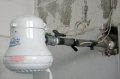
I don't think there's much difference in total electrocution statistics with proper installs but I've seen to pretty sketchy 220V installs around the world.
Showers_in_Guatemala.JPG
There is often a big difference between theory and practice.
 
Last edited:

Reloadron

Joined Jan 15, 2015
7,889
I have heard that its received at the house as +- 55 V ? effectively centre tapped, so you can never get more than 55V above earth,
Well now you know that is not the case. The only time I ever saw 120 volt power delivered as 60 - 0 - 60 volts was on board a US aircraft carrier in the Aircraft Intermediate Maintenance Department areas. Not even sure about anywhere else on the ship but the 120 VAC 60 Hz power was 60 - 0 - 60 and of course 120 VAC 3 Phase 400 Hz power. I had pretty much forgotten all of that till I saw your reference to 55 - 0 - 55 volts.

Ron
 

nsaspook

Joined Aug 27, 2009
16,322
Well now you know that is not the case. The only time I ever saw 120 volt power delivered as 60 - 0 - 60 volts was on board a US aircraft carrier in the Aircraft Intermediate Maintenance Department areas. Not even sure about anywhere else on the ship but the 120 VAC 60 Hz power was 60 - 0 - 60 and of course 120 VAC 3 Phase 400 Hz power. I had pretty much forgotten all of that till I saw your reference to 55 - 0 - 55 volts.

Ron
Almost all ac distribution systems on U.S. Navy ships are ungrounded.
Ungrounded electrical systems have no intentional connections between the electrical conductors and the ground (ship’s hull). These systems were chosen for their higher reliability because grounding of a single conductor will not typically produce enough fault current to interrupt power. Grounds must be removed as soon as possible to maintain this advantage, however, because a second ground on another phase will cause a power loss and could endanger personnel.
This means that electrical safety is secondary to electrical reliability in military power systems.
 
Last edited:

dendad

Joined Feb 20, 2016
4,637
I think it is in the UK, according to a program I saw, the commercial construction industry has the 240V to 55-0-55V transformer for their on site tools for safety reasons as during construction, the risk of cutting power tool cables is much higher.
It sounds like a good idea to me.
 

Reloadron

Joined Jan 15, 2015
7,889
Almost all ac distribution systems on U.S. Navy ships are ungrounded.


This means that electrical safety is secondary to electrical reliability in military power systems.
Absolutely but with a few exceptions. Of course I was part of the exceptions. This is a good read on US Navy shipboard power.

320-1.2.1.1 System Grounding. All ac distribution systems on U.S. Navy ships are ungrounded. However, certain avionics shops, aircraft servicing systems, and landing craft air cushion (LCAC) servicing outlets are supplied from three-phase, four-wire systems that are supplied by transformers with a grounded, wye-connected secondary and single-phase, three wire grounded outlets with two pole ground fault current interruption (GFCI) protection are provided where required by the user equipment (see paragraph 320-1.2.1.3). Only one ground connection point is allowed for each grounded power system. Ungrounded electrical systems have no intentional connections between the electrical conductors and the ground (ship’s hull). These systems were chosen for their higher reliability because grounding of a single conductor will not typically produce enough fault current to interrupt power. Grounds must be removed as soon as possible to maintain this advantage, however, because a second ground on another phase will cause a power loss and could endanger personnel.
My work with the navy, as far as ships was primarily NAVAIR early on and only later involvment with NAVSEA and the subs.

I think it is in the UK, according to a program I saw, the commercial construction industry has the 240V to 55-0-55V transformer for their on site tools for safety reasons as during construction, the risk of cutting power tool cables is much higher.
It sounds like a good idea to me.
That has come up here in the forums. Yes, onsite electric tools like for construction are like 110 or 120 VAC. Here in the US most 120 VAC power tools, new design, have double insulated cases and built in the power cord GFCI. My small pressure washer and my power miter saw have in line GFCI.

Ron
 

Thread Starter

Deleted member 115935

Joined Dec 31, 1969
0
I think it is in the UK, according to a program I saw, the commercial construction industry has the 240V to 55-0-55V transformer for their on site tools for safety reasons as during construction, the risk of cutting power tool cables is much higher.
It sounds like a good idea to me.

Regarding construction industry in Europe.
you are right about the use of 110 V around site.

Its even colour coded . All 240V on site is in blue cables and connectors, the 110V is in yellow and you can not plug one into the other... and 415V three phase is red with an extra pin,

You see in remote parts of site, you see big yellow IP6x protected 240 to 110V transformers which have a centre tap at ground, and a big nut on the ground to allow you to put a ground stake in,

Thank you all for the interesting comments,
 
Top