Ultrasonic Nebulizer with ATTiny13

Thread Starter

felias

Joined Mar 22, 2025
2
Hello everyone,


This is my first post here, so I apologize in advance for any mistakes.

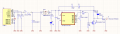
I'm currently working on a project where an ATtiny13 is the central controller of my circuit. The analog input PB2 is connected to the wiper of a 10kΩ potentiometer, which acts as a sensor. The ATtiny13 generates a 113 kHz PWM signal on PB0, which drives a MOSFET. The MOSFET switches GND for an oscillating circuit consisting of a 200 µH inductor and a 100 nF capacitor. The output of the capacitor is then used to drive an ultrasonic humidifier module rated at 2W and 5V. The problem lays not with the ATTiny as I've already got it to put out the 113kHz in different intervals depending on the position of the potentiometer.

I've already built the circuit, but unfortunately, it does not work as expected. My main questions are:
  • Did I choose the wrong MOSFET?
  • Are my component values incorrect?
  • What improvements can I make to get the circuit working?

I've attached my schematic for reference. I would really appreciate any insights or suggestions on what might be wrong.
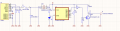
Screenshot 2025-03-22 235845.png

Thanks in advance for your help!
 
Mosfet seems ok to me, a 2A rating should be sufficient for 2W/5V=0.4A load.
What does it mean it’s not working?
Did you measure the voltage across DS of mosfet with scope?
 

nsaspook

Joined Aug 27, 2009
16,249
First, my usual comments, where are your bypass and energy filter capacitors from VCC/VDD/5VDC to GND? It seems that the sources of circuit building education these days are leaving out critical information on circuit building.

You need them (for reliable operation of circuits) near the controller and near the L1 +5vdc connection that powers the MOSFET to provide a good low impedance energy path for the ultrasonic humidifier module.

Not saying this is the problem here but it's something that unfortunately is very common with circuits posted here.
 

MisterBill2

Joined Jan 23, 2018
27,159
I started this post before post 3 arrived. So it is sort of redundant.
Are L1 and C1 supposed to be a resonant circuit??Is 113 kHz the resonant frequency of the nebulizer?? Is there simply not enough energy being delivered to have the proper effect??
Very pointedly, what is the specific complaint???
I can see immediately that the supply impedance is limiting the energy that inductor L1 can possibly deliver. The circuit needs a fast power diode between the ground and the top of L1, so that the collapsing magnetic field can deliver the power.
 

Thread Starter

felias

Joined Mar 22, 2025
2
First of all, thank you for your replys.

The main problem I am facing with the circuit, is that the 113kHz of my ATTiny aren't showing up at the drain of the MOSFET (Most of the time it shows around 20kHz and get's pretty hot). I've already tried the same circuit with a standard NE555 that delivers the 113kHz to a IRF3205 MOSFET with the same inductor and capacitor of the circuit above and it worked.

I've also made some of the general changes nsaspook and Bill have talked about. I've posted my new schematic below.Screenshot 2025-03-23 145031.png
 

nsaspook

Joined Aug 27, 2009
16,249
First of all, thank you for your replys.

The main problem I am facing with the circuit, is that the 113kHz of my ATTiny aren't showing up at the drain of the MOSFET (Most of the time it shows around 20kHz and get's pretty hot). I've already tried the same circuit with a standard NE555 that delivers the 113kHz to a IRF3205 MOSFET with the same inductor and capacitor of the circuit above and it worked.

I've also made some of the general changes nsaspook and Bill have talked about. I've posted my new schematic below.View attachment 345216
C2 looks fine but

C3 and C4 are connected wrong.
They need to be in parallel with one end on VCC and the other end connected to GND like C2.

Those connections must be as short as possible and close as possible to L1 and the source pin on the MOSFET.
 

MisterBill2

Joined Jan 23, 2018
27,159
In addition, that fast diode, D3, is not connected correctly. In a switching supply the diodes are intended to direct the inductive spike, not reduce it.
 

MisterBill2

Joined Jan 23, 2018
27,159
Typically, piezo-electric nebulizer devices are intentionally driven at or close to the mechanical resonant frequency. And usually that is a bit above the audio frequency range by a few kilohertz. In this case, my guess is that the IO of that " ATTiny " is not able to deliver nearly enough drive at that frequency.
Many times, a lack of adequate drive will result in a power device not switching as desired, but rather working in the linear mode and getting rather hot about it.
 

DickCappels

Joined Aug 21, 2008
10,661
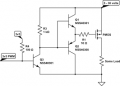
That ATTINY13 probably cannot drive the capacitive load that the MOSFET gate presents.

You can use a driver chip or something like the circuit below.
1742875730772.png
If you use a lower switching frequency it should make your life easier (easier to drive the gate capacitance).
 

MisterBill2

Joined Jan 23, 2018
27,159
D.C. has backed up the probability that the gate drive is not adequate for the application.
IN ADDITION, it is not likely that using PWM in a non-resonant arrangement will provide an adequate control function.
Does the TS know what the mechanical resonant frequency of the piezo/disc assembly is?? and why was the 113KHZ frequency selected??
Off-resonance PWM will probably not be efficient even if it can be made to work.
 
Top