Ultrasonic automizer mister/fogger does not work when fully submerged in water, why?

Thread Starter

Adamelli

Joined Sep 14, 2020
66
1658331667173.png

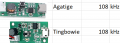
I got some ultrasonic mister/fogger transducers and circuit boards. So far they all need to be on the water's surface to work. When submerged, they stop working. This guy shows another way to make it work: https://www.amazon.com/gp/customer-...f=cm_cr_arp_d_rvw_img?ie=UTF8&ASIN=B073322QF8

Although, I want to make it like the commercial ones work. They are just submerged in water 1/2-1". Do I need a ceramic instead of metal piezo? Does it need to be run at a higher power? I tried searching around, but have not found anything useful that addresses these questions.
 

MrSalts

Joined Apr 2, 2020
2,767
If you are swinging the crawl on the surface, you are easily making splashes with droplets drifting across to the next lane of the pool - possibly splashing the face of the guy in the next lane doing the backstroke.

Now imagine, how hard you'd have to kick to splash his face if you were swinging along the bottom of the pool. Imagine what the "drop size" would be in each case. Think of the radius of influence required from a point source of energy to break the surface tension of the water by a movement at the bottom of the pool.

I think trying to atomize water from a submerged point is a waste of energy and the drop size would be so large that they wouldn't really be atomized - they would be large drops that wouldn't really carry into the air or evaporate to increase the humidity.
 

ThePanMan

Joined Mar 13, 2020
862
Long time ago, messing with an ultrasonic cleaner (for jewelry) I put my finger into the water. Didn't feel anything. Pushed my finger in a little deeper and I hit the sweet spot where the acoustic energy was focused and it hurt to the bone of my finger.

I've had those smoke dishes where you put the UST (Ultra Sonic Transducer) in the water and it causes atomization of the water at the surface. When put into a deeper bowl they barely worked. Likely it has to do with the frequency and wave length of the UST. Get it right and it'll probably work like a champ. Get it wrong and it'll work like a politician. Lots of energy consumed with little to no results.
 

Thread Starter

Adamelli

Joined Sep 14, 2020
66
trying to atomize water from a submerged point is a waste of energy and the drop size would be so large that they wouldn't really be atomized - they would be large drops that wouldn't really carry into the air or evaporate to increase the humidity.
One major difference, maybe the only real difference, is how the commercial 12-head ones have gigantic high wattage power supplies (e.g., 400 W at 40 V). The small development circuit boards are a few watts around 5 V.
 

ThePanMan

Joined Mar 13, 2020
862
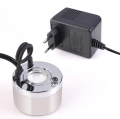
Haven't seen my smoke dish in a long time. It's powered from a fist sized wall wart. Don't know off hand what voltage or wattage it's capable of. But for sure I got tired of replacing the ceramic disks due to their breakdown. AND I don't recall if they were ceramic or metallic. Bottom line - they're somewhere in a closet in the basement.
 

ThePanMan

Joined Mar 13, 2020
862
Here's one similar to mine, only mine had several LED's around the perimeter. Some Red, some Green and some Blue. Some electronics inside the head unit controlled the brightness of each group of coloring causing a changing appearance in the smoke of colors slowly fading from one color to another.

Notice the wall wart. Mine operated on 120VAC, the one pictured obviously operates on 240VAC.
1658336142630.png
 

Thread Starter

Adamelli

Joined Sep 14, 2020
66
So the next question becomes...

How to find whitepapers about ultrasonic atomizer mister/fogger circuits?

I've seen Instructables and some low-wattage schematics. Instead, I want to see something 300-500 W application circuits or something discussing it.
 

MrSalts

Joined Apr 2, 2020
2,767
So the next question becomes...

How to find whitepapers about ultrasonic atomizer mister/fogger circuits?

I've seen Instructables and some low-wattage schematics. Instead, I want to see something 300-500 W application circuits or something discussing it.
Check the website of a ultrasonic transducer's website.
 

Thread Starter

Adamelli

Joined Sep 14, 2020
66
Reading through these:

Ultrasonic atomization of liquids in drop-chain acoustic fountains (2015)
https://www.ncbi.nlm.nih.gov/pmc/articles/PMC4428615/


Tissue Atomization by High Intensity Focused Ultrasound (2012)
https://www.ncbi.nlm.nih.gov/pmc/articles/PMC8320307/


L. D. Rozenberg and O. K. Eknadiosyants, “Kinetics of ultrasonic fog formation,” Sov. Phys. Acoust. 6, 369–374 (1960).
E. L. Gershenzon and O. K. Eknadiosyants, “The nature of liquid atomization in an ultrasonic fountain,” Sov. Phys. Acoust. 10, 127–132 (1964).
O. K. Eknadiosyants, “Role of cavitation in the process of liquid atomization in an ultrasonic fountain,” Sov. Phys. Acoust. 14, 107–111 (1968).

Ultrasonic cavitation monitoring by acoustic noise power measurement (2000)
https://sci-hub.se/10.1121/1.1312360

J. Frohly, S. Labouret, C. Bruneel, I. L. Baquet, and R. Torguet, “Ultrasonic cavitation monitoring by acoustic noise power measurement,” (2002).
https://sci-hub.se/10.1121/1.1500754

A. D. Maxwell, C. C. Cain, T. L. Hall, J. B. Fowlkes, and Z. Xu, “Probability of cavitation for single ultrasound pulses applied to tissues and tissue-mimicking materials,” Ultrasound Med. Biol. 39, 449–465 (2013).
https://www.ncbi.nlm.nih.gov/pmc/articles/PMC3570716/

V. A. Khokhlova, M. R. Bailey, J. A. Reed, B. W. Cunitz, P. J. Kaczkowski, and L. A. Crum, “Effects of nonlinear propagation, cavitation, and boiling in lesion formation by high intensity focused ultrasound in a gel phantom,” J. Acoust. Soc. Am. 119, 1834–1848 (2006).
https://sci-hub.se/10.1121/1.2161440


Maybe it's too industry specific to find a high power circuit?
 
Top