Two Half-fast Questions

Thread Starter

bidwin

Joined Jan 22, 2015
16
Disclaimer: I know virtually nothing about electronics. I can usually tell where the juice goes into a schematic and where it comes out, but all the gizmos in between are just black boxes to me. But, I have some "electronics-oriented" questions that I hope can be understood and answered by someone here:

1. I have a cheapo battery tester that’s supposed to determine if many commonly-used household batteries are good or bad. I understand that batteries should be tested under load to make a good determination. If I measure the resistance of the tester’s various battery type settings, eg. 9V, AA, C, etc, would that resistance be the same as that put on the battery being tested?

2. I read somewhere that a load of about 100Ω should be placed on a household battery as it’s being tested to determine if it’s good or not. I have some 100Ω 1/4 watt resistors. Would these be OK to provide a load if I test batteries with my multimeter?

Thanks,
Baffled Bill
 

sagor

Joined Mar 10, 2019
1,049
1) Maybe. Depends if the test meter has any diodes or other devices in it and if the meter resistance is in parallel or series with the contacts, etc. It might be "close" to what the actual load is.
2) A 100 ohm 1/4W resistor is ok for testing standard 1.5V household batteries. Not good for 9V battery types, too high a load (need higher resistance).
 

BobTPH

Joined Jun 5, 2013
11,515
You would put a different load on a AAA cell than you would in a D cell.

If you want to test batteries for a specific device, you could measure the voltage while it is running.
 

MrChips

Joined Oct 2, 2009
34,807
For testing 1.5 V cells, I use a flashlight bulb as the load. I watch the needle of an old analog voltmeter and the brightness of the bulb to determine if it's time to send to hazardous waste.

For 9 V battery, a 100 Ω load would be about right. If the voltage drops below 7.5 V, it is time for a replacement. ( I know, I like to squeeze as much juice out of it, depending on the application.)
 

dl324

Joined Mar 30, 2015
18,326
1. There's more than one type of tester and you don't give any information about the one you're referring to. You'll probably get something close.

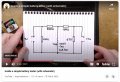
I searched for a battery tester teardown and found this:
simpleBatTest-1.jpgsimpleBatTest-2.jpg

2. That source probably didn't know what they're talking about.
 

Ian0

Joined Aug 7, 2020
13,131
I have loads of test equipment, but if I want to know whether batteries are any good, I put them in a torch*. If it lights up then they are OK.

WHy would you ever have any batteries kicking about that may or may not be good? If they are still in their original packet, then they are unused, and you put them in something which you use until it stops working. They they aren't any good.

* "torch" = "flashlight" in American.
 

crutschow

Joined Mar 14, 2008
38,503
Here's one half-fast answer:
I have good results just testing the no-load voltage of alkaline batteries.
>1.5V per cell is near full capacity, 1,25-1.3V is near half capacity, and below 1.1V is near dead.

There is some life in an alkaline even below 1.1V as I have a wireless mouse that will keep working with an AA alkaline battery until its near 0.7V (now that's dead :rolleyes:).
 
Last edited:

WBahn

Joined Mar 31, 2012
32,823
1. I have a cheapo battery tester that’s supposed to determine if many commonly-used household batteries are good or bad. I understand that batteries should be tested under load to make a good determination. If I measure the resistance of the tester’s various battery type settings, eg. 9V, AA, C, etc, would that resistance be the same as that put on the battery being tested?
Depends on the design of the tester.

2. I read somewhere that a load of about 100Ω should be placed on a household battery as it’s being tested to determine if it’s good or not. I have some 100Ω 1/4 watt resistors. Would these be OK to provide a load if I test batteries with my multimeter?
Think about this -- you just asked about measuring the resistance of a tester at different battery type settings for commonly-used household batteries, and then next you are assuming that a single resistance of 100 Ω is somehow the one single load resistance for any type of household battery.

Does that make sense to you?

The best, and generally easiest, way to tell if a battery still has some life left in it is to install it in the thing you want to power with it and, if the thing works, then the battery still has enough life left to make the thing work. How long it will continue to work is still an unknown -- but, frankly, putting it on some kind of tester is usually not going to answer that question a whole lot better (not to mention draining some of said life from the battery in the process). If you need it to last as long as it can, then use fresh batteries from a quality source and use the batteries-with-unknown-life-remaining in things that are more tolerant of using batteries with unknown life remaining.

If, for some reason, you really want to get some kind of indication of the state of charge of a battery, get the discharge curve from the manufacturer and load it according to the discharge curve, matching your application as best you can, and see how many hours of service it have effectively been used and how many hours are likely left -- keeping in mind that there's a lot of uncertainty in this, or nearly any, test of battery state.

As for your 1/4 W resistors, you will hit 250 mW in a 100 Ω resistor with just 5 V placed across it, and it will get very hot. A common rule of thumb is to not push resistors beyond half of their power rating, which would be about 3.5 V.

If you look at the product sheets for 1.5 V alkalines, you see that their curves are generally produced using something between about 1.5 Ω and 25 Ω, while 9 V batteries typically use 300 Ω to 1000 Ω.
 

Thread Starter

bidwin

Joined Jan 22, 2015
16
Thank you all very much for your responses to my questions. I appreciate your taking the time to do so.
BB
 
Top