TVS diode trace distance?

Thread Starter

joewales44

Joined Oct 8, 2017
218
i understand it's best to place TVS diodes as close as possible to power source.
due to board limitations, i need to place it about 1 inch past the part i need to protect.
1. will it provide any protection when placed farther away from power source than the part needing protection?

also, i need to let power pass through a SS14 diode to the TVS diode.
2. can a SS14 diode react as quick as the TVS to pass a voltage spike?
3. how big a voltage spike can a SS14 handle?

i would like real world experience opinions.
not hypothetical answers.
thanks
 

ebp

Joined Feb 8, 2018
2,332
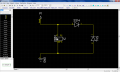
No worries about the extra bits in the pic - the essential parts are very clear, which is what counts.

As long as power is applied, the Schottky diode largely drops out of the picture in terms of transients. It can be considered to be an ON switch. In any case, Schottky diodes are extremely fast, so even without existing bias it would either pass a forward-biasing spike or block a reverse spike. There is a bit of capacitance effectively in parallel with the diode, so a very small amount of charge would go through if there were a reverse spike while the power was off.

Placing the TVS on the "wrong" side does definitely impair its ability to limit the voltage at the protected IC because of the inductance of the connections between the two. An inch each way in the path isn't too bad unless any spike were extremely fast rising. If you can, keep the traces to the TVS as close together as possible to minimize "loop area" which helps minimize effective inductance (you get some cancellation of magnetic fields). It is hard to quantify the magnitude of spike that might remain at the IC terminals without knowing the spike risetime. The total energy in the spike also matters since the higher the current in the TVS, the higher the clamping voltage. High spike current also causes voltage drop across the resistance of the connections between the IC and the TVS.

If possible, place a power supply decoupling capacitor very close to the IC. It will help to "eat" the residual spike energy that the TVS can't clamp because of the inductance. The higher the capacitance, the better, as long as it is a physically small cap with very short leads. If it is to be surface mount, probably about 1 µF would be adequate and better than 100 nF.

===
Revised schematic arrived as I was typing:
Now I don't see the purpose for the Schottky diode. The previous remarks still largely apply, but now the forward voltage of the diode must be added to the clamping voltage of the TVS to determine the voltage at the IC power terminals. This again depends on the current through the TVS. The datasheet for the Schottky will probably include a graph of forward voltage versus current.
 

Thread Starter

joewales44

Joined Oct 8, 2017
218
thanks for your very detailed answer.
the schematic is just a simplified version of the entire circuit.
that's why the schottky doesn't make sense.
i have a large quantity of unidirectional tvs diodes that i need to use.
so i need reverse polarity protection going to the tvs.
this is one of the reasons for the shottky.
i drew it in the wrong place, but the schottky would actually be located just before ground.
thanks again.
 
Top