Turning on LEDs in sequence after a condition

Thread Starter

toozie21

Joined Oct 4, 2012
59
This goes with one of my Christmas projects (other threads are on here).

I have a dynamo with a hand crank on it. The user will turn the crank and light a series of leds (or some other 5v/12v light).

My issue is trying to come up with a non microcontroller way to slowly turn on the LEDs one after the other. Since the dynamo will get harder to turn the more current is required, I'd like to be able to turn one light on, then the next one would need to be turned on, then the third, etc.

I figure once the dynamo is over a set voltage, the first LED would turn on and now they will have to crank harder to maintain the voltage and increase the current it is trying to supply. Does this make sense?

I could do this stuff with a micro, but I was trying to think of a slick way to do this in analog and not need any external power. Ideas?

Thanks!
 

ebeowulf17

Joined Aug 12, 2014
3,307
This goes with one of my Christmas projects (other threads are on here).

I have a dynamo with a hand crank on it. The user will turn the crank and light a series of leds (or some other 5v/12v light).

My issue is trying to come up with a non microcontroller way to slowly turn on the LEDs one after the other. Since the dynamo will get harder to turn the more current is required, I'd like to be able to turn one light on, then the next one would need to be turned on, then the third, etc.

I figure once the dynamo is over a set voltage, the first LED would turn on and now they will have to crank harder to maintain the voltage and increase the current it is trying to supply. Does this make sense?

I could do this stuff with a micro, but I was trying to think of a slick way to do this in analog and not need any external power. Ideas?

Thanks!
I'm reaching back >20 years to a high school physics class, so I could easily be remembering this wrong, but...

I thought that the force it took to turn the dynamo was more closely related to voltage than current, and that having more resistance in the circuit effectively made it harder to turn. Conversely, the more loads you have in parallel (less resistance) the easier it would be to turn the crank. Of course, easier cranking doesn't mean more current - I think you'll have to turn faster for more current, but that the torque required with more lights will be lower. This is all assuming the LEDs are wired in parallel, not in series.

I welcome corrections, clarifications, or just plain rebuttals if I've totally missed on this one!
 

WBahn

Joined Mar 31, 2012
32,852
It gets harder to turn as the load increases (decreasing resistance). Take a permanent-magnet DC motor and turn it by hand. Now short the leads and turn it by hand.
 

Reloadron

Joined Jan 15, 2015
7,890
I have a dynamo with a hand crank on it. The user will turn the crank and light a series of leds (or some other 5v/12v light).
I would place a suitable load (to be determined) on the hand crank generator (dynamo) and use a LM 3914 (LM3914 Dot/Bar Display Driver) The higher the voltage to the load the LEDs illuminate in a bar graph display. The LM3914 is the bread and butter of the system. This is how I would go about getting started anyway. There are other ways to get there.

Ron
 

Thread Starter

toozie21

Joined Oct 4, 2012
59
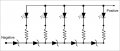
Maybe something like this.

I apologize in advance if this will not work, I don't have a sim, or time to breadboard.

View attachment 145569
Did you mean to use zeners in your drawing? I tried it with zeners, but it didn't seem to work right (in simulation; I am trying to use simulation as a learning tool instead of going straight to the bench this time). If I put regular diodes in and turn them around, it actually does work much better and seems to work like how I was imagining it, BUT the voltage gets dropped on each subsequent LED, so I would be limited with how many I could use. I wonder if there might be a way around that though.
 

Thread Starter

toozie21

Joined Oct 4, 2012
59
It gets harder to turn as the load increases (decreasing resistance). Take a permanent-magnet DC motor and turn it by hand. Now short the leads and turn it by hand.
Yeah, this seems to be my experience. With an open circuit (well, a voltmeter on it), the voltage is only limited by my crank speed. It doesn't feel any harder to turn at 20V than 5V except that I have to maintain a faster RPM.

But, when I shorted out the leads, it was noticeably harder to turn (I was basically trying to prove what you were saying a couple of days ago).
 

Thread Starter

toozie21

Joined Oct 4, 2012
59
I would place a suitable load (to be determined) on the hand crank generator (dynamo) and use a LM 3914 (LM3914 Dot/Bar Display Driver) The higher the voltage to the load the LEDs illuminate in a bar graph display. The LM3914 is the bread and butter of the system. This is how I would go about getting started anyway. There are other ways to get there.

Ron
So a LM3914 is a very popular choice for this sort of problem. I actually picked a few up a few months back in case I wanted to use them. The reason I sort of abandoned it was that I thought that I would need a separate voltage on the 3914 to give the bargraph something to compare against. Is there another way around this?
 

Thread Starter

toozie21

Joined Oct 4, 2012
59
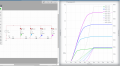
I made some mods to the resistors in the simulation I based off of Spidey's thoughts, and it actually looks close. To see the start up time, I have a DC source step up to 5V from 0V 1ms into the simulation with 5ms of risetime. I am not sure if this is doing what I really think, but it is at least a start. I am totally open to other ideas and modifications.

upload_2018-2-9_21-56-27.png
 

ElectricSpidey

Joined Dec 2, 2017
3,335
My first thought was the 3914, but quickly realized that you would need a second voltage source, then I thought of using regular diodes (as in my first post) but the problem of over driving the first ones that light came to mind, so I changed to the zeners.
 

Reloadron

Joined Jan 15, 2015
7,890
So a LM3914 is a very popular choice for this sort of problem. I actually picked a few up a few months back in case I wanted to use them. The reason I sort of abandoned it was that I thought that I would need a separate voltage on the 3914 to give the bargraph something to compare against. Is there another way around this?
The LM3914 Dot Bar Display driver would be my choice. The chip has a wide supply voltage range. and if we look at the application on page two of the linked data sheet single supply power can range from 6.8 to 18 Volts. The shown application uses a 0 to 5 volt input supply or input. The input is derived from your source (your dyno or generator). Page eight illustrates another simple application. Another nice feature is the ability to very easily control the LED current so if you look the LEDs have no external current limiting resistors. A single chip offers ten steps (10 LEDs) and they can be cascaded to as many as 100 depending on how many steps you want. The chip also comes in a plain 14 pin DIP package making for easy mounting or use on a proto board. The chip also offers a dot or bar display feature which is nice.

As I mentioned earlier there are several ways to go about doing what you want to do, I am just saying which would be my choice and pointing out the why. Anyway, the chip is a single supply chip with a wide voltage range. Your input to the chip will be a scaled output of your generator. The greater the load on the generator the more difficult to crank it, depending on your configuration you could likely switch loads in and out using either physical switches or MOSFETs for the switching duty .

Ron
 

Thread Starter

toozie21

Joined Oct 4, 2012
59
The LM3914 Dot Bar Display driver would be my choice. The chip has a wide supply voltage range. and if we look at the application on page two of the linked data sheet single supply power can range from 6.8 to 18 Volts. The shown application uses a 0 to 5 volt input supply or input. The input is derived from your source (your dyno or generator). Page eight illustrates another simple application. Another nice feature is the ability to very easily control the LED current so if you look the LEDs have no external current limiting resistors. A single chip offers ten steps (10 LEDs) and they can be cascaded to as many as 100 depending on how many steps you want. The chip also comes in a plain 14 pin DIP package making for easy mounting or use on a proto board. The chip also offers a dot or bar display feature which is nice.

As I mentioned earlier there are several ways to go about doing what you want to do, I am just saying which would be my choice and pointing out the why. Anyway, the chip is a single supply chip with a wide voltage range. Your input to the chip will be a scaled output of your generator. The greater the load on the generator the more difficult to crank it, depending on your configuration you could likely switch loads in and out using either physical switches or MOSFETs for the switching duty .

Ron
I like the LM3914, I just still don't understand how it works well without a second supply. If I tie it to the voltage coming out of the dynamo, it will always be "the max."

I do have a small buck converter I could use to give give me a steady 5v or 12v. But I haven't figured out how to use it to my advantage yet either.
 

Reloadron

Joined Jan 15, 2015
7,890
I believe when you say "second supply" you are referring to the power for the chip. In other words you want something where the signal from the dyno and other than the dyno signal nothing else is required. The LM3914 can be run off a simple and inexpensive wall wort. However if you want a solution where your siganl off the dyno powers the LED string then you do not want the LM3914 or any solution similar. In that case I would consider what you used in post #10.

Ron
 

Thread Starter

toozie21

Joined Oct 4, 2012
59
I believe when you say "second supply" you are referring to the power for the chip. In other words you want something where the signal from the dyno and other than the dyno signal nothing else is required. The LM3914 can be run off a simple and inexpensive wall wort. However if you want a solution where your siganl off the dyno powers the LED string then you do not want the LM3914 or any solution similar. In that case I would consider what you used in post #10.

Ron
Yeah. I was trying to make this standalone and all people powered. I thought that it would be cool to show people how much effort it takes to generate enough power just light up a few lights.
 

Thread Starter

toozie21

Joined Oct 4, 2012
59
I believe when you say "second supply" you are referring to the power for the chip. In other words you want something where the signal from the dyno and other than the dyno signal nothing else is required. The LM3914 can be run off a simple and inexpensive wall wort. However if you want a solution where your siganl off the dyno powers the LED string then you do not want the LM3914 or any solution similar. In that case I would consider what you used in post #10.

Ron
My issue with the diode approach modeled above is that though they start at different times like I want, but they all reach max current at the same time. I would have liked the maxes to be staggered as well. Guess I need to try playing with it some more (I spent an hour or so, but I think that there has to be something cheeky I can add to help with that.
 
Top