DPDT switch to make two lamps either parallel or series by turning the switch

Thread Starter

Edman83

Joined Jan 21, 2025
34
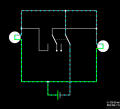
The problem from the Grob's basic electronics book, 11th edition. Laboratory Application Assignment for chapter 11. 1742117142507.png
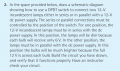
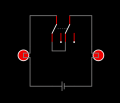
I tried so many configurations, tried to ask Claude, DeepSeek, but it's not working. It's easy to construct it parallel or in series, but I have no clue how to make it work only by one DPDT. When trying to connect it to throws, one cancels another and current flows only through one bulb in both cases. https://tinyurl.com/2bjo6jdw - there my attempts in falstad simulation. Can any one help me to draw this scheme? May be any advice?
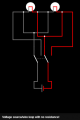
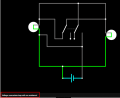
1742117570659.png
In this attempt simulation complains about the loop, as I understand here:
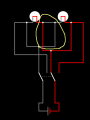
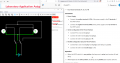
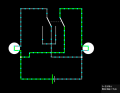
1742117735857.png
Is it the problem with the real circuits or is it just a quirk of the program?
 
Last edited by a moderator:

Thread Starter

Edman83

Joined Jan 21, 2025
34
Hint. The switch goes between the two lamps.
1742126868964.png
1742127041874.png
This not gives me ideas, unfortunately. Have another hint? From where i should connect lamps, poles or throws? It is so frustrating to spend so much time only to one problem, and even don't find answer. But i really want to know how to draw this scheme.
 

Ian0

Joined Aug 7, 2020
13,097
Start off with both lamps in series across the battery.
You are correct that it needs a DPDT switch. Both halves of the switch go between the two lamps.
Symmetry is the key.
 

Ian0

Joined Aug 7, 2020
13,097
Yes.
Now, looking at each lamp, it should be easy to see where to connect the unused switch terminals so that the two lamps connect in parallel.
 

Thread Starter

Edman83

Joined Jan 21, 2025
34
Yes.
Now, looking at each lamp, it should be easy to see where to connect the unused switch terminals so that the two lamps connect in parallel.
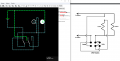
1742131760665.png
OMG, I finally did it! Thank you so much—my whole evening totally paid off!
 

LowQCab

Joined Nov 6, 2012
5,101
This "principle", of switching between Series and Parallel is very useful for
controlling the speeds of 2 identical Cooling-Fans.
This provides 3-Fan-"speeds", Off, Very-Low, and Blast,
and extends the Life-Expectancy of the Motors tremendously, and keeps everything very quiet,
instead of the Fans cycling Off/High. Off/High, Off/High continuously.

This is basically how the Radiator-Fans on my Truck are setup to operate,
only it's accomplished with 2-SPDT ~30-Amp-Relays.
2 Relays act together as a single "DPDT-Relay" to control the Series/Parallel function.

The fans are not ever connected to the Battery, they are powered by a big 3-Phase-Bridge-Rectifier
that is separately tapped directly into the Alternator Windings,
and so, the Fans are powered only when the Engine is running.
No Battery, or high-Current-Switch/Relay, is needed for "Off".

It works great.
Low-Speed on all 4 Fans provides plenty of Air-flow for the AC to operate properly,
and keep the Engine cool at the same time,
on a ~90+degree day, in stop & go traffic jams,
and, it eliminates the complexities and expense of building a very high-Current Motor-Speed-Controller.
( the 2-Motors together pull roughly ~50-Amps on "High-Speed", (25-Amps each), but High-Speed is only rarely required )
( there are 2-Fans pushing from the front of the Radiator, and 2-Fans pulling from the back, at all times )
( ~100-Amps total with both pairs of Fans on "High",
but this has never been commanded by the 2-Thermostats so far, (above 195F-degrees Coolant-Temp) )
.
.
.
 
Last edited:

MrAl

Joined Jun 17, 2014
13,667
The problem from the Grob's basic electronics book, 11th edition. Laboratory Application Assignment for chapter 11. View attachment 344654
I tried so many configurations, tried to ask Claude, DeepSeek, but it's not working. It's easy to construct it parallel or in series, but I have no clue how to make it work only by one DPDT. When trying to connect it to throws, one cancels another and current flows only through one bulb in both cases. https://tinyurl.com/2bjo6jdw - there my attempts in falstad simulation. Can any one help me to draw this scheme? May be any advice?
View attachment 344655
In this attempt simulation complains about the loop, as I understand here:
View attachment 344656
Is it the problem with the real circuits or is it just a quirk of the program?
Hi there,

QUESTION: Is it a "make before break" switch or not?

One of the things you have to pay careful attention to is the type of switch. Even though you have a particular part number DPDT switch it may not be the same as another switch with a different part number.

The difference is whether it is "make before break" or not.
If it is not a "make before break" switch then it should work out ok, but if it is a "make before break" switch then you could end up with a momentary short somewhere when the switch is thrown one way or another. That could easily damage the contacts even on the first try, and possibly blow a fuse.

To see what happens if you have a "make before break" switch, short out all the contacts associated with each single switch part.
If you had a SPDT switch you would just imagine that you had shorted out all the contacts. With a DPDT you have two sets of contacts to short out, but only each set gets shorted not all of the contacts. This gives you an idea what could happen before you even build the circuit.

It also depends on how the circuit is wired however some circuits may not be affected.
 

Ian0

Joined Aug 7, 2020
13,097
Toggle and rocker switches (and relays) are almost certainly break before make.
Slide switches and rotary switches can be either.
 
Top