turning on a mosfet with an and gate output

Thread Starter

robotDR

Joined Mar 17, 2020
138
Hello All,

I want to turn on an N fet DMN2400UFB-7 using the output of a gate.

One chip offers 7.8mA output and another one offers 32mA at the output.

I would prefer to use the one with 7.8mA because it offers more inputs. ( i need 10 inputs and this one chip can handle 10. it's actually a nand gate but i can work around that). Otherwise I need to use 7 chips (4x 2 input chips and 3x 3 input chips) and those offer 32mA output but I also need 10x of these so multiply that all by 10.


so, if the N fet mentioned above has 2.2nC and 78pF at the gate, and i want to limit it to 5mA, I need to use 660R resistor in series with the gate and I think that should results in a turn on time of about 440nS.

But is that correct? Or will the current to charge drop and now my 660R is hurting that time.

I am turning on a relay coil with this mosfet. I am not switching it. It will turn on and then turn off once. can turn off 100's of ms after it turns on maybe even seconds after it turns on. after that, the test is over and it wont turn on for hours again.
 

Thread Starter

robotDR

Joined Mar 17, 2020
138
Hi thanks for responding. 8 input NAND gate: SN74HCS30PWR vs a mix of 2 and 3 input gates: SN74LVC1G08DPWR + SN74LVC1G11DRYR
 

Ian0

Joined Aug 7, 2020
13,097
Have you considered making a diode AND gate and driving the MOSFET using a MCP1402? I know it needs an awful lot of diodes, but diodes are cheap and it might make the pcb tracking easier.
 

BobTPH

Joined Jun 5, 2013
11,463
Why are you so concerned about lowering the speed of turn on? Normally one wants the opposite.

And, in general, when switching as slowly as you are, the switching speeds are unimportant. I typically use no resistance when switching that slowly. The gate itself will limit its current output effectively for that short a period.

Unless I am missing something, I think you are way overthinking this problem.
 

Ian0

Joined Aug 7, 2020
13,097
Why are you so concerned about lowering the speed of turn on? Normally one wants the opposite.

And, in general, when switching as slowly as you are, the switching speeds are unimportant. I typically use no resistance when switching that slowly. The gate itself will limit its current output effectively for that short a period.

Unless I am missing something, I think you are way overthinking this problem.
Driving the gate with a high resistances makes it possible for Miller feedback through the gate-drain capacitance, and that could turn into oscillation and resonate with any inductance, which could destroy the MOSFET. I always use a small damping resistance, 100Ω for a small MOSFET, 33Ω for a larger one being switched occasionally. There is no advantage in switching a relay, and a real possibility of the contacts chattering.
 

BobTPH

Joined Jun 5, 2013
11,463
I always use a small damping resistance, 100Ω for a small MOSFET, 33Ω for a larger one being switched occasionally.
I would agree if driving from a high current driver. But a typical logic gate has that kind of resistance already, no?

I have had no problems driving gates directly with microcontroller outputs at low switching speeds.
 

Ian0

Joined Aug 7, 2020
13,097
I would agree if driving from a high current driver. But a typical logic gate has that kind of resistance already, no?

I have had no problems driving gates directly with microcontroller outputs at low switching speeds.
About 45Ω for HCMOS, but I usually include a resistor, because there always seems to be a track that the gate signal has to jump over.
 

Ian0

Joined Aug 7, 2020
13,097
There was the 74ALS133, 13 input NAND, and the 74S134, 12 input NAND, but whether you could still find them for sale is doubtful.
I don't think the TTL devices would have enough positive going output voltage to switch a MOSFET reliably.
The other alternative would be to use 8-input gates then buffer the output with a couple of 74HC367/368/541 etc. bus driver devices, or for bigger devices, TC4468s
 

sarahMCML

Joined May 11, 2019
695
I don't think the TTL devices would have enough positive going output voltage to switch a MOSFET reliably.
The other alternative would be to use 8-input gates then buffer the output with a couple of 74HC367/368/541 etc. bus driver devices, or for bigger devices, TC4468s
I realise that, but quoted them because the original request was for a 10 Input device. You could always add a pull-up resistor if needed!
 

MisterBill2

Joined Jan 23, 2018
27,174
Use the selected "AND" gate to drive a transistor to operate a solid state relay. OR drive a small logic-input SSR directly.
OR use a PNP transistor to drive the mosget gate from a higher voltage.
 

Thread Starter

robotDR

Joined Mar 17, 2020
138
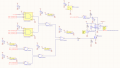
Thanks everyone! great points and suggestions. This is what I have put down considering what I could find. I probably am over thinking it. my main concern was causing trouble inside a gate with small sourcing capability so i was trying to limit it. i dont care about rise time, i was just trying to design for a low current source capability from the last gate. But I think some of you are right and i was overthinking it.

1750743906208.png
 

Thread Starter

robotDR

Joined Mar 17, 2020
138
If you've got a number of relays to drive use a ULN2003. That's what they were meant for!
That’s cool, thanks! Looking at the datasheet, it shows it has 3k of resistance in series between “in” and the gate. That seems like a lot right?

also, why is the description on DigiKey calling it a BJT array when it looks like an Nfet array? Typo or am I missing something?

thanks for the suggestion!
 

Ian0

Joined Aug 7, 2020
13,097
That’s cool, thanks! Looking at the datasheet, it shows it has 3k of resistance in series between “in” and the gate. That seems like a lot right?

also, why is the description on DigiKey calling it a BJT array when it looks like an Nfet array? Typo or am I missing something?

thanks for the suggestion!
Digikey is correct. It is a bunch of darlingtons. Just treat the input as though it were the input of a logic gate.
Assuming HFe of about 5000, it would need 100uA input to drive a 500mA output.
The input Vbe would be about 1.3V for a darlington, so 3k on the input would give about 1.2mA to the darlington, which would be enough to get it as well saturated as darlingtons can get.
It's just as happy with 3.3V logic as 5V because it is OLD and comes from the days of TTL where 5V logic only had 3.3V outputs.
 
Top