Turning an offset dc sinewave into a linear output

Thread Starter

cmartinez

Joined Jan 17, 2007
8,786
Elementary, my dear Watson.
Sherlock never said that :rolleyes:

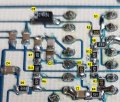
Anyway, I did just what you said, and here's a pic of the board's underside.
01.jpg
As you can see, the right side of the 33K resistor at the output (R9) is not soldered :mad: ... courtesy of your clumsily distracted fellow here south of the border ... :oops:

I think it should work right after I fix that tiny, insignificant, and emotionally catastrophic little detail... I'll do just that and get back to you with the results.
 
Last edited:

crutschow

Joined Mar 14, 2008
38,540
Sherlock never said that
True.
But it sounds like he should have. :p

A picky comment on the soldering. :D
There is generally too much solder, leaving solder blobs that can hide cold solder joints.
They all should look more or less like the right side of C4, with a small amount of solder that is obviously wetting both the part and the trace.
Using smaller diameter solder wire (perhaps 16mil/0.4mm/26AWG) can make it easier to control the amount of solder used for each joint.
 

Thread Starter

cmartinez

Joined Jan 17, 2007
8,786
A picky comment on the soldering.
I'm going to take your soldering advise very seriously, my friend. The solder I'm currently using is Kester's 0.020" 66/44. But I read somewhere that a 60/40 blend is a better alternative. Finding the 0.016" diameter you're suggesting shouldn't be much of a problem. And yes, I'm well aware of how a good solder joint should look like.

Anyway, my PCB has another three similar arrangements, and an additional two of them had points that had missing solder... I'm normally a meticulous person, but I was working a bit too hard during that session. Good thing I didn't mess things up any worse.

I've tested the circuit, and at 0V at its input, it shows a 20mV output ... unlike the sim, which shows 100mV at the output under the same conditions. But I'm sure that discrepancy isn't that important, is it? I haven't tested it yet with a sinewave at its input, that's something that's gonna happen in a week or so. I'll let you know how it went.

Many thanks!
 

crutschow

Joined Mar 14, 2008
38,540
I've tested the circuit, and at 0V at its input, it shows a 20mV output ... unlike the sim, which shows 100mV at the output under the same conditions.
That's likely due to the offset of the op amps, which can vary in the real world as compared to the sim, (in this case the real world is better than the sim) so I doubt that's a problem.
 

Thread Starter

cmartinez

Joined Jan 17, 2007
8,786
I'm back, and with excellent news. The circuit has performed exactly as expected, with an extremely small amount of noise (considering all the constraints) and a more than acceptable response time. What's more, my greatest fear had to do with the working range of the application, which depends entirely on the chip's sensitivity, the coil's number of turns, and the current flowing through it; and in the end it all worked out.

The only thing under my control was guessing the number of turns needed for the coil, and I did that after paying close attention to the chip's datasheet. In the end I chose to go for a ballpark figure of 3-1/2 turns, which turned out to work perfectly ok, thank God.

My very many thanks to all who participated in this thread, most especially Crutschow. If anyone would like to know any further details on this circuit and its application, I'm only a click and post away from helping you out, if I can.
 
Last edited:

Thread Starter

cmartinez

Joined Jan 17, 2007
8,786
Whenever I start a thread, I always try to give it some form of closure, if possible. And here it is, the final result of all the work put into this little project. And btw, @shortbus, I think you might find this application to your liking:

You too, @MaxHeadRoom

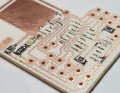
Also, I've followed your advice regarding proper SMT soldering, cruschow. And I'm trying to be a little less generous with the solder on my next circuit. So far the results look quite promising:

Image00001.jpg

Cheers!
 
Last edited:
Top