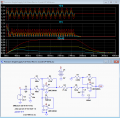
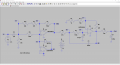
After careful evaluation of the latest circuit, I noticed that the last values I used for U1's gain resistors were producing a highly asymmetrical rectified wave at the MID test point. So I adjusted again the circuit with values of SMT resistors I have with me, and also the gain resistors of U2 to bring the output signal back into range and acceptable linearity. Here's the result.
Part of the reason for that is you used a value of 33kΩ for R8 instead of the 10kΩ I used (why?).
The asymmetry is due to the input impedance of the first stage being significantly different for the positive (near infinite) versus the negative portion (R3 in parallel with R2-R10) of the input waveform.
Incidentally changing D1 from a standard diode to a Schottky should have no significant effect on circuit operation.
The effective diode forward drop is reduced by the open-loop gain of the opamp.
Grounding both inputs, or shorting them together at some other potential, also causes the output stage to saturate, since the offset voltage of an op-amp is never exactly zero
"Grounding both inputs, or shorting them together at some other potential, also causes the output stage to saturate."
True, but I don't think that's a particular problem.
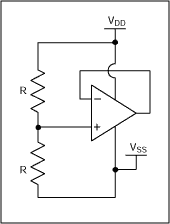
But alternately, connect the output to the (-) input and ground the (+) input.
The will put the output at ground potential without saturating and without any added parts.
"Grounding both inputs, or shorting them together at some other potential, also causes the output stage to saturate."
True, but I don't think that's a particular problem.
But alternately, connect the output to the (-) input and ground the (+) input.
The will put the output at ground potential without saturating and without any added parts.
Thanks, crutschow. That small advice from you just saved me valuable PCB space ... and a few cents worth of SMT resistors. And, say ... I remember now why I'm using a 33k resistor for R8. After all the adjustments I made to all the other resistors to values I have available, I noticed that leaving R8 as 10K would shift the output scale in a way that at 50% input amplitude the output would be a few mV short of the 2.5V expected. Adjusting R8 to 33k fixed that.
I noticed that leaving R8 as 10K would shift the output scale in a way that at 50% input amplitude the output would be a few mV short of the 2.5V expected. Adjusting R8 to 33k fixed that.
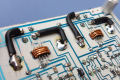
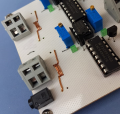
I've finally built the thing, but haven't tested it yet, that's something that's gonna happen in the next couple of weeks. Installing the MLX91205 was a piece of cake using low-temp soldering paste. But wrapping 3-1/2 turns of #22 ga wire around it was a bit tricky. Though I think I did a decent job in the end.
Well, I'm back ... I've tested the thing, and it isn't working ... I've gone through all the wiring, checked grounds, voltages, and have made sure that the parts in the circuit are exactly the ones as the parts in the sim, and still no results.
The input of the circuit is a steady 2.5V, just the way I want it to. But the output seems to be left "floating" (when it should be a flat 0V) when I apply power to it. When I either measure it with a MM, or scope it, the output seems to peak at 5V, and then after a few seconds drifts down to 0.5V, where it begins to very slowly oscillate.
Well, I'm back ... I've tested the thing, and it isn't working ... I've gone through all the wiring, checked grounds, voltages, and have made sure that the parts in the circuit are exactly the ones as the parts in the sim, and still no results.
The input of the circuit is a steady 2.5V, just the way I want it to. But the output seems to be left "floating" (when it should be a flat 0V) when I apply power to it. When I either measure it with a MM, or scope it, the output seems to peak at 5V, and then after a few seconds drifts down to 0.5V, where it begins to very slowly oscillate.
What happens when you feed in an AC input? Do you see the expected DC output then? In other words, is the problem only when you're close to zero volts target output?
What's your power supply? Do you have decoupling caps at all ICs?
I don't have any specific ideas yet - just troubleshooting and brainstorming. Good luck!
What happens when you feed in an AC input? Do you see the expected DC output then? In other words, is the problem only when you're close to zero volts target output?
What's your power supply? Do you have decoupling caps at all ICs?
I don't have any specific ideas yet - just troubleshooting and brainstorming. Good luck!
Yes, there are decoupling caps sprinkled all over. But the circuit's performance should be such that it has a 0V output when it has a 0V input, and that's not the case here.
I have a project in the Completed Projects section which is similar to your requirements. I present it for informational purposes only, as it may contain something you’d find useful.
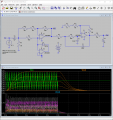
The problem manifests itself starting at node #2, but obviously the greatest discrepancy lies at node #8. And when "Out" is physically measured, it starts by peaking at 5V, and then it goes down to 0.36V after 4 or 5 seconds, as soon as either the probe of the MM or the scope is applied. Something's fishy and I just don't understand what it is.
I can confirm that I've already gone through each and every part on the PCB at least five times, and everything is connected according to plan.
Elementary, my dear Watson.
The exactly 0V at node 7 is a flag.
Think about that.
If the output on node 8 is 5V, then the voltage on node 7 should be about 1.67V.
It's exactly at 0V, which indicates that point is just sitting at ground with no connection to node 8 (or node 7 is shorted to ground).
I would check the connections for R6, R7, and R11.
Measure the voltage across R6.
Also check the resistor values across those devices and to ground with the circuit unpowered.

 Facebook
 Google
 GitHub
 Linkedin



 ...
...