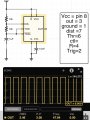
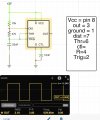
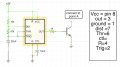
WOW! it does look like you've done this before. I take it OUT goes to point "A" Frequency could be slower, perhaps a wider pulse width? .. the button no longer exists... only the 555 circuit is in the battery compartment, and external 3 to 4.5 VDC comes in unseen...
OK.. to tell the whole story .. the sub will be submerged in mineral oil, in a Micro Ocean..a small display tank that makes waves and shows how they inundate on various shore models.. it's only for educational purposes. I don't build them any more, I just consult to museums and schools who want to have them built. for an example see:
I would like to show the Nautilus near the bottom, where neither waves nor the boat is affected by each other.
Use silicone oil because mineral oil will swell into the plastic and cause the plastic to get thick and crack. Use some of your scraps to test. Even test silicone oil.
Ou can change the cap to get much slower. I didn't tune the frequency. 10x to 100x cap will give longer pulses and higher value resistor (bottom resistor) will increase pulse duration.
Interesting... I had thought of silicon oil... has to be a viscosity close to that of water.. The tank isn't plastic, but the sub is.. all the land models are PVC, Acrylic, and Epoxie .. no issues with mineral oil observed yet. I generally understood the mineral oil to be inert.. will not interact with anything ... it's used to submerge computer components for cooling. and a food safe lubricant.
Ou can change the cap to get much slower. I didn't tune the frequency. 10x to 100x cap will give longer pulses and a higher value resistor (bottom resistor) will increase pulse duration.
MrSalts... your input is much appreciated.. I'm a little worried about connecting the output of the 555 chip to Point "A"
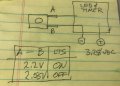
This is how I see what we know at this time:
The 555 chip will be applying 3-4.5 VDC to Point "A" (normally at 2.6 to 2.2 depending on if lights are off or on) many times a second... while "A" can go to ground at any time while lights are on.. can it go positive while lights are on? (above 2.2 V)?
Regards, Michael
MrSalts... your input is much appreciated.. I'm a little worried about connecting the output of the 555 chip to Point "A"
This is how I see what we know at this time: View attachment 245610
The 555 chip will be applying 3-4.5 VDC to Point "A" (normally at 2.6 to 2.2 depending on if lights are off or on) many times a second... while "A" can go to ground at any time while lights are on.. can it go positive while lights are on? (above 2.2 V)?
Regards, Michael
Most likely, the Point A is the input to a logic chip or a microcontroller or (most likely) the trigger (pin 2) of a 555 timer. These are high input impedence and no significant current will flow out of point A to ground.
Let's try, connect your Nautilus to your breadboard power supply. Touch a 1k Resistor across Point A and Point B to see if it triggers. If not, try a 100 ohm.
Also, measure voltage across Point A and Point B when you are powering the Nautilus from your breadboard.
You are awesome MrSalts .. I will make it happen.. if it works.. you get a bag-o-Lindt-chocolate truffles PS: I think I have all the parts &
0.629 Hz ought to be fine ...
You are awesome MrSalts .. I will make it happen.. if it works.. you get a bag-o-Lindt-chocolate truffles PS: I think I have all the parts &
0.629 Hz ought to be fine ...
My biggest concern is what the mineral oil will do to your plastic. Injection-moldable plastics are much more susceptible to swelling than cast resins that polymerize in the mold. Please check if your scraps from the cut-off bottom will be compatible with your mineral oil.
Most likely, the Point A is the input to a logic chip or a microcontroller or (most likely) the trigger (pin 2) of a 555 timer. These are high input impedence and no significant current will flow out of point A to ground.
Let's try, connect your Nautilus to your breadboard power supply. Touch a 1k Resistor across Point A and Point B to see if it triggers. If not, try a 100 ohm.
Also, measure voltage across Point A and Point B when you are powering the Nautilus from your breadboard.
You need a resistor to drop some voltage. Lets use 400 mV. So, you need to say if it;s less than 400 mV turn it on. Turning it on will make it >400 mV, so it turns off. There might be a problem as to how long you have to press the button.
So, you would put some resistor that drops >400mV in series with the power negative. or maybe power positive,. Look at the datasheet.
400 mV is the minimum you can set using this part.

 Facebook
 Google
 GitHub
 Linkedin

done a lot with 555 chips... but couldn't design a 555 circuit to do this now... sniff