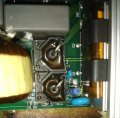
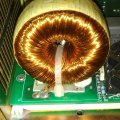
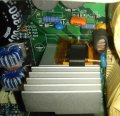
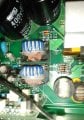
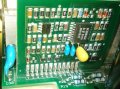
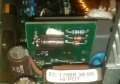
"Some photos of the board would be helpful. I'd like to see the bits around Q1 and Q2, notably T1 (the size of which will instantly tell if it a PFC boost inductor), and also some detail around Q7 and T6."
OK, I believe I have correctly identified and removed those components. C1 tests at 1.24 nF and R1 (1003) and R2 (1001) are very close to their rated values. D2 tests good on a diode test but I am wondering about DZ2. It tests good on a diode test but when I tested for breakdown voltage I ended up with 4 nine-volt batteries in series and it was still passing the full voltage. Does that seem reasonable in this application? If I need to replace it I have no access to specs and I don't think it is marked at all. U1 is marked 393 K914.
C1 is at the top left corner in the photo and none of the smd caps have any markings at all. C9 is next to last in the third row of components. All of the smd caps appear identical in size and thickness.
The 47 µF capacitor in the datasheet is for the main filter on the "C" pin. That pin serves both as the power supply pin for the IC and the feedback pin for regulation. As the circuit is implemented, C9 is the main filter capacitor. Without knowing the values of R2 and C1 it is hard to say what they are supposed to be [edit - had deleted a sentence & made a mess] for. C1 would add an extra pole in conjunction with R1. R2 may be intended to add a zero to compensate for the extra pole.
I would expect the zener DZ2 to be something around 10 to 12 volts. The regulated voltage on C9 would be about 6-7 volts higher.
If that housekeeping supply is not working, nothing else will. If any output is overloaded all outputs will be low. Note that once the PFC circuit is running, VB will approximately double with 120 VAC input.
C1 is at the top left corner in the photo and none of the smd caps have any markings at all. C9 is next to last in the third row of components. All of the smd caps appear identical in size and thickness.
The 47 µF capacitor in the datasheet is for the main filter on the "C" pin. That pin serves both as the power supply pin for the IC and the feedback pin for regulation. As the circuit is implemented, C9 is the main filter capacitor. Without knowing the values of R2 and C1 it is hard to say what they are supposed to be [edit - had deleted a sentence & made a mess] for. C1 would add an extra pole in conjunction with R1. R2 may be intended to add a zero to compensate for the extra pole.
The internal circuitry of the chip can also supply voltage to the 'C' pin and C9 cannot serve as the reservoir capacitor for that function as it would be isolated by D2 which would be reverse biased under those conditions.
I misread the measured value of the cap on the C pin - but what's three orders of magnitude in the grand scheme of things?
The cap on C certainly can't be made arbitrarily small, since it must be able to keep the IC going until it is sustained by its own (usually) private winding on the transformer. It would be necessary to carefully evaluate the whole power supply to determine the minimum allowable capacitance. A few microfarads seems likely for the DIP part (most of the supply current will probably be gate drive and one big advantage of these integrated devices is that they don't have to be overgenerous with gate drive).
Once again, it has been several years since I designed any Power Integrations parts into anything, and I developed no love for them in the process. That combined power-feedback pin is a pain. (plus the FET has no avalanche capability at all, so the snubber for leakage inductance has to be just-so).
If I were testing the housekeeping supply I would use a current-limited bench supply to see if I could locate an overload on any of the outputs of T4 (AC mains totally disconnected). Lacking that, since it does appear to be doing something, I'd meter each output, though since they track it may be hard to detect if one is the offender. If the capacitance on the C pin is quite small it may be that the chip just keeps shutting down and retrying at a rate high enough to produce a voltage that looks stable, if low, with a meter.
Sorry if I was confused. You were originally asking about PCB2 and that is where C9 is. Both PCB1 and PCB2 have U1, R1, R2, C1, D2, and DZ2 on them. Here is a photo of PCB1 and I will test the components there soon.
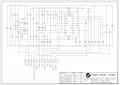
This is frustrating but I want to carry on trying to figure it out. When I removed some components from PCB2 (schematic below) for testing I suspected DZ2 (top left) is bad because its forward voltage appears unlimited. I connected more 9v batteries and had a voltage available of 56.3v. When inserting DZ2 into this loop (with a resistor) the voltage only drops to 55.9v. Since DZ2 is connected to pin 2 of U1 (LM393) and this chip has a maximum voltage of 36v it doesn't seem likely to me that this can be correct. The tiny glass zener has no markings. I reached out to the manufacturer that sent me the schematics several days ago but no reply. I'd like to replace this diode before trying to go further but I have no clue of the proper voltage rating. Any educated guesses? Thanks!
I will test DZ1 and if it's good that should shed some light. I tested DZ2 both directions, getting the high voltage reading one way and a small fraction of a volt the other. Maybe it shouldn't have any reading at all the wrong direction?
My career was as a Honda auto tech and I had to ask people a lot of "obvious" questions to get to the bottom of things. You can never have too many facts.
Thanks for bearing with me. I have removed and tested DZ1 and double checked that I was testing them correctly. Both seem fine on a regular diode test, reading well under a volt and OL when reversed. Using batteries I had a 46v supply and testing DZ1 it read 8.80v but testing DZ2 again it would basically not drop at all, maybe only 0.2v lower. According to the website where I found the test method, the zener diode is open. Before I order up (with yet another shipping charge!) should I just go ahead and replace U1 (LM393) anyway? Likely voltage for DZ2? Any other thoughts at this stage?
It certainly sounds like DZ2 is faulty. Do you have any evidence that U1 is faulty?
That circuit board is not receiving the correct power from PCB1 at the moment. I would be concentrating on that problem first. It is possible that that problem is caused by some overloading on the PCB1 outputs but that kind of fault can be difficult to track down.
It certainly sounds like DZ2 is faulty. Do you have any evidence that U1 is faulty?
That circuit board is not receiving the correct power from PCB1 at the moment. I would be concentrating on that problem first. It is possible that that problem is caused by some overloading on the PCB1 outputs but that kind of fault can be difficult to track down.
I am only wondering if U1 could have been damaged by the fact that DZ2 apparently failed to limit voltage to it. I don't really have any understanding of the interactions here.
Even if the zener had failed short-circuit, the voltage that would be applied to the comparator input would be somewhat less than the comparator's supply voltage due to some drop across R3. Even if R3 were zero, the voltage would be no greater than the comp's supply. The comparator won't work properly at that voltage but it won't be harmed.

 Facebook
 Google
 GitHub
 Linkedin