Trying to understand TV Power Supply Schematic

Thread Starter

Gravydog

Joined Mar 8, 2018
41
The power supply died in my old CRT projector. I know enough about electronics to be dangerous but apparently not enough for this. Referring to the schematic I have included I have 177 vdc across +VB and -VB at the top right corner. The only visual clue I found was a small 1kv ceramic cap split open in the bottom center area, C28. Next to it I also found a 1kv diode D17 was shorted. I couldn't find any other bad components in the area so I replaced both of those but there is no difference.

+VB and -VB are present in the problem section but I get no significant voltage readings at any of the output pins from transformers T9 and T10, bottom left and right corners. Q7 and Q8 are mosfets on a heat sink. I unsoldered both and they seem to test correctly with a DVM but I realize they could be failing under load. I understand transformers need fluctuating voltage to operate but when I try to measure voltage across the input pins 1 and 3 for T9 or 2 and 4 for T10 I see basically 0 volts on the AC or DC scales of my DVM. This is where I am extra lost. Since the section is fed DC voltage I am assuming the transformers should be getting switched DC to operate? If this is true should I be able to see some reading on my Fluke meter? I have a scope but I am not proficient with it. When I probe the transformer pins I get a rough dc sine-ish pattern of 177 volts but I get the same pattern all over the pcb so I am not thinking that is telling me anything. I don't have an isolation transformer.

My guess is that maybe Q7 and Q8 are bad but it is purely a guess! I would really appreciate some collective wisdom here.

Rob
 

Attachments

Dodgydave

Joined Jun 22, 2012
11,395
Yes Q7 is an Nfet oscillator with transformer T6, i would be removing the transistor and replace it, are the voltages present on the Q8 oscillator outputs, on the right side? , are Q7,8 the same number?
 

Thread Starter

Gravydog

Joined Mar 8, 2018
41
Yes Q7 is an Nfet oscillator with transformer T6, i would be removing the transistor and replace it, are the voltages present on the Q8 oscillator outputs, on the right side? , are Q7,8 the same number?
Thanks for the reply. As I have checked things over and over and tried to come to a better understanding I think it comes down to this: since I have VB+ and VB- present at the source and drain of both Q7 and Q8 and VB- present at both gates and all the diodes and resistors between VB- and the gates test good it must be that the mosfets are the point of failure (duh). I removed them again today and retested with my DMM using a method found online. Most of the time they both passed but a couple of times on one of them when testing resistance between the source and drain the reading would drop from about 2.5 M ohms as if a capacitor was charging and it would end up about 10 K and would do this in both polarities. The other mosfet never did this so it looks like a real problem to me. Earlier I had wondered why neither transformer was working when I had only found bad components on one drive circuit but now I see that even though the transformer drive circuits are duplicates of each other they are also completely tied in parallel to each other so now I am thinking that one failed mosfet is killing the operation of the other. I knew I should have ordered them with the other parts but they seemed to test out ok and my thrifty nature prevailed. Live and learn, I guess. I'll post my results in a few days after my parts arrive.

Rob
 

Thread Starter

Gravydog

Joined Mar 8, 2018
41
Well, I am getting thoroughly frustrated with this. I am a lifelong do-it-yourselfer and normally manage to get up to speed enough to repair things but this is proving tough for me.

I received the new mosfets and installed them and there is no difference. Again, referring to the lower center of the schematic, I have +vb and -vb present at both mosfets, Q7 and Q8. At this point I have removed and tested all the components between -vb and both gates and all test good. The diodes are 15v zeners and I tested all 4 using 2 nine volt batteries in series, all good. All the resistors test very close to their spec as do the caps. All the windings for T9 and T10 show low resistances (in circuit) with nothing connected to the sockets they feed. I even unsoldered one pin of the primary on one transformer so I could prove the winding wasn't open.

Anyone?
 

dtron

Joined Feb 18, 2018
1
Well, I am getting thoroughly frustrated with this. I am a lifelong do-it-yourselfer and normally manage to get up to speed enough to repair things but this is proving tough for me.

I received the new mosfets and installed them and there is no difference. Again, referring to the lower center of the schematic, I have +vb and -vb present at both mosfets, Q7 and Q8. At this point I have removed and tested all the components between -vb and both gates and all test good. The diodes are 15v zeners and I tested all 4 using 2 nine volt batteries in series, all good. All the resistors test very close to their spec as do the caps. All the windings for T9 and T10 show low resistances (in circuit) with nothing connected to the sockets they feed. I even unsoldered one pin of the primary on one transformer so I could prove the winding wasn't open.

Anyone?
What measurement do you get across the pins of P1 disconnected
 

MCNA2512

Joined Mar 14, 2018
2
Hello, I think you should
change C29 and D16.
check R33, R34, D18, D22
Verify Voltage:
-Vaux: it should be approx. 12Vdc.
- ST.BY_5v / 0.5A.
When activating INT1 check that the part of the source is activated: 20-180V
- Then, verifies that the pulses arrive at DRIVE_Q7 and DRIVE_Q8 that apparently are the primary of the trafo in PCB3 B410.
Consider the different references well when making the measurements:
GND -VB

Luis
 

Thread Starter

Gravydog

Joined Mar 8, 2018
41
"What measurement do you get across the pins of P1 disconnected"

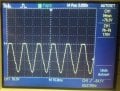
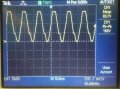
P1 is a GBU8K bridge rectifier. Unpowered testing of each of the DC legs (still soldered in) shows about 0.5v forward and OL reversed to the other 3 legs using diode testing. Powered, there is 122v AC to the AC legs and 167v DC across the + and - legs. I have attached pics of the scope pattern of each of the DC legs. I see the little hitch in the patterns but I don't know if it is significant or not. Again, I basically have no experience with a scope but I am surprised that the DC doesn't seem filtered or smoothed since C26 and C27 (top right) are across it. They are both 400v 330uF electrolytics that are not bulged or leaking and tested good when removed from the board. Do you want me to unsolder P1 anyway?

IMG_20180314_200601.jpg IMG_20180314_200415.jpg
 

Thread Starter

Gravydog

Joined Mar 8, 2018
41
I think you should change C29 and D16. check R33, R34, D18, D22 Verify Voltage: -Vaux: it should be approx. 12Vdc. - ST.BY_5v / 0.5A.
While I don't understand everything you told me I can do some of it. I have had R33, R34, R51, R52, D18, D22, D23 and D24 off of the board and tested, all good. I have had C29 and C42 off for testing as well. D16 and D27 haven't been off but appear to test fine in place, 0.475v/OL.
I think you have led me to a new area of investigation: VAUX measured at D10 shows less than 3v DC but D10 tests good in place. ST.BY_5v measured at R35 has zero volts.

I got excited for a minute there- I suddenly realized that the grounds for C30 at the top and for C43 and C123 are all open to each other until you mount the board in its housing (they are each connected to metal standoffs. I wouldn't have thought this was the way things were done.)

Now I have about 4vdc on VAUX and ST.BY_5v has about 0.2v so no joy. I'm done for tonight. Thanks to anyone helping or considering it.

Rob
 

AlbertHall

Joined Jun 4, 2014
12,626
Do you know what the VB voltage should be?
122V mains input will give you about 170V rectified across C4. D46 will then pass on that voltage to VB. As you have about 170V on VB it would seem that the Q1 & Q2 circuit isn't doing anything. If that circuit is supposed to raise the voltage (I can't see what else it would do) then maybe the VB voltage is just too low for the rest of the circuit to work.
 

Thread Starter

Gravydog

Joined Mar 8, 2018
41
Do you know what the VB voltage should be?
122V mains input will give you about 170V rectified across C4. D46 will then pass on that voltage to VB. As you have about 170V on VB it would seem that the Q1 & Q2 circuit isn't doing anything. If that circuit is supposed to raise the voltage (I can't see what else it would do) then maybe the VB voltage is just too low for the rest of the circuit to work.
I don't have any info on what VB should be. I am lost in understanding how the voltage can be raised when +VB and -VB are direct lines from the rectifier but I will try to investigate those parts tonight, thanks.
 

AlbertHall

Joined Jun 4, 2014
12,626
The voltage rating of C26 or C27 might be a clue.
Do you have a circuit of PCB2?
I suspect that Q1/Q2 circuit is for power factor correction and irs output should be higher than the 170V input voltage.
 

Thread Starter

Gravydog

Joined Mar 8, 2018
41
The voltage rating of C26 or C27 might be a clue.
Do you have a circuit of PCB2?
I suspect that Q1/Q2 circuit is for power factor correction and irs output should be higher than the 170V input voltage.
I actually do have it, attached. The IC is a UC3854DW power correction factor chip. C26 and C27 are matching 400v 330uF electrolytics that tested good off the board.
 

Attachments

ebp

Joined Feb 8, 2018
2,332
The circuit is a self-oscillating flyback converter. The process by which the FET is turned on and off is somewhat less than obvious, but basically it relies on an initial small current through the primary (upper, in the schematic) winding of T6. As the FET starts to turn on current through T6 increases, turning the FET on harder. Presumably the core of T6 saturates, at which point it ceases to be a tansformer, the FET starts to turn off, T6 primary current reverses direction making the FET turn off harder. When the FET turns off the energy stored in flyback inductor (masquerading as a transformer) T9 is dumped to the secondary windings. And it starts all over again. The assortment of inductors and capacitors surrounding the FET will provide paths and shape waveforms for neat and orderly switching. If any of those parts isn't what it ought to be switching may be prevented. A single shorted turn in T6 will kill the circuit stone cold dead.

Q1 and Q2 very likely are involved in power factor correction, but the schematic makes it hard to tell what is supposed to be going on. The names of the signals to PCB2 strongly support the notion of active PFC. To do active PFC the instantaneous current must be directly proportional to the AC line voltage but the average current must be inversely proportional - signals names for the required parameters are there. I'm guessing it operates the inductor at the continuous-discontinuous current boundary (one current sense transformer for the upslope, one for the downslope). A PFC circuit would make VB+ quite well regulated, freeing all the rest of the switchers from the need to run closed loop to regulate reasonably well.

Some photos of the board would be helpful. I'd like to see the bits around Q1 and Q2, notably T1 (the size of which will instantly tell if it a PFC boost inductor), and also some detail around Q7 and T6.
 

ebp

Joined Feb 8, 2018
2,332
UC3854 - my old nemesis! I designed that beast into a 1200 W PFC stage shortly after it was released. Unitrode kept revising the ap note for it as I struggled with it. As I recall it got up to Rev G. I've never seen any other ap note with so many revs!
 

ebp

Joined Feb 8, 2018
2,332
Is the projector specified for "universal" input voltage, typically 100 to 240 VAC?
If so, the voltage from the PFC stage is likely to be in the 385 to 400 VDC range (something above peak of 240 VAC +10%).
 

AlbertHall

Joined Jun 4, 2014
12,626
The 400V rating for those capacitors suggests that the voltage there should be much nearer 400V than 170V.

The UC3854 needs at least 16V VCC to turn on and the source for that voltage is the feedback to U1 on PCB1, across C9.
Measure that voltage.

As the outputs from the U1 circuit are low then the C9 voltage is likely to be low as well.
 

Thread Starter

Gravydog

Joined Mar 8, 2018
41
Is the projector specified for "universal" input voltage, typically 100 to 240 VAC?
If so, the voltage from the PFC stage is likely to be in the 385 to 400 VDC range (something above peak of 240 VAC +10%).
Yes, it is 120-240 volt input.
 

Thread Starter

Gravydog

Joined Mar 8, 2018
41
The 400V rating for those capacitors suggests that the voltage there should be much nearer 400V than 170V.

The UC3854 needs at least 16V VCC to turn on and the source for that voltage is the feedback to U1 on PCB1, across C9.
Measure that voltage.

As the outputs from the U1 circuit are low then the C9 voltage is likely to be low as well.
The voltage across C9 measures 3.8vdc.
 
Top