Facebook
 Google
 GitHub
 Linkedin
Hi,
I have built an emulated Atari ST and am trying to get it working with contemporary hardware. To this end I am attempting to recreate the 13pin din monitor socket and the idea is to have a switch to go between the low/med and high modes. I have a VGA to CGA conversion board that outputs RGBs and composite video. I am trying to get this so it works with the SC1224 and compatible monitors which require RBGHV not RGBs. I don't have this monitor at the moment so I'm using an NEC Muyltisync E222W monitor which apparently supports 15Khz. My plan is to use either a GS4981 or an EL4583 sync splitter to extract the V&H sync for this purpose. The GS4981 is on order so until that arrives I'm testing with a LM1881. I've been told the csync output is similar enough that it could at least be used in place of the Hsync for testing at least. However I'm getting some odd results with both chips.
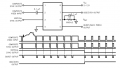
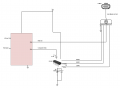
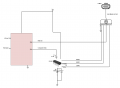
I have hooked them up as per the suggested circuits. Composite video through a 1uF capacitor to the video input. Another 1uF capacitor connected in parallel with a 680K resistor between Reset and Ground and a 470ohm resistor on the csync output. With this I can get a lovely stable RGBs image through the scart cable on my old CRT TV. So far so good, csync seems to be fine. But I'm getting very little on the vsync. Eventually I worked out there is a tiny voltage of around, either 0.7v or 0.07v (I forget which, sorry), which is far lower than the ~5v I have read should be expected. On the EL4583 the horizontal line is around 5v but it does an odd thing when used with the RGBs scart and TV. You will be aware that these cables use either the vsync or hsync pins to connect to pin 16 of the Scart which is the RGB Blanking signal, This pin needs to be high in order for the TV to switch to RGB mode. If I take a line from the 5v supply (higher that the 3v max suggested) the switch works fine but if I use the hsync from the EL4583 (or odd even on the LM1881) to do this switching nothing happens - and indeed the voltage across the cable drops to zero - so I'm guessing some kind of protection in either the TV or the chip? Obviously at 0.7v I can't test the vsync for this.
As for the image on the NEC monitor I get a blank screen - specifically no image BUT NOT no signal. If I remove the H and V sync lines it then shows no signal so there are signs that something is happening but not enough to display the image. As yet I have not tested to see if the H sync drops to 0v when connected to this monitor. I will do this in the next round of testing, but I'd really appreciate it if someone could try and explain what might be going on here.
Finally, just to say last night I went back to basics and connected up the LM1881 to a different composite source - no monitor connected just to read the voltages of the outputs and the results were the same. I don't have an oscilloscope to test these signals more thoroughly, although I think I will probably end up getting one before long.
Thanks for your help.
I have built an emulated Atari ST and am trying to get it working with contemporary hardware. To this end I am attempting to recreate the 13pin din monitor socket and the idea is to have a switch to go between the low/med and high modes. I have a VGA to CGA conversion board that outputs RGBs and composite video. I am trying to get this so it works with the SC1224 and compatible monitors which require RBGHV not RGBs. I don't have this monitor at the moment so I'm using an NEC Muyltisync E222W monitor which apparently supports 15Khz. My plan is to use either a GS4981 or an EL4583 sync splitter to extract the V&H sync for this purpose. The GS4981 is on order so until that arrives I'm testing with a LM1881. I've been told the csync output is similar enough that it could at least be used in place of the Hsync for testing at least. However I'm getting some odd results with both chips.
I have hooked them up as per the suggested circuits. Composite video through a 1uF capacitor to the video input. Another 1uF capacitor connected in parallel with a 680K resistor between Reset and Ground and a 470ohm resistor on the csync output. With this I can get a lovely stable RGBs image through the scart cable on my old CRT TV. So far so good, csync seems to be fine. But I'm getting very little on the vsync. Eventually I worked out there is a tiny voltage of around, either 0.7v or 0.07v (I forget which, sorry), which is far lower than the ~5v I have read should be expected. On the EL4583 the horizontal line is around 5v but it does an odd thing when used with the RGBs scart and TV. You will be aware that these cables use either the vsync or hsync pins to connect to pin 16 of the Scart which is the RGB Blanking signal, This pin needs to be high in order for the TV to switch to RGB mode. If I take a line from the 5v supply (higher that the 3v max suggested) the switch works fine but if I use the hsync from the EL4583 (or odd even on the LM1881) to do this switching nothing happens - and indeed the voltage across the cable drops to zero - so I'm guessing some kind of protection in either the TV or the chip? Obviously at 0.7v I can't test the vsync for this.
As for the image on the NEC monitor I get a blank screen - specifically no image BUT NOT no signal. If I remove the H and V sync lines it then shows no signal so there are signs that something is happening but not enough to display the image. As yet I have not tested to see if the H sync drops to 0v when connected to this monitor. I will do this in the next round of testing, but I'd really appreciate it if someone could try and explain what might be going on here.
Finally, just to say last night I went back to basics and connected up the LM1881 to a different composite source - no monitor connected just to read the voltages of the outputs and the results were the same. I don't have an oscilloscope to test these signals more thoroughly, although I think I will probably end up getting one before long.
Thanks for your help.