Trying to make a soft starter on my off grid solar setup for tools

Thread Starter

SimonMester

Joined May 27, 2025
15
Hello!

So I am a little new to electronics, I am a chemical engineer by trade, but I was always interested in electronics. Recently I made a solar setup for a little cottage I have, it is completely off grid. Just a few panels, charge controllers into a 12V 200aH lifepo battery, with a 1kW inverter. I run a few chargers, lights, computer, pump etc.on it.
I have a table saw here, that has a peak power use of 1200W, but is uses less most of the time, so my inverter can handle running it no problem, but has trouble starting it. Takes a few attempts quickly one after another to spin it up successfully. Once it's running zero problems.

Clearly the surge current to start is just a bit too much, despite it being a fairly gradual startup. I have a lot of components, and I was wondering if I could wire up some kind of capacitor bank to help with the kickstarting. I have 22F 2.8V caps, 1n5822 diodes, lots of resistors, even a 2ohm 50W power resistors.

I have an idea on roughly how this could work, but wanted to ask about before setting fire to capacitors with some rookie mistake. Could someone enlighten me please?
 

schmitt trigger

Joined Jul 12, 2010
2,026
I also agree that a common light dimmer is both the lowest cost and most straightforward solution.
But I would have to ask you first: is your inverter a pure sinewave one or is the cheaper variety with stepped square wave output?
 

Thread Starter

SimonMester

Joined May 27, 2025
15
I also agree that a common light dimmer is both the lowest cost and most straightforward solution.
But I would have to ask you first: is your inverter a pure sinewave one or is the cheaper variety with stepped square wave output?
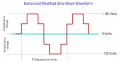
It just said 'modified sine wave' not sure which that means.
 

Papabravo

Joined Feb 24, 2006
22,058
It will be easier to make a 'modified since wave' inverter than a true sine wave inverter. This is especially the case if you use a garden variety micro controller to get the timing correct. You can even use an off the shelf bipolar DC power supply.
 

Ian0

Joined Aug 7, 2020
13,097
As a chemist, you could always use the old and scary theatre dimmer. Two probes and a bucket of salt water. Dip the probes deeper into the bucket to increase the power. Be careful with the chlorine gas that it evolves.
 

MisterBill2

Joined Jan 23, 2018
27,159
If the motor is indeed a universal motor, with brushes, the motor will be happy with a square wave or DC or modified sine wave. But I am not sure how the dimmer will work. Of course, an actual universal motor could be started with simply a series resistor.

If the motor is an induction motor that is a different thing completely. To start that with limited power can be done with a reduced voltage start, and no load. The simple way to have a reduced voltage start is to use a transformer. A handy choice that might be found used would be a 120/240 volt transformer, either with a primary and secondary or an auto-transformer with a 240 volt winding tapped at 120volts. The auto-transformer will allow a half-voltage start at a quarter of the power, then once the saw is spinning, switch over to full voltage and full power. THAT is the simplest scheme .
 

Thread Starter

SimonMester

Joined May 27, 2025
15
If the motor is indeed a universal motor, with brushes, the motor will be happy with a square wave or DC or modified sine wave. But I am not sure how the dimmer will work. Of course, an actual universal motor could be started with simply a series resistor.

If the motor is an induction motor that is a different thing completely. To start that with limited power can be done with a reduced voltage start, and no load. The simple way to have a reduced voltage start is to use a transformer. A handy choice that might be found used would be a 120/240 volt transformer, either with a primary and secondary or an auto-transformer with a 240 volt winding tapped at 120volts. The auto-transformer will allow a half-voltage start at a quarter of the power, then once the saw is spinning, switch over to full voltage and full power. THAT is the simplest scheme .
Hmmm, it's model is "Einhell TC TS 210" 1200 W. Eu plug.
Thanks for the kind help. I welcome any suggestions.
 

MisterBill2

Joined Jan 23, 2018
27,159
Hmmm, it's model is "Einhell TC TS 210" 1200 W. Eu plug.
Thanks for the kind help. I welcome any suggestions.
A physical examination of the motor exterior should reveal access for changing the brushes, if it is a "universal" motor. AND the motor nameplate should include "AC or DC" as part of the power requirements. That part should be adjacent to the voltage and current requirements shown on the nameplate.
The reason that it matters is that the starting surge reduction schemes for the two very different types of motors are not the same.

And now I realize that we do not even know if the power source is 120 volts 60 Hz or 220 volts 50 Hz. And all of the detailed technical comments ??????
So we need the TS to provide us with the motor nameplate data: voltage, current, and frequency.
 

Thread Starter

SimonMester

Joined May 27, 2025
15
A physical examination of the motor exterior should reveal access for changing the brushes, if it is a "universal" motor. AND the motor nameplate should include "AC or DC" as part of the power requirements. That part should be adjacent to the voltage and current requirements shown on the nameplate.
The reason that it matters is that the starting surge reduction schemes for the two very different types of motors are not the same.

And now I realize that we do not even know if the power source is 120 volts 60 Hz or 220 volts 50 Hz. And all of the detailed technical comments ??????
So we need the TS to provide us with the motor nameplate data: voltage, current, and frequency.
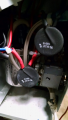
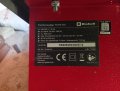
Looking everywhere, this is what I found on it
 

Attachments

MisterBill2

Joined Jan 23, 2018
27,159
OK, and Thank You. we have "S1"=900 watts and S6=1200 watts and the voltage listed as 220 to 240 volts 50Hz No mention of DC operation.
If a step-down transformer would be available, getting it up to speed on a lower voltage would be the way to go, if there could then be a way to quickly switch to full voltage.
A common dimmer switch can't work because they are only good for perhaps 250 watts, or possibly 400 watts.
 
Top