Triode tube

Thread Starter

Rufinus

Joined Apr 29, 2020
308
Another question

I have seen thist video of Mr Carlsons Lab

In 0:54 says that you can put on the filament 5V and 5A or 10V and 2,5A. How? I mean, the filament has a resistance., lets say 1ohm. If you put 5V, it drains 5amps. If you put 10V it drains 10 amps. How do you control that?

Thank you
 

Thread Starter

Rufinus

Joined Apr 29, 2020
308
but if you limit the current, the voltage drops no?

I mean, lets say the filament is 1 ohm. If you limit the current to 2,5 amps, the voltage will be 2,5 volts no?

I´m afraidit is a silly question, but i like to undertand the basics
 

nsaspook

Joined Aug 27, 2009
16,333
Many of those old RF tube had direct filament cathodes designed for center tapped power feeds to balance the cathode ripple. With a DC heating source you could run them in series or parallel.
1694467070485.png
 

SamR

Joined Mar 19, 2019
5,491
If you look on the World Radio History link that I posted and find the tab on the left side for Books:Technical you will find a section for RCA Technical. Near the middle of that list in the section Electron Tube Manuals is the 2-volume set published by RCA of Electron Tubes 1935-1941 Volume I and Electron Tubes 1942-1948 Volume II. These are not catalogs but rather design and technical manuals on tube construction and use and are full PDF copies of these books. This will take you to that page:
BOOKSHELF RCA: Radi Corporation of America tech guides (worldradiohistory.com)
On that same page you will even find the RCA 1928 Radiotron manuals with all the technical specs as well as construction details. RCA published quite a bit of design information except during the WWII years on both tube and solid-state design. Elsewhere under the Technical Books sections you will find works by DeForrest Kelly and many others.
 

Janis59

Joined Aug 21, 2017
1,894
Vacuum is measured in ""0,05 microns""?? Indeed!!
Then voltage is measured in inches and temperature in acres? Probably!

To make a DIY triode You must first to waste the materials and time, make computer modelling. For that exist the soft "Sim-ion" (proprietary). Get it, learn to use, then create the drawing of tube internals and read all the parameters You asked for. Then change the model geometry if needed and re-read the values again. Probably may try to get results in free of charge Lisa v8, however I am not sure it will get any good, at least SimIon is fully trustable.

Then, plan the materials inside and how it will be kept together - steel is contrindicated, alu and copper as well, may be nickel, under question AISI, may be molybdenum. Isolators - vacuum ceramics or mica, or glass/quartz glass. Oxygen sorber must be placed as well, inside. Filament must be tungsten with barium covering - learn how to cover it - may guess the chemical or electrochemical covering.

Next, learn the glass blower job. The critical points except the overall hand training are inputs welding in glass. Most effective tech is to weld molybdenum metal into molybdenum glass sort, and then weld the molybdenum glass with ordinary glass or better - the quartz glass. Or re-use the readymade inputs from crushed old tubes. The next is baking for thermal stress relieve. May observe it places and value by putting the product between two crossed polarization filters.

Then target of vacuum is hardly under the 1E-7 Torr, however better is 1E-9. Otherhow the free run path for ions (more precise - electrons) is kind of 0.05 microns :)
Thus the vapor ejection pump may forget immediately, thats hopeless for anything beyound the 1E-6 Torr. The right kind is turbomolecular backed by oilless 1E-3 forevacuum pump. Hope I must not to explain in details what happens with turbo if couple with "normal" oil-using prevacuum pump. Tube closing happens by welding the glass pipe so the atmospheric pressure closes the job.

So, this Napoleon Project is economically viable only in one case - if the goal is to get the abnormally large power tube, e.g. 30 megawatts or sth similar. For normal power, this is warm and insistent advice - simply take out the payment card and obtain made in factory. I want to make a Martian Spaceship, probably. Do You know why I am not even thinking about to make it? Too much a job, expenses, expertise and time demanded.
 
Last edited:

Thread Starter

Rufinus

Joined Apr 29, 2020
308
Vacuum is measured in ""0,05 microns""?? Indeed!!
Then voltage is measured in inches and temperature in acres? Probably!

To make a DIY triode You must first to waste the materials and time, make computer modelling. For that exist the soft "Sim-ion" (proprietary). Get it, learn to use, then create the drawing of tube internals and read all the parameters You asked for. Then change the model geometry if needed and re-read the values again. Probably may try to get results in free of charge Lisa v8, however I am not sure it will get any good, at least SimIon is fully trustable.

Then, plan the materials inside and how it will be kept together - steel is contrindicated, alu and copper as well, may be nickel, under question AISI, may be molybdenum. Isolators - vacuum ceramics or mica, or glass/quartz glass. Oxygen sorber must be placed as well, inside. Filament must be tungsten with barium covering - learn how to cover it - may guess the chemical or electrochemical covering.

Next, learn the glass blower job. The critical points except the overall hand training are inputs welding in glass. Most effective tech is to weld molybdenum metal into molybdenum glass sort, and then weld the molybdenum glass with ordinary glass or better - the quartz glass. Or re-use the readymade inputs from crushed old tubes. The next is baking for thermal stress relieve. May observe it places and value by putting the product between two crossed polarization filters.

Then target of vacuum is hardly under the 1E-7 Torr, however better is 1E-9. Otherhow the free run path for ions (more precise - electrons) is kind of 0.05 microns :)
Thus the vapor ejection pump may forget immediately, thats hopeless for anything beyound the 1E-6 Torr. The right kind is turbomolecular backed by oilless 1E-3 forevacuum pump. Hope I must not to explain in details what happens with turbo if couple with "normal" oil-using prevacuum pump. Tube closing happens by welding the glass pipe so the atmospheric pressure closes the job.

So, this Napoleon Project is economically viable only in one case - if the goal is to get the abnormally large power tube, e.g. 30 megawatts or sth similar. For normal power, this is warm and insistent advice - simply take out the payment card and obtain made in factory. I want to make a Martian Spaceship, probably. Do You know why I am not even thinking about to make it? Too much a job, expenses, expertise and time demanded.

Thanks for all your advice

With microns (of mercury), I mean the pressure, don´t look at me, in my country we proudly use the metric system.
1 torr = 1.000 microns.

I didn´t know the software. It looks useful, thank you. I have started using DUMET wire in the glass-metal joints (sodalime glass) and just after working on a part, I anneale it in an oven, so the glass part is going OK. For the rest of the parts I'm using nickel and for the filament, regular tungsteng. In the future I´ll try coating it with barium carbonate. and also with thoriated tungsnteng. But as you said, I´ll check the molibdenum.

Abouth the vacuum, I have a turbo molecular pump, but really do I need that? I mean, in youtube you find serios videos about people making tubes (triodes and CRT) with a HVAC pump and a getter. I haven´t set up the turbopump yet, so I´ll try with the difussion pump first. And I measure the vacuum with a cold cathode gauge.

And about the meaning of doing it, I just want to make son tubes and probably a radio. It will sound terribly, but it will be MY radio. I like to make things.
 

Janis59

Joined Aug 21, 2017
1,894
OK, then 5 microns is 5 Torr - just the bad forevacuum. Let read a bit about free run path length in vacuum - 5 Torr that are microns long, at 1E-6 Torr that is within order of milimeters (will it be Your electrodes so much close indeed?), but begining by 1E-7 the free path is within order of decimeters thus the sufficient. Oil ejector (heater bubbler) type high vacuum pumps get 1E-5 without a word, with altered pre-vacuum cascade in output it may give slight better than 1E-6 (I mean the ordinary forevacuum plus rotary Vankel boosterpump plus oil vapour ejector pump. If to throw out all those bad russian vacuum pils and substitute with order of 100 expensiver "capitalist" oils, then 1E-7 is on the edge of what is possible if pumping half-year long interruptionless. Vice versa, with turbopump You get 1E-10 in 15 minutes with just the four-stage oilless diaphragm pump at backing end, or at least near the 1E-9 Torr deep if backing pump is oil-filled rotary Vankel of three to four stages.

About SI system - absolutely agree that inspite of my personal not so warm thoughts about France, but theeir invented SI system was best what was happened with Europe indeed. And vice versa - American forcful spitefulness to adapt so much rational system in largest degree do their life much difficult. But... who we are that we cmay criticize the impressive nation - let it criticize (or mey be even condemn) their kids and grandkids. Yet about vacuum - all the instruments are made in US and are calibrated in Torr not in hektopaskals, therefore that is not problem to multiply every single figure with constant 133 Pa/Torr - just I have the visual memory thus it seems very unhandy for me to "jump out" ot the moving train to excercize in "more better" system of units. Sorry! Still I am living in country where everything else is measured in SI units.
 

nsaspook

Joined Aug 27, 2009
16,333
A micron is a thousands of a Torr or 1e-3.
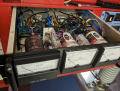
These are classic CCIG vacuum gauge readouts to 1e-7
1694789300278.png
1 micron is just starting to be in range of high vacuum for most systems.

1694789612964.png
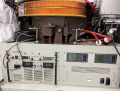
More modern vacuum readouts -7 is the normal operational chamber vacuum range.
1694789804468.png
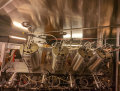
This is essentially a large vacuum tube with 4 large turbo pumps keeping the vacuum in the -8 Torr range when operational.

To the OP, use the turbo molecular pump, do a good tube bake-out and and use a getter to remove the residual from out-gassing. if you're only going to do this once, do it right for the best chance of success.
Don't even think amount using a diffusion pump unless you have a cold-trap and good clean oil. Those things are a mess.
 

Thread Starter

Rufinus

Joined Apr 29, 2020
308
be water cooled but there should to be a separate cold-trip to prevent diffusion oil migration at UH

Thanks for the info, I had no idea. But I´m afraid this thing is out my capacity. I have no access to dry ice or liquid nitrogen. Would it be so bad using a regular diffusion pump water cooled without the cold trap?
 

nsaspook

Joined Aug 27, 2009
16,333
Thanks for the info, I had no idea. But I´m afraid this thing is out my capacity. I have no access to dry ice or liquid nitrogen. Would it be so bad using a regular diffusion pump water cooled without the cold trap?
Sure you could try it and it might work just fine but the likelihood of back-streaming oil is high unless you are very careful about the entire process. A proper turbopump setup would be better as you can get clean vacuum in the -7 range easily without traps.
With cryogenic pumping you can start to push the -8 range and lower.
1695076401186.png
 

Thread Starter

Rufinus

Joined Apr 29, 2020
308
Ok ok. I was lazy about the turbo, but I think is worth it.

Nevertheless I think I can try to put a cold trap using glicol and peltiers. And the oil is DOW CORNING 704
 

nsaspook

Joined Aug 27, 2009
16,333
Ok ok. I was lazy about the turbo, but I think is worth it.

Nevertheless I think I can try to put a cold trap using glicol and peltiers. And the oil is DOW CORNING 704
Just be careful, in the old days I've cleaned up one too many vacuum chamber that were contaminated with vacuum oil. Nobody uses wet pump systems in the industry today other than to demo vacuum systems for kids and family.
1695140692924.png
 
Top