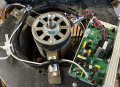
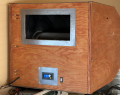
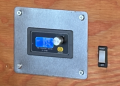
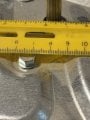
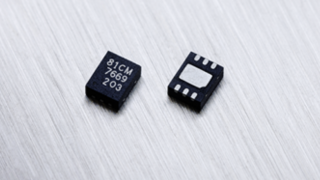
Went with 680Ω for my first test run. Figured it this way:
[( 13.6V - 1.2Vf) ÷ ( 680Ω + 22Ω ) = 18mA ]•12.8V = 233mW
[( 13.6V - 1.2Vf) ÷ ( 330Ω + 22Ω ) = 36mA ]•12.8V = 456mW
Math is not my strong point. If I did something wrong - school me.
And if I got it right, running at 20 to 30% should translate to around 58mW.
Resistor didn't even get warm to the touch.
Here's the result of the first test at 680Ω:
Controller set to 20Hz
Dial set to 22% min, 30% max
Air speed at 22% was gentle but strong.
Air speed at 30% was powerful.
Don't thin I'll be going much over that. And if ever I feel the need for higher speeds I can always change the max to a higher percentage.
Now - on to final assembly. Just waiting for paint to dry on the face plate where the controller will be mounted.
The whole inside of the cabinet is in the air stream. It's not necessary for the heat sink to be in the path of the blown air. Being in the drawn air flow will be far more superior to the amount of air flow inside the treadmill housing. Heating won't be an issue.
The motor is rated at 2.75 HP continuous, which would be "a serious breeze", So I am guessing it will be run far less that full power most of the time.
The motor is rated at 2.75 HP continuous, which would be "a serious breeze", So I am guessing it will be run far less that full power most of the time.
The motor is rated at 2.75 HP continuous, which would be "a serious breeze", So I am guessing it will be run far less that full power most of the time.
Here's the result of the first test at 680Ω:
Controller set to 20Hz
Dial set to 22% min, 30% max
Air speed at 22% was gentle but strong.
Air speed at 30% was powerful.
After hanging it on the wall I've upgraded the settings from above to 24% min and 40% max. I won't be spinning it faster than 40% except should some reason present itself. At 40% the thing is blowing like a motor cycle ride at 50MPH. I don't have a way of measuring the wind speed so the motorcycle ride is just an estimate. Don't hold me to any actual numbers.
I have never tested one or used one and so I really don't know. BUT 2500 seems reasonable. I did recently rescue a DC brushed motor from a leaf blower, rated 1/2 HP and 15,000 RPM. It has a problem, which is one commutator segment is slightly loose and is up several thousandths above the rest. The commutator arcing is awsome!!!
I have a geared DC motor from a garage door opener. Wonder what I might build out of that. It also is a 130VDC Permanent Magnet motor. I have some paint that I might build a rack to hold the cans and use the motor to tumble the rack causing the paint to stir continuously. I know the big box stores have can shakers and I don't want to build one of those. Having a rack that rotates on the order of 10 RPM would most certainly stir the paint overnight. Only, this is not a big need. I don't paint often. Would probably end up being another one of those things that takes up space.
A geared motor could work well for a hoist, if the reduction is adequate. And if the assembly still has the chain sprocket, then the roller chain can be the lift chain and avoid the need for a take-up spool. I have seen and used chain hoists like that and they work fairly well. Not large capacity, but good for a couple hundred pounds.
The tricky part is the scheme to keep the chain from tangling when the hoist lowers. That requires a well designed chain bucket, and a roller to align the chain with the sprocket on the slack side.
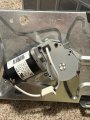
Was a belt drive garage door opener. The motor is a worm drive mechanism. The belt drive wheel has been removed. The other end is a spline drive, approximately 3/8" shaft, 1 3/8" high. MIGHT make a wooden table for it with a slightly smaller than 3/8" hole. Mount the table with three stabilizing wheels to prevent it from working loose on the shaft. Then mount cans of paint and rotate them with the table on a 60˚ angle causing the paint to stir about in the can. Off hand I don't know the speed, but as you can see it is now being claimed to be a 140VDC motor whereas in post #37 I called it a 130VDC motor. Haven't looked at it in a while.
The cabling going to the motor is of small gauge. I have an autotransformer rated at 2 amps I could use. Along with a diode or a bridge and a reversing switch I could make this in one afternoon.

 Facebook
 Google
 GitHub
 Linkedin