Facebook
 Google
 GitHub
 Linkedin
Hello, I am converting a lathe to a variable speed DC motor from a York Optimum 60100 treadmill. The treadmill had been junked with a broken belt but otherwise fine. For background, I am good with a soldering iron and have slightly better than the average person's knowledge of electronics.
I tested everything before dismantling the treadmill and all worked perfectly - able to set speed and stop/start with control panel etc. Tested at various times during tear-down too, and after I had adapted the motor on to the lathe.
But getting close to final commissioning, when I plug everything into the wall and switch on, the motor cuts in immediately for an instant at a high speed, the ceramic fuse on the board blows. This happens regardless of the setting on the control panel, or with it disconnected all together.
With fuse replaced, motor disconnected and control panel disconnected, once 240v supply is switched on the terminals on, the the motor terminals on the board power up immediately to about 348V (measured with a fairly cheap multimeter). With the mains switched off, the power bleeds away to 0V over several minutes. As soon as I connect motor, the same happens - motor starts and fuse blows.
I left the power supply, controller board etc mounted inside the tray from the treadmill as this is convenient, and simply relocated the motor to the lathe, and removed the incline motor. The idea is to situate the power supp/controller tray beneath the lathe, and the control panel (usually positioned in front of the treadmill user) above the lathe.
I can think of a few things that may have caused damage:
- I used a grinder on the tray to remove the four mounting lugs for the motor, without first removing the control board. The cutting took place from the outside of the tray, ie the lugs had been poked through holes in the tray, then welded into place. So the circuit board should have been reasonably well shielded from sparks, as it was on the other side of the tray to where I was grinding. I guess heat from the grinding may have passed to the FETs etc, which are attached to the tray via heatsink/mounting bracket of the control board, roughly six inches away from where the grinding took place. Or maybe static electricity, or debris? It looks like there are two FETs and then a transistor or diode (similar casing to the FETs) in a row on the heatsink. I have since removed the control board from the tray and cleaned it - there was hair, belt dust etc accumulated from its life in someone's home gym.
- I had wired a DPDT centre-off switch into the motor circuit, so that I can run the lathe forwards/backwards. I am wondering whether switching things on via the control panel, but having the forward/backwards switch in the OFF position, may have caused problems because there was no load on the FETs etc when they powered up etc. However I am also pretty sure I had the motor disconnected during earlier testing, and it did not cause any problems then when powering up.
- Finally, I did very briefly accidentally short what I think was the 240V connectors on the tray at one point, but there were no fuses blown or circuit breakers tripped.
(I am using terms like FET here but I must emphasise I have only a fairly basic understand of their exact workings)
The motor has three wires, + - and earth, and is 180V, 5A.
There is an earth terminal on the control board, but it is not connected, and I am not sure it was ever used, or whether it is needed to make the control board function correctly. The AC supply, treadmill motor and incline motor were all earthed to the tray and I have replicated this. I take it these earths are purely for safety, and not to shunt power to ground as part of voltage regulation, like might be done with a car or motorcycle regulator.
This is intended as a budget project – I was stoked when I finally found an abandoned treadmill that was just perfect for my conversion - so I am looking for the simplest things I can test/replace for a few bucks.
Does this sound like a pretty common manifestation of a FET or transistor/diode failure?
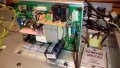
Hope someone can help ... picture attached. The board is labelled KING-I or KING-1, 900176/75(2) and I believe it's used on a few brands.
I tested everything before dismantling the treadmill and all worked perfectly - able to set speed and stop/start with control panel etc. Tested at various times during tear-down too, and after I had adapted the motor on to the lathe.
But getting close to final commissioning, when I plug everything into the wall and switch on, the motor cuts in immediately for an instant at a high speed, the ceramic fuse on the board blows. This happens regardless of the setting on the control panel, or with it disconnected all together.
With fuse replaced, motor disconnected and control panel disconnected, once 240v supply is switched on the terminals on, the the motor terminals on the board power up immediately to about 348V (measured with a fairly cheap multimeter). With the mains switched off, the power bleeds away to 0V over several minutes. As soon as I connect motor, the same happens - motor starts and fuse blows.
I left the power supply, controller board etc mounted inside the tray from the treadmill as this is convenient, and simply relocated the motor to the lathe, and removed the incline motor. The idea is to situate the power supp/controller tray beneath the lathe, and the control panel (usually positioned in front of the treadmill user) above the lathe.
I can think of a few things that may have caused damage:
- I used a grinder on the tray to remove the four mounting lugs for the motor, without first removing the control board. The cutting took place from the outside of the tray, ie the lugs had been poked through holes in the tray, then welded into place. So the circuit board should have been reasonably well shielded from sparks, as it was on the other side of the tray to where I was grinding. I guess heat from the grinding may have passed to the FETs etc, which are attached to the tray via heatsink/mounting bracket of the control board, roughly six inches away from where the grinding took place. Or maybe static electricity, or debris? It looks like there are two FETs and then a transistor or diode (similar casing to the FETs) in a row on the heatsink. I have since removed the control board from the tray and cleaned it - there was hair, belt dust etc accumulated from its life in someone's home gym.
- I had wired a DPDT centre-off switch into the motor circuit, so that I can run the lathe forwards/backwards. I am wondering whether switching things on via the control panel, but having the forward/backwards switch in the OFF position, may have caused problems because there was no load on the FETs etc when they powered up etc. However I am also pretty sure I had the motor disconnected during earlier testing, and it did not cause any problems then when powering up.
- Finally, I did very briefly accidentally short what I think was the 240V connectors on the tray at one point, but there were no fuses blown or circuit breakers tripped.
(I am using terms like FET here but I must emphasise I have only a fairly basic understand of their exact workings)
The motor has three wires, + - and earth, and is 180V, 5A.
There is an earth terminal on the control board, but it is not connected, and I am not sure it was ever used, or whether it is needed to make the control board function correctly. The AC supply, treadmill motor and incline motor were all earthed to the tray and I have replicated this. I take it these earths are purely for safety, and not to shunt power to ground as part of voltage regulation, like might be done with a car or motorcycle regulator.
This is intended as a budget project – I was stoked when I finally found an abandoned treadmill that was just perfect for my conversion - so I am looking for the simplest things I can test/replace for a few bucks.
Does this sound like a pretty common manifestation of a FET or transistor/diode failure?
Hope someone can help ... picture attached. The board is labelled KING-I or KING-1, 900176/75(2) and I believe it's used on a few brands.