Transistors used in guitar preamp input section

Thread Starter

rpschultz

Joined Nov 23, 2022
838
OK, so expanding on the above simplified input using an op amp instead of transistors. The below has a gain pot at the end, but uses 3 op amps. Is it possible to do input buffer, HPF and gain knob using only 2 op amps? Can the HPF be the input buffer? or gain knob be input buffer?

View attachment 311263
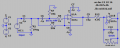
What if I remove the first op amp U2? Still gives a 60 Hz HPF and 1M impedance I think. Then U1A steps the impedance down.

1704030426594.png
 

Ian0

Joined Aug 7, 2020
13,158
What if I remove the first op amp U2? Still gives a 60 Hz HPF and 1M impedance I think. Then U1A steps the impedance down.

View attachment 311355
Unfortunately not.
Your impedance becomes about 13k (39k in parallel with 20k) because both R7 and R9 are both terminated on low impedances.
V3 does not model the transducer, because V3 has an output of zero and your transducer doesn't!
Generally, a Sallen & Key filter driven with a high impedance source becomes an oscillator.
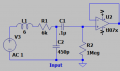
You might have noticed that on my SPICE simluation, I have L1 and R5 in series with the source and C4 in parallel.
L1 and R5 are the inductance and resistance of a guitar pickup, and C4 is the capacitance of the cable.
[Edit] that's why I was asking about your transducers, so that I could get an approximate electrical model of them for simulations.
You can then see how such things as input impedance and cable capacitance affect the frequency response.
 

Thread Starter

rpschultz

Joined Nov 23, 2022
838
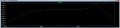
Well that's interesting, yeah I noticed but didn't understand it. OK I modeled that, but it gives some funky stuff after 2k due to the capacitor. If I remove the 330p it is a flat response.

I can measure the resistance of my guitar pickups, but how do you measure inductance? The internet confirms your 330p, as 30p/ft or 11 ft cable seems reasonable. Probably a little higher for 15ft cable. Adding a 10p cap in SERIES with the 450p moves that high frequency shift way up and out of audible range, also reduces it's magnitude. A 10p cap like this could simply be added at the input jack I would think from signal to ground?!?

1704031523965.png
1704031546983.png
 

Ian0

Joined Aug 7, 2020
13,158
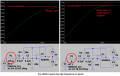
That peak is real! 10pF across the input doesn't do anything for it, it just increases the parallel capacitance from 330pF to 340pF.
Reduce R2 to 100k to get rid of it.
Ever wondered why guitarists complain that their guitar sounds different on stage? They are using a longer lead!
 

Thread Starter

rpschultz

Joined Nov 23, 2022
838
Oh right, parallel caps add. Series caps are like parallel resistors. No way to add capacitance in series. A 15 db bump at 3-4k probably isn't a bad thing. I've read people talk about this type of thing and never really believed it, it's hard to hear or at least compare. But now that I can simulate it, this gives me another tool of understanding.

I might have to burn some christmas money on a low capacitance cable!!! I need to learn how to measure capacitance. Oh great, another rabbit hole to wander around in:)
 

LowQCab

Joined Nov 6, 2012
5,101
The Pre-Amp needs to be attached somewhere to the Guitar.

This makes any long runs very Low-Impedance,
and almost eliminates any chance of picking-up Noise,
and makes the Cable-Length mostly irrelevant.

You could also incorporate "48-Volt-Phantom-Power" into your Cable to
eliminate the need for two 9-Volt Batteries at the Guitar.
.
.
.
 

Thread Starter

rpschultz

Joined Nov 23, 2022
838
The Pre-Amp needs to be attached somewhere to the Guitar.

This makes any long runs very Low-Impedance,
and almost eliminates any chance of picking-up Noise,
and makes the Cable-Length mostly irrelevant.

You could also incorporate "48-Volt-Phantom-Power" into your Cable to
eliminate the need for two 9-Volt Batteries at the Guitar.
Therein lies the rub. There are acoustic guitarists who don't want ANYTHING in their guitar to preserve the acoustic tone, they opt for a preamp outside the guitar. Yes, you can use phantom power over the cable to power the pickup externally, but that is compliocated and requires special gear. Some pickups have 9v batteries inside the guitar to power the pickup and drive the signal. Having a passive pickup with an external preamp is simplest but brings with it impedance issues that most players naively overcome with EQ.

I've done all the above, and have to admit I prefer the simplicity of passive guitar pickups. Occasionally I power an internal mic from an external 9v preamp. Luckily any sort of HF loss isn't detrimental to my tone. I've found WAY more HF loss from AD/DA digital pedals, such that I prefer to stay away from digital pedals as much as I can. Digital room reverbs are basically a necessity, but I try to stay as much analog as possible with acoustic guitar. Electric guitar is a completely different animal.
 

Ian0

Joined Aug 7, 2020
13,158
If only Alan Blumlein had been a guitarist! We'd then have balanced line connections and low impedance pickups that would be happy with long cables.
 

MrChips

Joined Oct 2, 2009
34,924
In today's digital world the tendency is to digitize the signal as early as possible.
Thus, if you wanted to bring acoustic performance to the digital age, you would use a MEMS microphone on the sound board and digitize it with 24-bit ADC.
Done. No loss, no distortion, no line frequency hum.
 

Ian0

Joined Aug 7, 2020
13,158
24-bit ADCs are a bit pointless as the best MEMS mics can only manage 73dB SNR. They are quite a way behind the best condensor mics, and they are noisier than dynamic mics.
I agree that the best thing to do with the signal is to digitise it as close to source as possible. That's what would happen to any mic connected to a mixing desk these days.
 

Ian0

Joined Aug 7, 2020
13,158
Therein lies the rub. There are acoustic guitarists who don't want ANYTHING in their guitar to preserve the acoustic tone, they opt for a preamp outside the guitar.
I can believe that. I can imagine the reaction when anyone suggests attaching a pickup to a classical guitar.
Like drilling holes in a Stradivarius violin.
 

Audioguru again

Joined Oct 21, 2019
6,826
I do not know why you want a 60Hz highpass filter at the input of the preamp. To reduce mechanical noises from tapping on the guitar?
The Sallen-Key filter circuit must be fed from a low impedance like from the output of a Fet or from an opamp.
Here are the results:
 

Attachments

LowQCab

Joined Nov 6, 2012
5,101
There are plenty of ways to go about almost perfectly Amplifying an Acoustic-Guitar,
the problem is all the "Old-Wives-Tales", and the "Well-Everybody-Knows-That",
blarney that substitutes for actual, demonstrable, enjoyable, High-Fi-Reproduction.

( Warning, Rant incoming !!!! )

Even the "Heavy-Metal" clowns will get into a serious "Tone-Wood" argument,
it's mind-blowing.:rolleyes:
They need to get smart, and listen to any experienced Engineer of their choice
who brings receipts and a reputation,
instead of listening to other Guitarists on the Internet, or trying to copy a famous Artist.

It's all about who You actually hang-out with, and how much You practice.
The audience can't "hear" that You paid ~$3000.oo for that
genuine, pristine, "Classic" collectible Guitar.
Way too many Musicians listen with their EYEs and their Wallets
instead of what gets reproduced for the audience.

And yes, I'm worn-out, and jaded, from dealing with
too many Guitarists from back in the ~'70's / '80's,
nothing has changed !!!

Turn-Down your Amp,
I can't hear myself !!!,
More Monitors !!!
.
.
.
 

Ian0

Joined Aug 7, 2020
13,158
There are plenty of ways to go about almost perfectly Amplifying an Acoustic-Guitar,
the problem is all the "Old-Wives-Tales", and the "Well-Everybody-Knows-That",
blarney that substitutes for actual, demonstrable, enjoyable, High-Fi-Reproduction.

( Warning, Rant incoming !!!! )

Even the "Heavy-Metal" clowns will get into a serious "Tone-Wood" argument,
it's mind-blowing.:rolleyes:
They need to get smart, and listen to any experienced Engineer of their choice
who brings receipts and a reputation,
instead of listening to other Guitarists on the Internet, or trying to copy a famous Artist.

It's all about who You actually hang-out with, and how much You practice.
The audience can't "hear" that You paid ~$3000.oo for that
genuine, pristine, "Classic" collectible Guitar.
Way too many Musicians listen with their EYEs and their Wallets
instead of what gets reproduced for the audience.

And yes, I'm worn-out, and jaded, from dealing with
too many Guitarists from back in the ~'70's / '80's,
nothing has changed !!!

Turn-Down your Amp,
I can't hear myself !!!,
More Monitors !!!
.
.
.
You’ll not get guitarists to believe the engineers until you’ve converted every single one of the “Golden Ears Brigade” audiophiles first.
 

Audioguru again

Joined Oct 21, 2019
6,826
The highpass filter has a 60Hz cutoff frequency that is at only -3dB which is only slightly less sound. Also, the filter is only 2nd order (-12dB per octave) that produces a noticeable level reduction of -20dB at 20Hz.
 

LowQCab

Joined Nov 6, 2012
5,101
But there is nothing that anyone wants below ~80Hz.

The trick is to go with ~40Hz through multiple-stages until You get a ~24 Db per Octave roll-off.
.
.
.
 

Audioguru again

Joined Oct 21, 2019
6,826
Maybe the highpass filter is used when the pickup is a wideband microphone.
There is a park near my home where a beggar plays an acoustic guitar that has a microphone. It is amplified with a battery-powered amplifier which plays through a speaker. A highpass filter is probably used to cut traffic noise.
 
Top