Audio amp pwr transistors (low hFE, and other spec rot)

Thread Starter

oh_uh_okay

Joined Aug 24, 2025
79
I suppose this query can apply to any semiconductor ... but can NORMAL (non-abusive) use of an amplifier cause, over time (e.g. decades), the hFe (or other specs/parameters) to "rot" or decay?
In servicing a 1980 Hitachi HA-4700 int. amp, that does work fine as is, all four of its orig Fujitsu power transistors (pair: Fujitsu 2SA1075 and 2SC2525 ) have hFE of 37 or 60, respectively. These now-vintage Fujitsu devices are no longer in production, and very difficult or $ to obtain new-old-stock. So I don't know how they spec'd in 1980.
I do have some modern substitutes (Sanken 2SC2922/2SA1494) that I will be installing soon. Their hFE are appox 125 to 137.

On a side note, how accurate are these cheap ($20) "M-Testers" for measuring hFE?
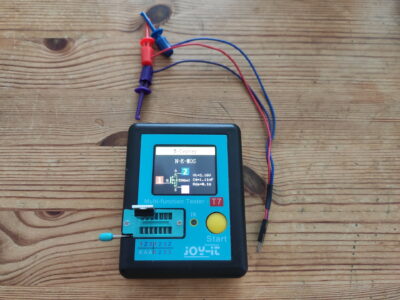

I have acquired a few of them over the years, and their hFE results (among other metrics) do vary, sometimes by more than 30
 
Last edited:

Thread Starter

oh_uh_okay

Joined Aug 24, 2025
79
Since I'm a lazy sort and don't feel like wading through a huge schematic to find the transistors your are referring to, please take a screen-shot of the transistors and some of the surrounding circuitry, and then post that here.
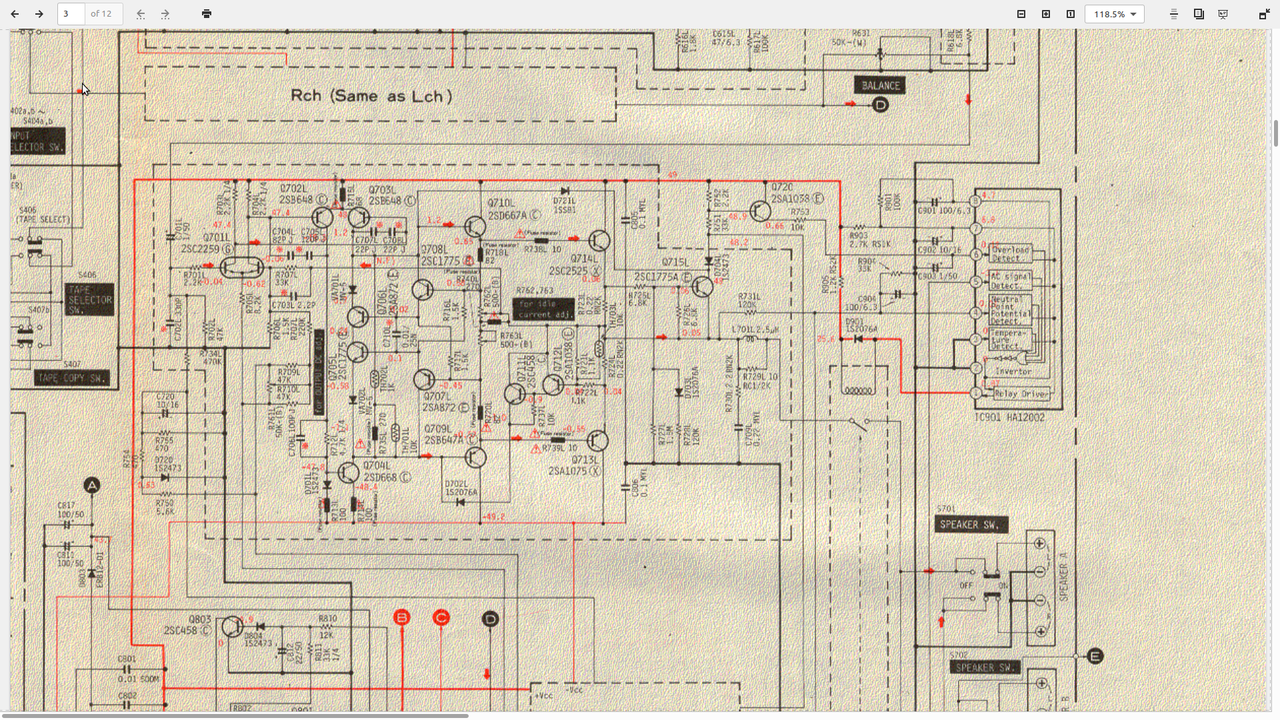
P. 3 in Serv Manl. Q713/714.
Many other vintage amps also use these same Fujitsu 2SA1075 and 2SC2525's. But they are very difficult to get reliable (new old stock) pieces of. And even many substitutes are no longer made (like the Sanken or even NTE).
 

WBahn

Joined Mar 31, 2012
33,075
I suppose this query can apply to any semiconductor ... but can NORMAL (non-abusive) use of an amplifier cause, over time (e.g. decades), the hFe (or other specs/parameters) to "rot" or decay?
In servicing a 1980 Hitachi HA-4700 int. amp, that does work fine as is, all four of its orig Fujitsu power transistors (pair: Fujitsu 2SA1075 and 2SC2525 ) have hFE of 37 or 60, respectively. These now-vintage Fujitsu devices are no longer in production, and very difficult or $ to obtain new-old-stock. So I don't know how they spec'd in 1980.
I do have some modern substitutes (Sanken 2SC2922/2SA1494) that I will be installing soon. Their hFE are appox 125 to 137.

On a side note, how accurate are these cheap ($20) "M-Testers" for measuring hFE?


I have acquired a few of them over the years, and their hFE results (among other metrics) do vary, sometimes by more than 30
Both the 2SA1075 and the 2SC2525 had a min hFE of 60, but that spec was at a current of 1 A and a Vce of 5 V. It may well have had a lower hFE at whatever current and voltage you tested it at. The datasheets aren't hard to find (just Google "2SA1075 data sheet").

Neither data sheet that came up as the first hit has typical parametric curves, so I don't know how they behave away from the specification test point. Though generally the gain goes up as the collector current is decreased for the same Vce, at least until you get to pretty low current levels, where it starts to drop off again.

The current gain of BJT transistors doesn't "decay" just because they are old. However, it can degrade if the transistors are overstressed, with the primary culprit being overheated and the second being excessive current or voltage. Each overstress event can degrade the performance and that degradation tends to be permanent and cumulative.
 

WBahn

Joined Mar 31, 2012
33,075
So why do manufacturers spec them with the higher beta I noted with testing the new Sankens?
Uh... the manufacturers spec their transistors according to the way they perform and what they are willing to guarantee.

Just because power transistors used as the output stages of power amplifiers generally don't need a lot of current gain, doesn't mean that that is always the case, nor does it mean that these transistors are only used as output stages in power amplifiers. The manufacturers don't control what applications their devices are used for. Their goal is to develop devices that are adequate for use in a wide array of applications so as to have as broad a market for their products.
 

Thread Starter

oh_uh_okay

Joined Aug 24, 2025
79
Btw ... since some of us are looking at those old datasheets ... did anyone notice both the original Fujitsu transistors featuring RET (ring emitter transistor) technology? Not sure the newer substitutes feature anything similar. So maybe there is something scientific about the "vintage" sound some of this era of gear is acclaimed for.
 

MisterBill2

Joined Jan 23, 2018
28,003
Definitely some transistor types are more linear than others!! And some are much lower noise than others. AND germanium transistors sound different from silicon transistors, according to some folks. Certainly in the same amplifier circuits they would sound different. Besides all of that, as some types of power transistors age with operation and temperature, the leakage current does increase, and if that alters the operating point a bit then often the distortion and the actual "sound" will change a bit. That has been my experience with a few pieces of equipment. As the leakage currents increase a bit on some devices the operating points can change and they will sound a bit different. Of course, the othercomponents mayalso change a bit with age, as well.
 
Last edited:

MisterBill2

Joined Jan 23, 2018
28,003
The fact is that many transistors do change a bit as they age IN USE. Sitting in a drawer, the change would be corrosion and oxidizing , which makes connecting them more difficult.
 

MisterBill2

Joined Jan 23, 2018
28,003
The parts of an amplifier that are most likely to change with aging are the capacitors, which tend to increase their leakage current and some do suffer reduced capacitance. And some varieties of power transistors do exhibit inreased leakage current with aging in operation.
In direct coupled amplifiers, such as shown in post#7, the failure can in many cases be in a much earlier stage, which then results in damage to the expensive output stage devices. So if the output devices have failed the cause may be in the earlier stages. A failed $1 transistor takes out both of the $27 output transistors, which are no longer available at any price. So quite a bit of testing of the whole circuit is required.
 
Last edited:

MisterBill2

Joined Jan 23, 2018
28,003
Uh... the manufacturers spec their transistors according to the way they perform and what they are willing to guarantee.

Just because power transistors used as the output stages of power amplifiers generally don't need a lot of current gain, doesn't mean that that is always the case, nor does it mean that these transistors are only used as output stages in power amplifiers. The manufacturers don't control what applications their devices are used for. Their goal is to develop devices that are adequate for use in a wide array of applications so as to have as broad a market for their products.
WAIT!! (reply to post #9 !! Power output stages certainly need current handling capability! AND current gain. THAT is why they are physically larger and often mounted on heat sinks. They seldom need a lot of VOLTAGE GAIN, except to accurately amplify their base drive current.
 

WBahn

Joined Mar 31, 2012
33,075
WAIT!! (reply to post #9 !! Power output stages certainly need current handling capability! AND current gain. THAT is why they are physically larger and often mounted on heat sinks. They seldom need a lot of VOLTAGE GAIN, except to accurately amplify their base drive current.
The current gain of a typical small-signal BJT is a few hundred, while for a typical power BJT it is a few dozen. For instance, the minimum spec'ed current gain of a 2n3055 is only 15.
 

MisterBill2

Joined Jan 23, 2018
28,003
The total required CURRENT GAIN of a POWER AMPLIFIER OUTPUT STAGE depends quite a bit on the required amplifier output power. It also depends on the amplifier's load impedance.
 

BobTPH

Joined Jun 5, 2013
11,616
The current gain of a typical small-signal BJT is a few hundred, while for a typical power BJT it is a few dozen. For instance, the minimum spec'ed current gain of a 2n3055 is only 15.
Which is why high power amps usually use Darlingtons in the output stage.
 
Top