Facebook
 Google
 GitHub
 Linkedin
Hello guys
Noob here and its been a while since I did audio amps, but I recently got back into them and as usual, have run into a little problem. As i looked around for material, i came across this site https://ludens.cl/Electron/audioamps/AudioAmps.html Very informative and the owner (Manfred) goes a little bit into detail describing the evolution of his project, but it's the last schematic that brought me to a grinding halt. In order to get rid of crossover distortion in the output stage, he introduces a Vbe multiplier and a current source to supply power to both the Vbe multiplier and the out put transistors. I know it works and its a common circuit because i have already seem a bunch of them already, but doesn't that bring about problems of its own. For instance, right off the top of my head, it seems to me that the voltage swing from the op amp can go as low as the op amp will go, but on the positive swing, it cant exceed 12v - (1.4v + 0.2v + 0.7v) = 9.7v. The 1.4v for the Vbe multiplier, 0.2v for the minimum Vce of Q4, and 0.7v for R6. The way i see it, if the output from the op amp exceeds 9.7v, Q4 would cut out because the collector voltage has risen beyond the emitter voltage and therefore current wouldn't flow. This would in turn cut supply to Q3, eliminating the output bias all together. I believe there would still be some leakage current through R6, and the emiter-base junction of Q4 would act as a diode, but thats irrelevant. From what I have gathered, the minimum output voltage the 4558 (which I'm using for this project) would achieve in this particular schematic is about 1.5v. So with that in mind, does that mean the we can only get about (9.7v - 1.5v) 8.3v swing out of the 4558 with this set up? I know that I would probably at best get a 9 volt (-1.5v from both rails at 12v) swing out of a cheap op amp like the 4558 and there isn't that much difference between 8.3v and 9v in practical terms, but I'd just like to confirm that my theory is correct so i can get a better understanding of the limitations of this design to avoid problems.
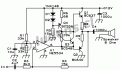
If my theory is correct, that would mean R1 and R2 would have to be re-adjusted if i want to use the whole dynamic range of the circuit, because there's a greater loss on the positive swing than there is on the bottom swing. Probably change R1 and R2 to get somewhere about 5.6 volts out of the divider to avoid clipping the positive swing.
I'd appreciate anyone's helpful thoughts.
Noob here and its been a while since I did audio amps, but I recently got back into them and as usual, have run into a little problem. As i looked around for material, i came across this site https://ludens.cl/Electron/audioamps/AudioAmps.html Very informative and the owner (Manfred) goes a little bit into detail describing the evolution of his project, but it's the last schematic that brought me to a grinding halt. In order to get rid of crossover distortion in the output stage, he introduces a Vbe multiplier and a current source to supply power to both the Vbe multiplier and the out put transistors. I know it works and its a common circuit because i have already seem a bunch of them already, but doesn't that bring about problems of its own. For instance, right off the top of my head, it seems to me that the voltage swing from the op amp can go as low as the op amp will go, but on the positive swing, it cant exceed 12v - (1.4v + 0.2v + 0.7v) = 9.7v. The 1.4v for the Vbe multiplier, 0.2v for the minimum Vce of Q4, and 0.7v for R6. The way i see it, if the output from the op amp exceeds 9.7v, Q4 would cut out because the collector voltage has risen beyond the emitter voltage and therefore current wouldn't flow. This would in turn cut supply to Q3, eliminating the output bias all together. I believe there would still be some leakage current through R6, and the emiter-base junction of Q4 would act as a diode, but thats irrelevant. From what I have gathered, the minimum output voltage the 4558 (which I'm using for this project) would achieve in this particular schematic is about 1.5v. So with that in mind, does that mean the we can only get about (9.7v - 1.5v) 8.3v swing out of the 4558 with this set up? I know that I would probably at best get a 9 volt (-1.5v from both rails at 12v) swing out of a cheap op amp like the 4558 and there isn't that much difference between 8.3v and 9v in practical terms, but I'd just like to confirm that my theory is correct so i can get a better understanding of the limitations of this design to avoid problems.
If my theory is correct, that would mean R1 and R2 would have to be re-adjusted if i want to use the whole dynamic range of the circuit, because there's a greater loss on the positive swing than there is on the bottom swing. Probably change R1 and R2 to get somewhere about 5.6 volts out of the divider to avoid clipping the positive swing.
I'd appreciate anyone's helpful thoughts.