The laptop supplies, via a series resistor, a supply voltage required by the FET inside a typical electret microphone.
The usual jack is for both input and output.
Never tried this experiment, but there are 2 possibilities:
1) You burn out the Bias Resistor inside the laptop - so you cannot use a "Electrec" or "Condensor" mic; but you can still feed a low (1 mV) Mono signal for recording.
2) You puncture the DC blocking capacitor inside the laptop and Damage the Audio Chip; maybe other components depending on what voltage is being fed.
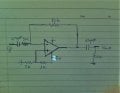
I'm actually building a circuit where I want to be able to record the signal variations when I hit a piezoelectric sensor on audacity. I'm using op amp in inverting amplifier configuration with DC offset of Vcc/2 to allow complete voltage swing. I want to feed this output to input of laptop using audio jack. My circuit is in the attachment. The input is signal from piezoelectric sensor.
If you're hitting a piezo transducer I think you'll find you don't need the amplifier. In fact, you'll probably have to attenuate the signal to avoid over-driving the laptop input.
If you're hitting a piezo transducer I think you'll find you don't need the amplifier. In fact, you'll probably have to attenuate the signal to avoid over-driving the laptop input.
Okay. But I want to know what is the bias voltage used in laptop and what happens if we exceed it? Does the signal variations from the piezo superimpose over the bias from laptop or does it get clipped off if it exceeds?
A piezo has a high output impedance that you are shorting with the extremely low 1k ohms input of your inverting opamp circuit. Nobody knows the output level of a shorted piezo but if you are hitting it then it might be high enough to cause the opamp to be clipping.
Then the output of your opamp (it has no part number) might be 25V peak-to-peak. A mic input might be damaged by a signal that is more than a few volts peak-to-peak.
You need a voltage-limiting circuit with a high input impedance, not an opamp with a high supply voltage and a low input impedance

 Facebook
 Google
 GitHub
 Linkedin