Transistors used in guitar preamp input section

Ian0

Joined Aug 7, 2020
13,158
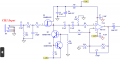
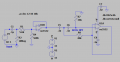
So the top circuit in post 1, would it work if I removed Q1, Q2, Q3 and R6? The signal would be at 0V I think, midway between rails.
And jumper R2-C5
No - because you would have removed the buffer, and the input impedance would be too low for the pickup to drive.
The input impedance would be approximately equal to R7 instead of R2.
You could replace Q1, Q2, R4, R5 by a single resistor, and keep J1, and that would work.
 

Audioguru again

Joined Oct 21, 2019
6,826
The old NE5532 opamp had a low input impedance for an old phono pickup, not a Jfet input opamp like a more modern TL071.
Also the opamp is a Sallen-Key filter that must be fed from a low impedance.
 

Ian0

Joined Aug 7, 2020
13,158
The old NE5532 opamp had a low input impedance for an old phono pickup, not a Jfet input opamp like a more modern TL071.
Also the opamp is a Sallen-Key filter that must be fed from a low impedance.
NE5532 introduced 1979
TL071 introduced 1978
Both still going strong. Any audio desk is still full of NE5532 op-amps, but not quite so many as were used before DSP took over all the processing.
As Self points out, the NE5532 takes a lot of beating, because it has a very low current noise for an op-amp designed for low voltage noise, but the TL071 is better for high impedance inputs.
A more modern JFET amplifier would be preferred to avoid the TL071's phase-reversal problem.
 

Thread Starter

rpschultz

Joined Nov 23, 2022
838
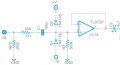
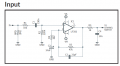
Here's another guitar pedal preamp section that runs on +/- 15v and doesn't use transistors, with unity gain. The diodes are just polarity protection I think? Does the pull down resistor set the impedance? or is that R2?
1703884177795.png
 

Thread Starter

rpschultz

Joined Nov 23, 2022
838
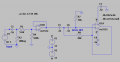
Comparing those 2 with the original circuit in post 1, I don't think the transistor arrangement provides any gain, right?

1703885156573.png
 

Audioguru again

Joined Oct 21, 2019
6,826
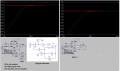
The opamp is a 2nd-order highpass filter to reduce 60Hz and lower frequencies.
The original circuit has a few useless parts.
R8, R9 and R10 do not reduce the input impedance because R8 does nothing and R9 produces positive feedback to make the cutoff a sharp corner when fed from a low impedance.

Here are the frequency responses of the original and simplified circuits:
 

Attachments

Thread Starter

rpschultz

Joined Nov 23, 2022
838
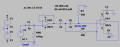
OK I see that U1A is a 2nd order HPF, and understand how R8, R10, R11 can create 6db gain. Is it possible to replace Q1, Q2, Q3 with an op amp (U1B) to reduce the impedance like in post #24? Like this? I'm just curious, I'm not sure which is better. Although 3 transistors have less overhead than an op amp from a layout standpoint.

I understand how R1, R2, R4 create the input impedance. I'm not exactly sure what impedance is optimal for acoustic guitar although 1 MΩ is generally good for most pickups.

1703905873865.png
 

Attachments

Audioguru again

Joined Oct 21, 2019
6,826
The NE5532 opamp does not have Jfet inputs, instead they are ordinary transistors. Then its datasheet says its minimum input impedance is only 30k ohms which is much too low for a guitar pickup and is even too low for a phono cartridge.

Modern opamps with Jfet inputs have an input impedance of 1 Tera ohms (1 million x 1 million). Then the external resistors determine the input impedance fed by the guitar pickup.

Post #24 uses a TL072 that has Jfet extremely high input impedance inputs.
 

Thread Starter

rpschultz

Joined Nov 23, 2022
838
I see from the datasheets that tl07x has a 10^12 input resistance, and the NE5532 has a min of 30k with 300k being typical. OK so a TL07x should work as an input buffer for a guitar, like post 24. Both the circuits in post 24, the older LF356 in post 25 and the transistor circuit use a FET, as I understand it, have high input impedance and low output impedance.

1703943072565.png
 

Thread Starter

rpschultz

Joined Nov 23, 2022
838
Still begs the question, which FET is better - transistor or op amp? A 2N5457 and 2N5088 are very common on the transistor side, also the J201. On the op amp side of things, I've seen a lot of JRC4580's and a few TL072's. It does seem like a preference for TL072/OPA2134 for applications that want to minimize distortion like synth and chorus pedals.
 

Ian0

Joined Aug 7, 2020
13,158
I see from the datasheets that tl07x has a 10^12 input resistance, and the NE5532 has a min of 30k with 300k being typical. OK so a TL07x should work as an input buffer for a guitar, like post 24. Both the circuits in post 24, the older LF356 in post 25 and the transistor circuit use a FET, as I understand it, have high input impedance and low output impedance.

View attachment 311253
You've got it!
 

Ian0

Joined Aug 7, 2020
13,158
Still begs the question, which FET is better - transistor or op amp? A 2N5457 and 2N5088 are very common on the transistor side, also the J201. On the op amp side of things, I've seen a lot of JRC4580's and a few TL072's. It does seem like a preference for TL072/OPA2134 for applications that want to minimize distortion like synth and chorus pedals.
JFET vs. JFET op-amp: The op-amp will give better distortion, the JFET better noise but only if you choose a good one.
A good FET (2SJ3557) will give <1nV/√Hz, but a 2N5457 is more like 40nV/√Hz, which is worse than the TL072. The TL072 (and NatSemi's LF353) have the weird phase-reversal problem which they have fixed in the OPA2134, which also has better noise than the TL072.
For most JFETs and JFET op-amps you can ignore the current noise (quoted at 10fA/√Hz for the TL072 and 3fA/√Hz for the OPA2134). The current noise multiplied by the input resistance adds to the voltage noise.
A bipolar op-amp such as the NJM4580 has lower voltage noise (3nV/√Hz) , but it's current noise isn't quoted. I'd guess at 1pA/√Hz, and that would make it virtually unusable at high input impedances.
 

Thread Starter

rpschultz

Joined Nov 23, 2022
838
The 2N4392 (from original circuit) has a noise of 1.2 nV/√Hz, similar to the 2SJ3557. TL07x says 18 nV/√Hz typ at 1khz. So the FET transistor could be better in that way.
 
Top