Transistor

Thread Starter

S.Sphereson

Joined Apr 17, 2014
15
Hi

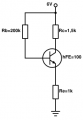
Need some help... For the attached transistor circuit I want to determine:


  • \(I_c\)
  • \(U_{ce}\)

Stuck and need some help on how to approach this.

Thanks!
 

Attachments

Last edited:

WBahn

Joined Mar 31, 2012
33,187
For every mA flowing in Rb, how much current is flowing in Re?

What is the sum of the voltage across Rb and Re?

What is the maximum current that can be flowing in Rc?

Can you write the three currents (Ic, Ib, and Ie) all in terms of just Ic?

Can you write an equation that sums up the voltages between ground and the supply that goes through Rb in terms of Rb, Re, Ic, and Vbe?

Can you write an equation that sums up the voltages between ground and the supply that goes through Rc in terms of Rc, Re, Ic, and Vce?
 

shteii01

Joined Feb 19, 2010
4,644
I am looking at example in my textbook that is almost same as your problem. The solution is a total of 6 equations. Assuming:
* you have textbook
* you know how to read
* you actually comprehend what you have read
The question becomes: What have you got so far?
 

Thread Starter

S.Sphereson

Joined Apr 17, 2014
15
So far:

\(I_b=\frac{6V-0.7V}{200000}\)

and..

\(I_c=\beta \times I_b\)

I know the emitter current is equal to the sum of base and collector current.
I just can't get the right values for \(I_b\) and \(I_c\) from start out.

This is a switch circuit, right?
 

WBahn

Joined Mar 31, 2012
33,187
So far:

\(I_b=\frac{6V-0.7V}{200000}\)

and..

\(I_c=\beta \times I_b\)

I know the emitter current is equal to the sum of base and collector current.
I just can't get the right values for \(I_b\) and \(I_c\) from start out.

This is a switch circuit, right?
In order for your equation for Ib to be correct, the voltage ACROSS Rb would have to be (6V-0.7V). Is that the case? For that to be the case, the voltage at the emitter of the transistor would have to be 0V? Do you believe that that is the case?

Okay, you have given:

Ic = β Ib

and

Ie = Ib + Ic

So use these two equations to write Ib in terms of Ic (and β) and Ie in terms of Ic (and β).
 

shteii01

Joined Feb 19, 2010
4,644
So far:

\(I_b=\frac{6V-0.7V}{200000}\)

and..

\(I_c=\beta \times I_b\)

I know the emitter current is equal to the sum of base and collector current.
I just can't get the right values for \(I_b\) and \(I_c\) from start out.

This is a switch circuit, right?
Alright, let us work on Ib first.

You know that the drop from the top of the circuit to the bottom (ground) is 6 V.

So work your way from the top to the bottom using the Rb:
* you have some voltage drop across Rb, this voltage is Ib*Rb
* next you have some voltage drop from B to E, 0.7 V
* next you have voltage drop across Re, Ie*Re
So:
Ib*Rb+0.7+Ie*Re=6
200kIb+0.7+1kIe=6
We have two unknows, Ib and Ie.
Now we do approximation of Ie: Ie=(1+hFE)Ib=(1+100)Ib=101Ib
So:
200kIb+0.7+1k(101Ib)=6
Now we have one unknown, Ib. Go find Ib.
 

shteii01

Joined Feb 19, 2010
4,644
Thanks!!

Had no idea of how to do the emitter current approximation. Finding Uce now is not a prob!

Thanks again!:)
One important note. This approach assume that the transistor is in the Forward-active mode. Once you find Vce, you can determine if your original assumption (transistor is in the Forward-active mode) is correct. If Vce>Vce(saturation), then the assumption is correct. If Vce<0, then assumption is wrong and transistor is in Saturation mode and you need Vce(saturation) to find Ic.
 
Last edited:

WBahn

Joined Mar 31, 2012
33,187
One important note. This approach assume that the transistor is in the Forward-active mode. Once you find Vce, you can determine if your original assumption (transistor is in the Forward-active mode) is correct. If Vce>Vce(saturation), then the assumption is correct. If Vce<0, then assumption is wrong and transistor is in Saturation mode and you need Vce(saturation) to find Ic.
Tweak: If Vce < Vcesat, then it is in saturation.
 

WBahn

Joined Mar 31, 2012
33,187
Thanks!!

Had no idea of how to do the emitter current approximation. Finding Uce now is not a prob!

Thanks again!:)
But do you understand how to do it now? (As opposed to just parroting an equation provided by someone else).

You had everything you needed:

Ic = β * Ib
Ie = Ib + Ic

Therefore:

Ie = Ib + β * Ib = (1+β)Ib

Similarly, you can express everything in terms of Ic (or Ib or Ie) as follows:

Ic = Ic
Ib = Ic/β
Ie = Ic(1+β)/β

Now you can easily write the two equations I requested:

6V = Ie*Re + Vbe + Ib*Rb = Vbe + [Ic(1+β)/β]Re + [Ic/β]Rb
6V = Ie*Re + Vce + Ic*Rc = Vce + [Ic(1+β)/β]Re + [Ic]Rc

Using the above relationships to put all the currents in terms of Ic (the current you are interested in) you get:

6V = Vbe + [Ic(1+β)/β]Re + [Ic/β]Rb
6V = Vce + [Ic(1+β)/β]Re + [Ic]Rc

Notice that the first one allows you to solve for Ic directly, since it is the only unknown.

6V = Vbe + Ic[(1+β)Re+Rb]/β
Ic = β(6V-Vbe)/[(1+β)Re+Rb]

To find Vce, set the two equations equal to each other (which you can do because they are both equal to 6V) and you get

Vce + [Ic(1+β)/β]Re + [Ic]Rc = Vbe + [Ic(1+β)/β]Re + [Ic/β]Rb
Vce + [Ic]Rc = Vbe + [Ic/β]Rb

Vce = Vbe + Ic(Rb/β - Rc)
 

PRS

Joined Aug 24, 2008
989
WBahn, you sound like a good teacher. I was a tutor of math and chemistry at a local college. My approach is different from yours. Your approach is to get the student to think about the problem and, from the lecture or the text, come up with the solution. In my experience this is not always the best approach.

I discovered that the student needs to be shown how to solve the problem, and once that is done the theory makes sense. This approach is more effective, I think, because people cannot really be taught how to think. That is a gift from God and a trait all humans have from birth. What they need is to be shown how to solve the problem and then correlate the solution to the theory.
 

WBahn

Joined Mar 31, 2012
33,187
WBahn, you sound like a good teacher. I was a tutor of math and chemistry at a local college. My approach is different from yours. Your approach is to get the student to think about the problem and, from the lecture or the text, come up with the solution. In my experience this is not always the best approach.

I discovered that the student needs to be shown how to solve the problem, and once that is done the theory makes sense. This approach is more effective, I think, because people cannot really be taught how to think. That is a gift from God and a trait all humans have from birth. What they need is to be shown how to solve the problem and then correlate the solution to the theory.
But a point to keep in mind is that most people that come to a site like this HAVE been shown how to solve the problem. It's been presented in lecture where example problems have been worked, it's been presented in their text where more example problems have been worked. While it can and does happen, most of the time just seeing one more problem worked for them is not going to suddenly make things click. Instead, it will make them think that they've learned something when, in reality, all that has happened is that their homework has been worked for them and they are no better prepared to solve the next problem as they were the present one. And engineering is about problem solving.

Now, showing them an example of a somewhat different problem can help by bringing the prior examples they have seen worked closer to the problem they are presently struggling with. But they need to make the final connections in their own mind otherwise they will become, at best, parrots and not engineers.
 

PRS

Joined Aug 24, 2008
989
But a point to keep in mind is that most people that come to a site like this HAVE been shown how to solve the problem. It's been presented in lecture where example problems have been worked, it's been presented in their text where more example problems have been worked. While it can and does happen, most of the time just seeing one more problem worked for them is not going to suddenly make things click. Instead, it will make them think that they've learned something when, in reality, all that has happened is that their homework has been worked for them and they are no better prepared to solve the next problem as they were the present one. And engineering is about problem solving.

Now, showing them an example of a somewhat different problem can help by bringing the prior examples they have seen worked closer to the problem they are presently struggling with. But they need to make the final connections in their own mind otherwise they will become, at best, parrots and not engineers.
I noticed as a student just being introduced to the ideas of science, the texts seemed abstract. They were general. Then we were given problems we were to solve from these abstractions. This was like giving the students algebra before they were given practical problems to solve.

And that's backwards from the way were taught in elementary school. There we were taught to solve concrete problems with simple arithmetical algorithms ,then we were taught algebra. The generalizations of algebra only made sense when we could compare them to the concrete problems of arithmetic.

I had a calculus teacher who insisted he was teaching his students how to think. But this was not the case. People are born with the ability to think. The solution of mathematical problems must be taught by example, not by teasing the student.
 

shteii01

Joined Feb 19, 2010
4,644
You are both right.

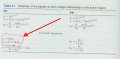
The problem is that OP did not read the textbook. Here is why:


Basically the teaching technique that you employ does not matter because the OP did not even bother of looking up the material in their textbook.
 

Attachments

WBahn

Joined Mar 31, 2012
33,187
You are both right.

The problem is that OP did not read the textbook. Here is why:


Basically the teaching technique that you employ does not matter because the OP did not even bother of looking up the material in their textbook.
Do we even know that that's the text that the OP is using? Even if it is, it may be that the OP just didn't make the connections even though they are pretty much right there. It's easy to miss things when you are struggling with something new.
 

WBahn

Joined Mar 31, 2012
33,187
I noticed as a student just being introduced to the ideas of science, the texts seemed abstract. They were general. Then we were given problems we were to solve from these abstractions. This was like giving the students algebra before they were given practical problems to solve.

And that's backwards from the way were taught in elementary school. There we were taught to solve concrete problems with simple arithmetical algorithms ,then we were taught algebra. The generalizations of algebra only made sense when we could compare them to the concrete problems of arithmetic.

I had a calculus teacher who insisted he was teaching his students how to think. But this was not the case. People are born with the ability to think. The solution of mathematical problems must be taught by example, not by teasing the student.
Saying that "people are born with the ability to think" if far too simplistic. First off, it begs the question of what it means to "think". Here we are talking about thinking in two different ways -- how to solve problems and how to gain new knowledge.

The Socratic method is a very effective teaching technique and has been around for a long, long time. It is not "teasing the student" nor is it inferring that the student is dumb. It's intent is to guide the student into starting from what they already know and walking toward what they are trying to learn. But, effective as it is, it does require that both parties be willing to participate. That is it's greatest shortcoming because many students aren't willing to do so.
 

shteii01

Joined Feb 19, 2010
4,644
Do we even know that that's the text that the OP is using? Even if it is, it may be that the OP just didn't make the connections even though they are pretty much right there. It's easy to miss things when you are struggling with something new.
I am not claiming what text OP has. Like I said earlier, my textbook has almost the same example problem, where solution is given step by step. But! In order to have access to the formulas and the example problem solutions, YOU HAVE TO OPEN THE EFFING TEXTBOOK!

It does not matter what teaching technique you use if OP does not even going to BOTHER to open the textbook.
 

PRS

Joined Aug 24, 2008
989
Saying that "people are born with the ability to think" if far too simplistic. First off, it begs the question of what it means to "think". Here we are talking about thinking in two different ways -- how to solve problems and how to gain new knowledge.

The Socratic method is a very effective teaching technique and has been around for a long, long time. It is not "teasing the student" nor is it inferring that the student is dumb. It's intent is to guide the student into starting from what they already know and walking toward what they are trying to learn. But, effective as it is, it does require that both parties be willing to participate. That is it's greatest shortcoming because many students aren't willing to do so.
I went through school from kindergarten through four years of college and I tutored college students. Based on my own learning experience and my tutoring I came to believe what I believe about education.

I am very familiar with your philosophy. But here's mine and please give it some consideration. I took calculus and was about to fail when I dumped the class. I asked my teacher if I could get the Study Guide that went along with the text book. He said ordinarily he wouldn't but in my case he allowed it. After I got the study guide, which showed the solutions to the text problems I took the class again and got an A.

From there I became a tutor at the same college. I came to realize that for some students they just had an attitude that prevented them from learning, and they were not really willing to put in the time it takes to learn the discipline. Others were willing but were stymied by incomprehension. The latter were like me when I was about to fail calculus.

So I learned to differentiate between the poor attitude people and instructed them to put more time into their study (besides working their homework for them) and the slower learning people like myself and for the latter I taught them how to work the problems. This latter technique paid off. My students gained good grades.

This was not cheating. This was showing the student how to work the problem and when he/she encountered a similar problem on a test, he/she was able to do it successfully.
 
Top