No. 27mA is not used in this circuit.
The collector current is 2.92mA and the base current is 27uA (micro-amps). The current in R4 is 648uA but could be reduced to about 270uA.
No. 27mA is not used in this circuit.
The collector current is 2.92mA and the base current is 27uA (micro-amps). The current in R4 is 648uA but could be reduced to about 270uA.
The simulator says that the current in R4 is 648uA and you can easily calculate it to see if it is wrong.
1) The supply is 12V, R3 is 15k and R4 is 2.9k.
2) Assuming that the transistor collector voltage is half the supply voltage then its 2k collector resistor has a current of 3mA.
3) Assuming that the transistor has a beta of 110 then its base current is 3mA/110= 27uA.
4) The emitter voltage is about (3mA + 27uA) x 400 ohms= 1.2V.
5) The base voltage is about 1.2V + 0.7V= 1.85V.
6) Then the current in R4 is about 1.9V/2.9k= 655uA.
There is a small error (655uA instead of 648uA) because we don't know which transistor so we don't know its exact base-emitter voltage. Its exact base-emitter voltage is calculated to be 0.68V.
Direct coupling is quite a bit more advanced, get a single stage to work then learn to couple two single stage amps together with a simple capacitor first.
It's rare that you ever do as it can only be in a complicated circuit where you're sending a bit of the emitter current back to the base through a capacitor - even then you'll have phase shifts to deal with.
Come on guy, get the one transistor designs down then move on to coupling two of them together with an interstage capacitor or transformer, this knowledge is so easy to find it isn't really even worth you asking here about it.
I have study -ve and +ve feedback in this four configuration like Voltage series,..etc.
but i don't know to assemble or design it, as AG was telling that for large amplitude signal distortion occur at output for this -ve feed back should be given, how??
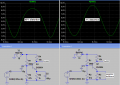
The emitter resistor provides negative feedback. If the emitter resistor has a bypass capacitor shorting it at AC frequencies then there is no AC negative feedback so the AC voltage gain and distortion are very high. When the emitter resistor does not have a bypass capacitor then the gain and distortion are reduced due to the negative feedback.
Here I show on the left side a transistor with its emitter resistor bypassed. It has horrible distortion and its voltage gain is about 5V/25mV= 200.
On the right side is the transistor without an emitter bypass capacitor and its distortion is much lower and its voltage gain is 4.2V/460mV= 9.1.
You can use two transistors to make an amplifier with a gain of 200 and low distortion. Each transistor would have negative feedback so each one has a gain of the root of 200 (14.14). Or negative feedback can be added from the output to the inverting input.
AG how you have calculated the distortion is 40%-3%??,
what about 5V & 4.2V from where you have calculated??
and if we not use bypass capacitor that mean it is -ve feedback, if yes of which type and other type of feed back why not were used??
The collector of the transistor is at about +5VDC. It swings 4.2V peak in a low distortion negative direction to +0.8V as shown on the simulation. The input from the signal generator is also a peak voltage.
if we not use bypass capacitor that mean it is -ve feedback, if yes of which type and other type of feed back why not were used??
Yes, it is negative feedback. Ask your teacher to tell you which type of feedback.
There are other types of negative feedback but this one is the simplest.
Rritesh, I can't say that I've ever seen a software version of a distortion analyzer but that doesn't mean they don't exist. They were a common (but expensive) piece of test equipment back in the old days when repairing audio equipment was actually done, nowadays most things except the highest end stuff just gets tossed in the trash and replaced. I never owned one but have worked with them, about all the precision audio stuff I've got left is a very high resolution frequency analyzer that was used with a very flat response studio microphone in an anechoic chamber to chart the frequency response of speaker systems. You had to transpose a little to compensate for the graph of the microphone's frequency response but it was an invaluable tool when building your own speakers or setting up a custom setup in someone's home. I sometimes had to build systems for people that were custom built into an existing wall mounted bookcase "entertainment center" as they'd call them nowadays and would have to spend a lot of time getting the port(s) and crossover just right so the response was as flat as I could get it.
Needless to say I had some failures that still sounded good enough to them, but I also had a lot that turned out to be almost perfectly tuned to the room they were being used in. I think the most difficult I had to build was for a business partner who had a huge living room + game area + open kitchen and I ended up using 36" EV speakers on the low end, don't even know if you can buy those anymore.
To measure the distortion of an amplifier, you load it with its normal load and feed it a pure sine-wave. The distortion analyser connects to the load and notches away the fundamental frequency of the sine-wave and shows the amplitude of the harmonics (distortion) plus noise (hiss, hum and rumble).
Yes, it is negative feedback. Ask your teacher to tell you which type of feedback.
There are other types of negative feedback but this one is the simplest.
AG the feedback is taken from collector i.e. output but, here you have taken from emitter it doesn't effect the working of amplifier and i thick the feed back is current series feedback is this wright??

 Facebook
 Google
 GitHub
 Linkedin