Transistor onset of saturation

Thread Starter

KevinEamon

Joined Apr 9, 2017
284
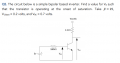
upload_2017-4-24_0-45-45.png
So I've been happily calculating values for these transistor circuits. I actually analysed this one, using the methods I'd learned. Usually by assuming Vbe was 0.7.
Then ib = (Vbb-Vbe)/Rb and so on and so forth.

I realized this is a different question so I went back to my notes and saw that, for this problem, I must assume the 0.2 saturation value.

My notes state that:-

Ic = (Vcc-Vce)/Rc

However and here comes the problem:-
My notes show that 6.02/4.6k = 126mA

So I thought that must be wrong it must be 5.98/4.6K = ....???

So I flicked to the next example in my notes and that's exactly the same...

The 0.2 is being added with exactly the same formula???upload_2017-4-24_0-45-45.png
 

Thread Starter

KevinEamon

Joined Apr 9, 2017
284
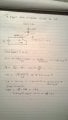
Hmmm I think I managed to get the answer, even though I assumed the 6.02V value here in these notes.

2017-04-24 03.04.02.jpg

Ignore my notes on the top there
 

WBahn

Joined Mar 31, 2012
32,908
Where is this 5.98 V coming from? Or 6.02 V, for that matter?

You have Vcc = 6.0 V.

You have Vce = Vcesat = 0.2 V.

Does not KVL therefore require that the voltage across the collector resistor be 6.0 V - 0.2 V = 5.8 V?
 

WBahn

Joined Mar 31, 2012
32,908
That is correct.
The answer is 1.3mA.

Important information missing in the above is the Vce at which β is specified (it's often at a Vce of 5V).
It's the standard piecewise-linear simple transistor model in which Vbe is a constant in either active or saturation, beta is a constant in the active region, Vce is a constant in saturation, and the transition from active to saturation is distinct at the point where the active beta and the saturation Vce are both satisfied simultaneously.
 

MrAl

Joined Jun 17, 2014
13,716
Hi,

Yeah i had to scratch my head at this too when i saw either 6.02 or 5.98 which is not the correct voltage across Rc. Strange, it appears that the value for Vce used was 0.02 instead of 0.2 volts.

Also, the result they are looking for is a voltage not a current. Apparently they want to know what value to change the 3v source to in order to satisfy the circuit as described. It's going to have to be higher than 3v.

I am assuming that we can use 25 as the beta in saturation, as that seems to be what they are indicating.
 

Thread Starter

KevinEamon

Joined Apr 9, 2017
284
lol thats a good point guys regarding the voltage across Rc. Who knows? I just work here. I'll email the lecturer.
 
Last edited:

Thread Starter

KevinEamon

Joined Apr 9, 2017
284
Opps false alarm I placed a decimal point where the minus should have gone. Note to self:- Getting old sit closer to board. Sorry guys. In my defense another student did this as well, so wasn't just me.
 

WBahn

Joined Mar 31, 2012
32,908
Opps false alarm I placed a decimal point where the minus should have gone. Note to self:- Getting old sit closer to board. Sorry guys. In my defense another student did this as well, so wasn't just me.
Not quite sure to what you are referring.

Typos are certainly a way of life and while we can do things to reduce them, we will never make them go away entirely.
 

Thread Starter

KevinEamon

Joined Apr 9, 2017
284
haha Yeh. So in the notes it looked like 6.02/4.7k
that 6.
Was actually a 6-
but as I say another student had the same so either it was a really short minus, or the lecturer made a typo... Typos cost a fortune in time. dT/dt = T e ^ -t
:)
 

WBahn

Joined Mar 31, 2012
32,908
haha Yeh. So in the notes it looked like 6.02/4.7k
that 6.
Was actually a 6-
but as I say another student had the same so either it was a really short minus, or the lecturer made a typo... Typos cost a fortune in time. dT/dt = T e ^ -t
:)
Ah. And were is an example were proper tracking of units might have caught the mistake.

What you wanted was

(6 V - 0.2 V) / 4.7 kΩ

Most typos of the type you described (not all) would have messed up the units. For instance

(6 - 0.2 V) / 4.7 kΩ

would have been wrong because you are subtracting a voltage from a pure number.

(6 V . 0.2 V) / 4.7 kΩ

would be nonsensical.

(6 V 0.2 V) / 4.7 kΩ

would have been multiplying V by V leading to units of power overall when you need units of current.

Yes, typos cost a fortune in time. So wouldn't it be a good idea to adopt simple practices that let you catch most of them fairly quickly?
 

WBahn

Joined Mar 31, 2012
32,908
Another couple of very useful habits to get into are:

First:

Work your problems symbolically as far as possible, substituting actual values in as close to the end as possible. This drastically reduces the opportunities for simple arithmetic errors render your work worthless early on. Plus, fixing errors in symbolic work is generally MUCH easier to do compared to finding and fixing a math error and then having to propagate it through the rest of the work accurately.

To do this, replace given constant values with parameters such as Rb, Rc, Vcesat, Vbe, Vcc, etc.

This also lets you see what is important to what in the end result and to also reuse the fruits of your efforts when changes are made: What if Vcc is changed to 5 V? What value of Vcc will result in the onset of saturation when Vbb is 15 V? These and many other questions can be answered by slight manipulations of the symbolic results of the original question, but if you worked numerically from the start then you have to start over to answer each of these questions.

Second:

Break your work into two conceptual parts. In the first part you set up the equations based on the circuit principles and do little, if any, mathematical manipulation. In the second part you do the math on the equations from the first part and this part should involve invoking few (ideally no) circuit concepts. The electrical engineering is all on the first part while the second part is just cranking a math handle. You can focus on the EE concepts in the first part and not messing up the math in the second. Humans, with rare exceptions and regardless of what we like to delude ourselves into believing, are not good at multitasking -- we tend to make a lot more mistakes when we do. So if you are constantly trying to both apply circuit concepts and math concepts at the same time, you are much more likely to mess up one, the other, or both.

Combined with this you make a clear demarcation when you transition from one stage to the next (I often draw a physical line across the paper) and before you proceed you review your setup equations to ensure that they are correct. You make sure the signs on all of your terms are all correct. You ensure that all of your KVL/KCL equations are all correct. You ensure that every place you used Ohm's Law was done correctly. You check every circuit concept you can, because if any of them are wrong, the rest of your work is wasted time. Plus, at this point, making these checks is usually very straightforward because the form of the setup equations generally match the application of the circuit concepts almost directly (which is another reason for doing little to no manipulations of equations in this stage.
 

Thread Starter

KevinEamon

Joined Apr 9, 2017
284
Thanks once again Wbahm ill take all you've said onboard. I've already started to adopt some of the unit tracking methods so you must be having a positive effect on me somewhere. Had I used constants I probably could track where exactly but as it stands I've only got a hand full of digits to go on. :)
 
Top