Transistor Magnetism releation

Thread Starter

I have no education!

Joined Sep 19, 2012
47
Yeah I know what ac coupling is, it removes the dc offset on a mixed frequency ac signal.

Can't ask a question?

Again if I have a ac generated magnetic field in my hand, that is it is time changing. I bring this field close to a dc current. There is no way in the laws of physics that this magnetic field could ever, even for the slightest un measurable time, affect dc current?

Why does it affect ac but will never under any circumstances affect the dc current?

Thanks
 

Thread Starter

I have no education!

Joined Sep 19, 2012
47
That's correct.

A pure AC voltage source has zero DC component. In general, the AC source may have a DC component. A series capacitor can be used to remove the DC component if in fact the DC component is not part of the signal.

Also why would you need to couple the signal via a capacitor if the dc is not part of the signal? The reason one would couple is to remove the underlying dc signal. I think you meant to write " part of the wanted signal" ?
 

Ron H

Joined Apr 14, 2005
7,063
Yeah I know what ac coupling is, it removes the dc offset on a mixed frequency ac signal.

Can't ask a question?
I thought I answered the question that you asked.

Again if I have a ac generated magnetic field in my hand, that is it is time changing. I bring this field close to a dc current. There is no way in the laws of physics that this magnetic field could ever, even for the slightest un measurable time, affect dc current?
I get the impression that you think that AC and DC, one the same wire, are somehow separate entities. Forgive me if I'm wrong.
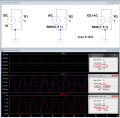
Attached is a graph showing a (1) DC current of 1A, (2) an AC current of 1A p-p with zero DC, and (3) a DC current of 1A with an AC current of 1A p-p superimposed on it.
If you bring an AC field close to a wire with DC on it, the current in the wire will look like case (3), with the magnitudes DC and AC components, and the frequency of the AC, varying depending on the situation.

Why does it affect ac but will never under any circumstances affect the dc current?
DC cannot be "transmitted" through a transformer, which is what you are describing. The induced current will be exactly the same frequency(s) as the magnetic field.

Thanks[/QUOTE]
 

Attachments

Thread Starter

I have no education!

Joined Sep 19, 2012
47
Hey thanks for the info!!

Yeah im not sure that im explaining my self correctly. Lets forget all the superimposed stuff for a minute.

My question was basically this, so if i have a time changing magnetic field and bring it into contact with a dc current. There should be some interference in that DC current?

If not then why not?

Im not implying there is dc current induced or ac current induced. I'm getting at the point of, do the electrons, in the DC, take notice of the field and change there behaviour accordingly.

Thanks for your feedback. Your last message was very well written!!
 

Ron H

Joined Apr 14, 2005
7,063
My question was basically this, so if i have a time changing magnetic field and bring it into contact with a dc current. There should be some interference in that DC current?
Well, yes, the DC current will have an AC current superimposed on it. I guess that could be considered to be interference. I thought you were thinking that the DC value could change.
Maybe the other guys understood you long before I did. I guess I'm dense.:(
 

Thread Starter

I have no education!

Joined Sep 19, 2012
47
You are from dense sir!!

One question, if the magnetic field superimposes a current onto the DC then surely the DC current is changing?

It comes down to what superimposing a ac current literally means on a fundamental level?

thanks for your educated feedback, its indespensible!!
 

Ron H

Joined Apr 14, 2005
7,063
You are from dense sir!!

One question, if the magnetic field superimposes a current onto the DC then surely the DC current is changing?

It comes down to what superimposing a ac current literally means on a fundamental level?

thanks for your educated feedback, its indespensible!!
It is changing, but the average value does not change. The instantaneous value changing could cause problems.
Here's a far-fetched scenario which would be unlikely to happen, but it will illustrate your point:
Loudspeaker AC currents can be on the order of Amps. Speaker wires are generally run together as a pair, so if the pair gets close to another wire, very little coupling will occur, because the flux change in the outbound wire is cancelled by the flux change in the return wire.
Imagine a case (farfetched, as I said) where the pair is separated, and only one of them is bundled with one or both of the amplifier power supply wires, and furthermore, the power supply has inadequate decoupling to ground at the amplifier. The current induced in the power supply wire due to the proximity with the speaker wire could cause feedback (independent of any actual signal, such as music), which in turn would likely cause oscillation at some frequency(s).
 

Thread Starter

I have no education!

Joined Sep 19, 2012
47
that is a well thought out example!!

Im sorry im my questions seem, i dont know, very hypothetical. Its just my mind. I have always been taught to always question what if, what if, what if.

Thanks again for your most excellent feedback it is very much appreciated!!!

thank you again!!

:D
 
Top