Don't use a 9V battery on a transistor. It can breakdown the base-emitter junction and damage current gain. Some LEDs can also be damaged by reverse current.
Don't use a 9V battery on a transistor. It can breakdown the base-emitter junction and damage current gain. Some LEDs can also be damaged by reverse current.
Yes. If his only source is a 12VDC power supply, I was planning on using a voltage divider to bring the voltage down to power an LED plus one diode voltage drop (or even use the panel volt meter as some kind of indicator).
Let's start with where you are now, in terms of what is your electronics and school background?
What equipment and parts do you have on hand?
How far do you want to take this experiment?
I got it working. The problem was with the 12 V DC Transformer. It was broken. I tried with an old laptop charcher that inputs 220 V AC from power outlet and outputs 19V DC. The transistor is working how intended now. Thank you! My next question is how many Ohms a resistor should have to drop the 19V DC from the laptop charger to 1.3V LED? I tried to use this forumula:
Amp = Volts dropped / Ohms
19-1.3=17.7(volts to be dropped)
0.5 Amps(the laptop charger) = 17.7 / x ohms
x = 17.7 V / 0.5 Amps
x = 35.4 ohms
It doesnt seem a correct value
You were doing pretty well until you used the current output capability of the charger to calculate the resistor value. You should be finding a resistor value that limits the current to something that the LED can tolerate without damage. We suggest that you use a red or green LED like the one Mr. Chips showed you in post #20 of this thread.
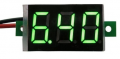
The device you showed (above) is much more complicated and a single LED -it appears to be some kind of digital panel meter. You will do better at this point to keep it simple and just use single LED as shown in post #20. The forward voltage of that LED is about 2V and a good current to operate the LED like that in post #20 is about 15 milliamps (0.015A).
From a 12 volt power supply your resistor would be (12V-2V)/.015A = 666Ω. You can use 620 or 680 ohms, the actual value is not critical.
I have a npn 2n2222 TO92 30V maximum transistor. I connected the + of a 12 V DC power source to a led, the led 2nd input to the collector, the base is unplugged and the emitter is connected to the minus of the source. I sketched this in a free app online(sorry if it looks like a 5 year old kid drawing). In the left is the circuit using conventional symbols, in th right is the same thing drawn with real life situation: View attachment 250377
My question is why is the led lit, when the base is unplugged? It shouldnt allow electricity to flow from collector to emitter if the base unplugged, correct? It looks like it allows and that completes the circuit and lit the led.
I got it working. The problem was with the 12 V DC Transformer. It was broken. I tried with an old laptop charcher that inputs 220 V AC from power outlet and outputs 19V DC. The transistor is working how intended now. Thank you.
Amp = Volts dropped / Ohms
19-1.3=17.7(volts to be dropped)
0.5 Amps(the laptop charger) = 17.7 / x ohms
x = 17.7 V / 0.5 Amps
x = 35.4 ohms
It doesnt seem a correct value
LaTeX is a bit of a pain to use, but formulas will be much easier to read if you use it. There's a sticky post in Homework Help that'll get you going. We usually use abbreviations for volts and amps.
\( R = \frac{V}{I} = \frac{19V-1.3V}{0.5A} = 35.4\Omega \)
The problem is that the LED current shouldn't be 0.5A unless it's a high power type. A more normal maximum continuous current would be 20mA, so the current limiting resistor would be more like 1kΩ. A Vf of 1.3V is a bit low.
Just because a maximum forward current is specified, that doesn't mean you have to operate the LED at it's maximum. For indicators, a few mA might be sufficient for standard brightness LEDs.
EDIT:
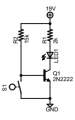
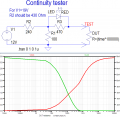
You can use this circuit to test your transistors and LEDs:
LED forward voltage = 2V
LED current = 9.5mA
Base current = 1.2mA
For a 2N2222, we assume Ib = 0.1Ic, so a 15k base resistor would support a collector current of 12mA. We assume a Vce(sat) of 0V for first order calculations.

 Facebook
 Google
 GitHub
 Linkedin