Facebook
 Google
 GitHub
 Linkedin
Good Day To All!
While salvaging components from a defective switch mode power supply, I tested the transformer (removed from the circuit board) and ended up puzzled.
When I connect the primary (120 vac), I can have a secondary of 12 vac. However, if I swap "Line" and "Neutral" on the primary, I get 16 vac across the secondary.
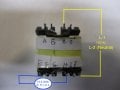
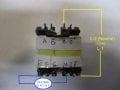
I am pretty confused as to why the secondary voltage changes when the primary phasing is reversed. At first I thought it might be because my test bench's isolation transformer is exactly that- the ground and neutral are not bonded. Next, I carefully tested with the iso trans bonded and got the same result. A search of the part number showed no data sheets to help me out. (Note that one of the secondary taps is common with one of the primary taps. Photos Attached)
Thinking age has caught up with my brain and I forgot something basic, I took a spare 40va transformer I have for my boiler and connected it to my isolation transformer. I can swap phases with no change in secondary voltage. (Phew! I'm not losing it...yet)
The only real experience I have with transformers is my former employment, but most of the transformers I installed or serviced were three phase and typically in the 480 vac to kV range. On those, one may swap phases A & C (and B if it was a Wye system) with no change in secondary voltage. I occasionally was called upon to swap out single phase transformers on unit heater controls or motor starters, or buck-boost transformers, but I never did any experimenting around with reversing primary phases.
What is causing a phase reversal to change the secondary voltage?
Thanks For The Education- I appreciate it!
Enjoy Today,
Paul
While salvaging components from a defective switch mode power supply, I tested the transformer (removed from the circuit board) and ended up puzzled.
When I connect the primary (120 vac), I can have a secondary of 12 vac. However, if I swap "Line" and "Neutral" on the primary, I get 16 vac across the secondary.
I am pretty confused as to why the secondary voltage changes when the primary phasing is reversed. At first I thought it might be because my test bench's isolation transformer is exactly that- the ground and neutral are not bonded. Next, I carefully tested with the iso trans bonded and got the same result. A search of the part number showed no data sheets to help me out. (Note that one of the secondary taps is common with one of the primary taps. Photos Attached)
Thinking age has caught up with my brain and I forgot something basic, I took a spare 40va transformer I have for my boiler and connected it to my isolation transformer. I can swap phases with no change in secondary voltage. (Phew! I'm not losing it...yet)
The only real experience I have with transformers is my former employment, but most of the transformers I installed or serviced were three phase and typically in the 480 vac to kV range. On those, one may swap phases A & C (and B if it was a Wye system) with no change in secondary voltage. I occasionally was called upon to swap out single phase transformers on unit heater controls or motor starters, or buck-boost transformers, but I never did any experimenting around with reversing primary phases.
What is causing a phase reversal to change the secondary voltage?
Thanks For The Education- I appreciate it!
Enjoy Today,
Paul
Attachments
-
 58.7 KB Views: 14
 -
 58.7 KB Views: 12