Topo Map with flashing LED

Bernard

Joined Aug 7, 2008
5,784
Presume that you have a 12 V power supply; connect a red LED in series with a 2k R to give 5 mA to check for
brightness, a 1k will give 10 mA. How many do you really want; early it was 300 now 100 ??
Replaced 1 W white with 3 red LED's & 330 ohm R along with 27 ohm in parallel to represent a load of 125 mA.
10 ohm load = 300 mA but is loading Cap. so discharge R has lost control
 

Bernard

Joined Aug 7, 2008
5,784
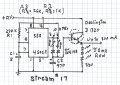
Pulsing LED's. Cycle time about 2 sec. up, 2 sec. down. Using a 2 stage timing arrangement allows adjustment of max. & minimum brightness, a lot of interaction between the 10 k pots. Pot settings, R3, charging, 7.6 k, R2, discharging, dim but not off, 1 k. C2 is large to hold impedance down so D 1320 does not load down the timing . Should be able to drive 110 LED's, or 180 if current lowered to 5 mA.
For transistor could try TIP 127, or make one from 2- 2N2222's at reduced current.
A better look might be achieved by using constant current charging of C2 by replacing R3 with a LM334, will look it up.
Transistor will need a heat sink, about 10 sq. in. as it is always drawing current as when driving a 10 ohm R
I'm sure this is clear as mud, but ask away.
PWM driver probably will not need a heat sink, could rStream # 16 00001.jpg un as many LED's as you wished. Should be labeled Stream # 18
 
Last edited:

Thread Starter

lednoob

Joined Jan 13, 2016
171
Pulsing LED's. Cycle time about 2 sec. up, 2 sec. down. Using a 2 stage timing arrangement allows adjustment of max. & minimum brightness, a lot of interaction between the 10 k pots. Pot settings, R3, charging, 7.6 k, R2, discharging, dim but not off, 1 k. C2 is large to hold impedance down so D 1320 does not load down the timing . Should be able to drive 110 LED's, or 180 if current lowered to 5 mA.
For transistor could try TIP 127, or make one from 2- 2N2222's at reduced current.
A better look might be achieved by using constant current charging of C2 by replacing R3 with a LM334, will look it up.
Transistor will need a heat sink, about 10 sq. in. as it is always drawing current as when driving a 10 ohm R
I'm sure this is clear as mud, but ask away.
PWM driver probably will not need a heat sink, could rView attachment 106721 un as many LED's as you wished.

I have a bunch of tip120 and tip125's. Will the Tip120 work?
 

Bernard

Joined Aug 7, 2008
5,784
What a find-- TIP 120 should be fine. I'll keep PNP , Darlington, TIP 125 in mind for future.
This circuit should drive 300 LED's, loaded it with about 5 ohms & kept on ticking.
 
Last edited:

Thread Starter

lednoob

Joined Jan 13, 2016
171
What a find-- TIP 120 should be fine. I'll keep PNP , Darlington, TIP 125 in mind for future.
This circuit should drive 300 LED's, loaded it with about 5 ohms & kept on ticking.

I have about 140 TIP120. My dad had it in a big bag. I have never used the Darlington before. Physically looks like a SCR to me
 

Thread Starter

lednoob

Joined Jan 13, 2016
171
I have about 140 TIP120. My dad had it in a big bag. I have never used the Darlington before. Physically looks like a SCR to me

Good morning, ok I bread boarded Wendy's PWM as you recommended and when I connect the power the LED's fade in and stay on until I turn the power off.I'm sure I need to do a little adjustment to the circuit for the power on & off circuit.
 

Thread Starter

lednoob

Joined Jan 13, 2016
171
Good morning, ok I bread boarded Wendy's PWM as you recommended and when I connect the power the LED's fade in and stay on until I turn the power off.I'm sure I need to do a little adjustment to the circuit for the power on & off circuit.

This is the circuit in the video that I originally asked you about and would like to add a bunch of LED's. I am estimating 300 LED's so If I can get the PWM to do this then it will be for the RED channel. I am hoping that the stream #15 / 16 will be for the blue channel of 100 - 150 LED's and maybe the green channel as well.


Bernard

Joined Aug 7, 2008
5,784
Are both oscillators operating ?, U 1-3 should be a slow square wave, U 2-3 about 1 kHz, can slow it down by
temp. replacing C 2 with 100 uF, period now about 1 sec. which you can see. Temp. disconnect U3-5 & connect wiper of a pot , top end to + 12 V, bottom to gnd. Vary pot from low to 4 V, LED's should be off, between 4 & 8 V , LED's flickering & dimming, above 8 V LED's flickering @ U2 rate. Replace C2 with .1, flicker should be gone, dimming follows pot.
 

Bernard

Joined Aug 7, 2008
5,784
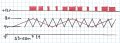
A graph might make it to see operation of comparator. Black triangle is the fast clock, from C2 going to -,
pin 6 of U3, red triangle is the slow clock from C1 to +, pin 5 of U3. When the V on + input is higher than
- input, the output will be +, pin 7, LED's - on. On graph, when ever the red line is above the black, the LED's will be on. If the fast clock is above 30 Hz, then eyes will not notice the flicker.
After you have it working, and do not want the LED's to completely go dark, you could try connecting a pot, around 100k, fromU2-5 & ground to bring black line down a bit. I have not tried this.Stream # 19 00000.jpg
 

Thread Starter

lednoob

Joined Jan 13, 2016
171
Are both oscillators operating ?, U 1-3 should be a slow square wave, U 2-3 about 1 kHz, can slow it down by
temp. replacing C 2 with 100 uF, period now about 1 sec. which you can see. Temp. disconnect U3-5 & connect wiper of a pot , top end to + 12 V, bottom to gnd. Vary pot from low to 4 V, LED's should be off, between 4 & 8 V , LED's flickering & dimming, above 8 V LED's flickering @ U2 rate. Replace C2 with .1, flicker should be gone, dimming follows pot.
the on & off video is replacing C2 .1 to 100uf only. The 2nd video is adding the pot to U3-5 and c2 back to .1. 4.29 v to U3-5. I tried adjusting R2 and no real change. The U3-5 pot varies the brightness but can't get the fade in & out yet.


Thread Starter

lednoob

Joined Jan 13, 2016
171
the on & off video is replacing C2 .1 to 100uf only. The 2nd video is adding the pot to U3-5 and c2 back to .1. 4.29 v to U3-5. I tried adjusting R2 and no real change. The U3-5 pot varies the brightness but can't get the fade in & out yet.


so here is a rough but very close estimate red led's fade in & out about 150 led's. blue chase led's = 65 and green = 50.
 

Thread Starter

lednoob

Joined Jan 13, 2016
171
Still waiting for answer to post # 269.
I believe both oscillators are working. I have pulsing from both 555 timers. I don't have an O scope. Was dropped during a move. Here is the latest video. I have the voltage to U3-5 about 4.2 volts. 1st video is with c2 =100uf . 2nd video is c2 = .1 very little dimming when turning the pot


Bernard

Joined Aug 7, 2008
5,784
I haven't a clew as what is going on. Guess I'll try bread boarding it.
As you seemed to want Stream # 15 inverted, ie LED s mostly off, with one in 4 on, made a short video
which keeps getting lost on you tube, but can be found at 100 0056, Bernard.
 
Last edited:

Thread Starter

lednoob

Joined Jan 13, 2016
171
I haven't a clew as what is going on. Guess I'll try bread boarding it.
As you seemed to want Stream # 15 inverted, ie LED s mostly off, with one in 4 on, made a short video
which keeps getting lost on you tube, but can be found at 100 0056, Bernard.
The other circuit I like is your stream # 14 & 16 that you were going to breadboard it. That marquee design will look cool.
 

Bernard

Joined Aug 7, 2008
5,784
PWM bread boarded with no glitches. Video on you tube, 100 0057 Bernard.
Values used: C 1 = 100 uF, R 1-2 = 15k, ( R 1 not used ), R 3 = 3k9, C 2 = 1 uF, R 4 = 1 k.
Q 1-2 not used, U 3-7 to gate of Q3, N ch. FET SM, 3055V. LED,s aquablue, 5 mm, 2.4 Vf, R's 3k9.
Connected U 1 & U 2 one at a time & checked before connecting to comparator, Grounded LED cathodes to be sure that all came on, connected FET & tested - gate grounded, LED's off, gate + 12 V- all LEDs on. Connected gate to U3-7 & tested- LED's pulsing going full on & full off. Connected 100 k pot. to + & -, ct. to U 1- 5, raised pin 5 from 8 V to where LED's just stayed on at minimum brightness.
 

Thread Starter

lednoob

Joined Jan 13, 2016
171
PWM bread boarded with no glitches. Video on you tube, 100 0057 Bernard.
Values used: C 1 = 100 uF, R 1-2 = 15k, ( R 1 not used ), R 3 = 3k9, C 2 = 1 uF, R 4 = 1 k.
Q 1-2 not used, U 3-7 to gate of Q3, N ch. FET SM, 3055V. LED,s aquablue, 5 mm, 2.4 Vf, R's 3k9.
Connected U 1 & U 2 one at a time & checked before connecting to comparator, Grounded LED cathodes to be sure that all came on, connected FET & tested - gate grounded, LED's off, gate + 12 V- all LEDs on. Connected gate to U3-7 & tested- LED's pulsing going full on & full off. Connected 100 k pot. to + & -, ct. to U 1- 5, raised pin 5 from 8 V to where LED's just stayed on at minimum brightness.

can you post your schematic?
 
Top