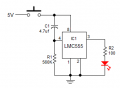
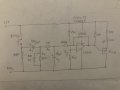
A rising edge triggered timed pulse with an automated reset of the output, NOT USING A 555 timer, with two in a single package, can be done with a CD4027 DUAL JK flipflop wired as a flopshot. That allows an adjustable delay using lower capacitor values for the timing portion, and having the input strictly edge triggered. One resistor from the "Q" output to the associated R input, and a suitable capacitor from that "R" input to common. The "J" input held high and the "K" input, sand "set" tied low. The button to +5 volts to the trigger input with 10K ohms to common. The "Q" output also drives the gate of the mosfet as shown in post #1.
The benefit is a much lower standby current , and the bigger benefit is it does not use a 555 timer.
THAT circuit requires that the button be held the entire time. I have included the flop-shot circuit in a standard product and it works well. The reset is not so very demanding on a fast rise time.
For rapid turn-off you can use a schmitt trigger made out of popular LM393 comparator.
The R1 & C1 sets the 5sec timing (change C1 for precise tuning), the R2 & C2 forms a low pass filter to debounce the button transitions.
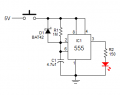
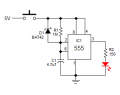
The schottky diode like Bat46 quickly discharges the C1 after button is released to be ready for the next button press.
I quite like the idea of this one.
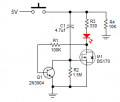
Am i correct in thinking that as the Gate voltage of M1 starts to fall, the voltage at the Drain will rise as M1 is not 'fully' On?
once the drain voltage gets to >0.6V, Q1 turns on and pulls the gate of M1 to GND, therefore turning off M1 immediately?
The time-out for the circuit with a MOSFET can vary significantly due to the wide value that its Vgs(th) can have from unit to unit (0.8V to 3V).
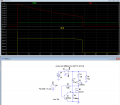
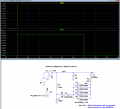
Below is the sim of a simple circuit using the low-cost TLV431 voltage reference configured as a comparator, which has a precise Ref switch point of 1.24V.
The CD4027 circuit is simple, and you get two complete systems in one IC. One resister and one capacitor per system. And it can work from 4 volts to 15 volts.
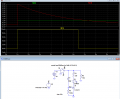
Below is the sim of a simple circuit using the low-cost TLV431 voltage reference configured as a comparator, which has a precise Ref switch point of 1.24V.
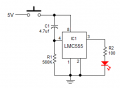
If you look at all of these circuits from the point of view of constants and variables. the constants are the circuit elements that are in all designs: a switch, the LED, its resistor, one timing R and one timing C. Everything else - other R's, other C's, transistors, IC's, etc. - are variables. The #35 circuit has only one such part, and its is only 3 pins.
I think that's the winner.
(I'm not counting the discharge resistor because it does not serve an explicit requirement.)
ak
One of these years I'll remember the 431 *before* Carl uses it.
The CD4027 circuit is simple, and you get two complete systems in one IC. One resister and one capacitor per system. And it can work from 4 volts to 15 volts.

 Facebook
 Google
 GitHub
 Linkedin