Facebook
 Google
 GitHub
 Linkedin

Hello everyone...
For some time now I've been thinking about developing a new way to control/command, sets of thyristors in anti-phase, using pulse width modulation (PWM), with zero-crossing synchronization (ZC).
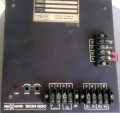
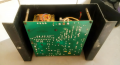
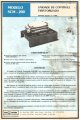
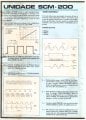
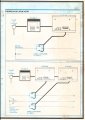
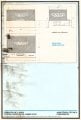
In fact, I had already used such resources, in temperature control for large industrial electric furnaces, especially for heat treatment and aluminum casting. Photos of the equipment already in use are attached, as well as a brochure with the respective datasheet.
PS: The equipment is old and was produced in Brazil, therefore with information in Portuguese.
If you observe the details you will understand that the equipment received an analog signal, from the temperature controller (PID) with a normalized range of 4-20 milliamperes; then the signal would be compared to the internal ramp voltage, determining an enable signal for firing the thyristors (with two phases in anti-parallel), always at the zero crossing.
The idea is to apply the same concept (PWM + ZC) to the speed control of induction motors; replacing noisy thyristor circuits with phase control. I believe the control could enable each half-cycle of the mains voltage, in a sequence of up to 127 half-cycles; because the mechanical inertia of any induction motor, allows the use of a train of half-cycles without any problem; in addition to canceling that characteristic 60 Hz hum (or 50 Hz depending on the mains).
To date, the only specialized IC I know for integrating a thyristor firing control is the TCA785; and the application requires phase control, which I intend to avoid.
For some time now I've been thinking about developing a new way to control/command, sets of thyristors in anti-phase, using pulse width modulation (PWM), with zero-crossing synchronization (ZC).
In fact, I had already used such resources, in temperature control for large industrial electric furnaces, especially for heat treatment and aluminum casting. Photos of the equipment already in use are attached, as well as a brochure with the respective datasheet.
PS: The equipment is old and was produced in Brazil, therefore with information in Portuguese.
If you observe the details you will understand that the equipment received an analog signal, from the temperature controller (PID) with a normalized range of 4-20 milliamperes; then the signal would be compared to the internal ramp voltage, determining an enable signal for firing the thyristors (with two phases in anti-parallel), always at the zero crossing.
The idea is to apply the same concept (PWM + ZC) to the speed control of induction motors; replacing noisy thyristor circuits with phase control. I believe the control could enable each half-cycle of the mains voltage, in a sequence of up to 127 half-cycles; because the mechanical inertia of any induction motor, allows the use of a train of half-cycles without any problem; in addition to canceling that characteristic 60 Hz hum (or 50 Hz depending on the mains).
To date, the only specialized IC I know for integrating a thyristor firing control is the TCA785; and the application requires phase control, which I intend to avoid.
Attachments
-
 775.1 KB Views: 9
 -
 520.4 KB Views: 12
 -
 387 KB Views: 12
 -
 339.5 KB Views: 14
 -
 249.3 KB Views: 13
 -
 286.4 KB Views: 11