Thoughts on a high frequency function generator.

OBW0549

Joined Mar 2, 2015
3,566
Wow. Nice!

I'm interested in how this is developing, and how the final result works out. This is some pretty serious engineering!
 

Thread Starter

RichardO

Joined May 4, 2013
2,270
I'm interested in how this is developing, and how the final result works out. This is some pretty serious engineering!
Here are some quickly made pictures of the triangle waves. The top waveform is at the output of the buffer amp and the bottom waveform is at the input of the buffer amp.
All the waveforms were done at 1 v/div.

The reason that the 20 MHz triangle at the output of the buffer amp is so large is that the comparator, flip-flop and current switch (and the buffer amp as well) take too long to switch the polarity of the charging current at the peaks of the triangle.

5MHz.JPG 10MHz.JPG 20MHz.JPG

p.s. Too quick with the pictures... I am not completely sure of the frequencies and the 10MHz picture is cropped funny. :oops:
 

OBW0549

Joined Mar 2, 2015
3,566
I wonder what that odd "jump" at the leading edges of the triangle wave (i.e., right after the ramp changes direction)? It almost looks like the waveform you get when you rapidly charge/discharge a capacitor having significant ESR, but it isn't clear to me how that could possibly be the case here.
 

Thread Starter

RichardO

Joined May 4, 2013
2,270
I wonder what that odd "jump" at the leading edges of the triangle wave (i.e., right after the ramp changes direction)? It almost looks like the waveform you get when you rapidly charge/discharge a capacitor having significant ESR, but it isn't clear to me how that could possibly be the case here.
ESR, maybe. Thanks for the reminder. The cap I am using is silver mica -- from who knows when. It is only 36pf so the SBB contacts are a significant amount of the total timing capacitance. The combination, has, no doubt, really ugly characteristics at these frequencies.

I suspect that ceramic caps aren't much better than the silver mica caps here. I know Pease said you should never use ceramic caps in critical circuits. I need to check his book to see his exact complaints.
 

Thread Starter

RichardO

Joined May 4, 2013
2,270
I wonder what kind of contact resistance you're getting on the SBB, also. Didn't think of that earlier.
I don't expect it to be high enough to be a problem at +/- 6ma. I should be able to see a glitch in the very peak of the triangle wave at lower frequencies. I will double check but I don't remember seeing any glitch like that.

I am still guessing it is related to the quality of the timing cap. Wait.... Maybe it is some of the square wave used to switch the polarity of the current that is coupling into the timing cap circuit.
 

Thread Starter

RichardO

Joined May 4, 2013
2,270
Now, that's a possibility...
Another great idea shot down by reality. I looked at the square wave the switches the 2I current source on and off. The glitch does _not_ happen at the switching time.

This is one I am going to have to think about a bit. Probably some kind of artifact of the SBB implementation. But it needs to be pusued just in case it isn't.
 

Thread Starter

RichardO

Joined May 4, 2013
2,270
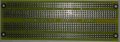
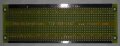
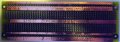
I am making some progress on the function generator. Here is a list of the major changes:

I have upgraded the current switch to use MMBTH81 transistors. They are higher frequency, lower capacacitance transistors than what I was using.

I put the SMD MMBTH81 and PECL termination parts on another SIP to reduce the number and length of jumpers on the SBB. All of the parts are surface mounted onto a 0.050" grid, through-hole prototyping board

I converted the existing SIP's to smaller diameter connector pins so they can plug into IC sockets as well as the SBB.

I now have SIP's for the current source, current switch, dual voltage comparator, PECL flip-flop and the FET gain-of-2 op-amp.

I have put copper tape onto a solder version of an SBB to create power and ground planes. I will be installing IC sockets for the SIP's. I will then add the remaining parts such as power supply bypassing, jumpers and the few parts that go between the SIP's.

In addition to having better power and ground distribution, the PCB has much less capacitance between contact strips. I am guessing that it is less than 1/3 as much.
(See the pictures).

I have been operating right at the limit of the power that the charge pump that supplies -5 volts can deliver. There was no power available to prototype the sine shaper circuit. I built a dedicated plus and minus 5 volt power supply that plugs into the SBB -- and eventually the soldered version with power and ground planes.

I am also doing simulations of the sine shaper. More to follow on that.

PCBB_front.JPG PCBB_back.JPG Tape_front_2.JPG Tape_back_2.JPG
 

Thread Starter

RichardO

Joined May 4, 2013
2,270
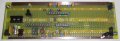
I have soldered parts to the board having the copper tape. I haven't applied power yet. I wanted you to see what it looks like before I blow something up. ;)

The 14-pin IC socket at the left will hold a DIP switch to select the timing cap. Up and to the right of the IC socket is a connector for the frequency pot. In the lower, right hand corner is the connector for power.

Passives.JPG
 

WBahn

Joined Mar 31, 2012
32,849
Out of curiosity. Have you ever considered fabbing some of those soldered breadboards of yours with the copper cladding intact so that you didn't have to use the foil? Do you find that the foil bus patterns are too different from project to project to allow that?
 

Thread Starter

RichardO

Joined May 4, 2013
2,270
Out of curiosity. Have you ever considered fabbing some of those soldered breadboards of yours with the copper cladding intact so that you didn't have to use the foil? Do you find that the foil bus patterns are too different from project to project to allow that?
Actually, this is the first time I have added the foil. I would consider adding the copper to the SBB on future versions. (I would also consider beefing up the power buses and maybe even specifying thicker copper).

The biggest danger is the added capacitance. It might be harder to remove unwanted "ground plane" than to add it like I have done here. Probably, not but.... I sometimes use a power bus for a long trace. This is usually when I don't want a long jumper going a good portion of the length of the board.

I think I would want the power and ground strips on both sides of the board. The tricky part might be getting the boards fabb'ed with plated holes to connect to the copper strips without getting the rest of the holes plated through. I would also need some solder mask if I put copper strips on the top side of the PCB. I would be inclined to leave the solder mask off the bottom side of the board to make it easier to connect to the power and ground planes by soldering.

The board in the picture is a pain in the ***. It has plated through holes. This makes it hard to use bare jumper wires without the danger of shorting to holes that the wire passes over. Considering the cost of PCB's made in China I might just try getting some new boards made.

p.s. I am, in general, happy with the results of adding the copper tape. If I have created a power to ground short in some way, I may change my mind. :eek:
 

Thread Starter

RichardO

Joined May 4, 2013
2,270
Not a good start. I immediately found I had forgotten to install 2 insulated jumpers. Once these jumpers were in, the circuit worked the first try. :D

Well it works but not as well as I had hoped. There is a strange oscillation. It is not too bad at high frequencies but gets worse the larger the timing cap. With larger timing caps it comes in bursts at one tip of the triangle wave. The oscillation is at about 150 MHz. I had seen this on the SBB and assumed that it would go away on the soldered version. Oh, well. Something new I will get to learn. :)

My best guess, right now, is that the op-amp is oscillating. I need to try putting a small resistor in series with its non-inverting input. Since the oscillation mostly occurs on one slope of the triangle it might be a oscillation in the current source or current switch.

More gory details to follow.
 

OBW0549

Joined Mar 2, 2015
3,566
The op amp would be my prime suspect for the oscillations, also. My experience with wideband op amps is that they are finicky little critters...
 

Thread Starter

RichardO

Joined May 4, 2013
2,270
The op amp would be my prime suspect for the oscillations, also. My experience with wideband op amps is that they are finicky little critters...
Probably doesn't help that it is hand wired on a pad per hole proto board -- Carefully hand wired but...

The fact the oscillation is mostly on one slope of the triangle wave makes me think it isn't the op-amp. Unless, the op-amp bypassing is not good enough on one power supply. Have you ever seen an op-amp oscillate on only one edge of a transition? I am not sure that I have but I can see how it might be possible.
 

Thread Starter

RichardO

Joined May 4, 2013
2,270
Sorry if I got it wrong. Are you actually using the LH002? Learnt that they were discontinued long time ago.
I have used them in the past but they won't work in this project. I played around with "improved" versions in LTspice. Again they were interesting but not useful for what I am doing. By the way, I think National came out with a monolythic version of the LH0002 but I don't think it performed quite as well. I don't know if it is still available.

The biggest limitation of the amplifier I need is that it must be FET input and have a massive gain bandwidth product (over 1 GHz) at a voltage gain of 2. The slew rate "only" has to be about 1000v/us.

The best part I have found is the OPA653. I have hand-wired an ADA4817 for the prototype. It is the ADA4817 that might be oscillating.
 
Top