The ProbeScope Project

Thread Starter

MrChips

Joined Oct 2, 2009
34,810
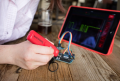
Inspired by a conversation with @cmartinez in another thread, I am starting this thread with a proposal to make a ProbeScope similar to this but with some differences.


Pokit Pro
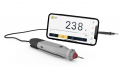
1691362558405.png

https://www.pokitinnovations.com/pokit-pro/

https://www.kickstarter.com/projects/pokitmeter/pokit-pro

Let us outline the basic specifications as an oscilloscope probe.

10mV to 600VDC
12-bit 1Msps
US$95 Kickstarter
Price: $298

Edit: After two days, I only just watched the video. Now I noticed that it does link to a smart phone wirelessly. Nevertheless, I will continue on with this project.
 

Thread Starter

MrChips

Joined Oct 2, 2009
34,810
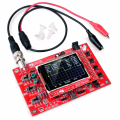
This popular hobby oscilloscope is sold as a kit or assembled.

DSO138
1691363285069.png

It is based on an STM32F103C8T6 MCU.

10mV/DIV - 5V/DIV
0-200kHz
12-bit 1Msps
US$15-$50

(As tested, 500kHz sampling rate, 0-100kHz usable range.)
 

Thread Starter

MrChips

Joined Oct 2, 2009
34,810
Proposed Specifications of ProbeScope

Model 1

10mV-10VDC
12-bit 2.5Msps
0-500kHz
Bluetooth to separate smart phone or Android tablet

Model 2
10mV-10VDC
12-bit 50Msps
0-10MHz

Challenges
Size
Packaging
Battery life
Cost
 

Thread Starter

MrChips

Joined Oct 2, 2009
34,810
How to proceed

Since I am very familiar with STM32F407 and I have working development boards for this, I will begin with programming this MCU.
Later, I will migrate to a low power STM32 MCU.

Model 1 will use the on-board 12-bit 2.5Msps ADC.
Model 2 will use an external 12-bit 50Msps ADC.

There is an option to add FFT capability.
 

Thread Starter

MrChips

Joined Oct 2, 2009
34,810
Getting Started

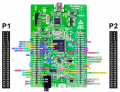
I have the STM32F4 Discovery board based on STM32F407VGT6.
1691417375921.png

I also have my own STM32F407VGT6 boards from previous projects. Hence, I am going to begin with one of these.
I will be using IAR Embedded Workbench IDE since I prefer its debugging features. At a later date I might port to STM32CubeIDE which is free.

STM32F407VGT6 100-LQFP has two 12-bit DACs and three 12-bit ADCs.
The maximum sampling rate of a single ADC is 2.4Msps. With triple interleaving, we can achieve 7.2Msps.
For now, we will begin with the single ADC.

I will be using the following pins on the 100-LQFP.

PA0 ADC1 channel-0 pin-23

PA4 DAC_OUT1 pin-29
PA5 DAC_OUT2 pin-30

PA8 MCO1 pin-67
PB12 GPIO pin-51


Initial Performance Test

The STM32F407 core is initially set to run at 168MHz. In order to confirm this, PA8 on pin-67 is configured to output MCO1, which is 42MHz.
At a later date I will attempt to run it at 200MHz.

Basic GPIO Test

Using GPIO library functions

C:
void main(void)
{
  HW_Init();
  while(1)
  {
     GPIO_SetBits(GPIOB, GPIO_Pin_12);
     GPIO_ResetBits(GPIOB, GPIO_Pin_12);
  }
}
HIGH = 40ns
LOW = 45ns
Period = 85ns

Basic GPIO Toggle direct to register
C:
void main(void)
{
  HW_Init();
  while(1)
  {
     GPIOB->ODR ^= GPIO_Pin_12;
  }
}
HIGH = 35ns
LOW = 35ns
Period = 70ns

End of basic GPIO tests
 

Thread Starter

MrChips

Joined Oct 2, 2009
34,810
This looks great. When you start selling the kits, I will certainly buy one.
I am not into this to make money. I am doing this for the fun, challenge, and gaining experience.
I doubt that I will be able to bring the cost down to a competitive price. When this is completed I will share it with all on AAC. I may have to retain the IP in the source code except if there are others who would like to contribute to the code development.
 

Thread Starter

MrChips

Joined Oct 2, 2009
34,810
Do you have a cost estimate for Model 2?
It's too early to say. My HW costs are looking around US$50.
The Android display is free, i.e. you supply your own as a smart phone or tablet. I will be developing this for the Amazon Fire 7 tablet (about US$70) which I already have.
 

dl324

Joined Mar 30, 2015
18,326
The Android display is free, i.e. you supply your own as a smart phone or tablet. I will be developing this for the Amazon Fire 7 tablet (about US$70) which I already have.
It would be nice if you could support old phones/tablets/android versions so they can be used for something useful.
 

Thread Starter

MrChips

Joined Oct 2, 2009
34,810
It would be nice if you could support old phones/tablets/android versions so they can be used for something useful.
That would certainly be a goal. We will start with one device and then try to port it to others. At the moment, it has to be an Android device.
 

Ya’akov

Joined Jan 27, 2019
10,235
That would certainly be a goal. We will start with one device and then try to port it to others. At the moment, it has to be an Android device.
In the future it might be worth considering using WiFi or BT as the interface. There are two two possibilities for this approach. One is to use it to haul data to am app running on the device. but my preference would be the second possibility, that is tun a web server on ProbeScope (could be a small. dedicated ESP MCU providing the WiFi and the cycles for the web server.

If the interface was designed to run in a browser. to would also be compatible with tablets. laptops. and desktops.
 

Ya’akov

Joined Jan 27, 2019
10,235
In the future it might be worth considering using WiFi or BT as the interface. There are two two possibilities for this approach. One is to use it to haul data to am app running on the device. but my preference would be the second possibility, that is tun a web server on ProbeScope (could be a small. dedicated ESP MCU providing the WiFi and the cycles for the web server.

If the interface was designed to run in a browser. to would also be compatible with tablets. laptops. and desktops.
I think I misinterpreted that photo and this is already wireless so then the second part (web interface over WiFi) is the relevant bit.
 

Thread Starter

MrChips

Joined Oct 2, 2009
34,810
Preliminary ADC and DAC tests
C:
void main(void)
{
  uint16_t v;
  HW_Init();
  DAC_Init();
  ADC_Init();
  while(1)
  {
     GPIO_SetBits(TEST_PORT, TEST_PIN);
     GPIO_ResetBits(TEST_PORT, TEST_PIN);
     v = ADC_Read(0);
     DAC_SetChannel2Data(DAC_Align_12bR, v);
  }
}
ADC input range = 0-3V
DAC output range = 0-3V
Sampling frequency = 350kHz

The ADC is sampled and the data is output to the DAC for confirmation.
This is with polled ADC conversion flag. I will be using DMA in the final product.

I am going to work on the Android display next.
 

Janis59

Joined Aug 21, 2017
1,894
There must mention the more actual problem is the abnormal price for opto-isolated probes imminent for adjusting the high power H-bridges of SMPS. Nowadays best DIY is 50-70 MHz however I see the component basis up to 160 MHz, but 200-300 MHz probe from LeCroy is obsolete, and other producers demand 60 000 USD.... 90 000 USD etc head spinning wonderprices. Oscillo MUST have a 4 or better 8 channels what all are isolated by optical thread. The best optotransmitter-receiver for a while I have found is HFBR1406/2406. The best architecture for it driving I have find is FOC6031 H-bridge steered by input signal. Sure if the near 200 MHz is got, the unit would be brilliant market product.
 
Last edited:

Thread Starter

MrChips

Joined Oct 2, 2009
34,810
There must mention the more actual problem is the abnormal price for opto-isolated probes imminent for adjusting the high power H-bridges of SMPS. Nowadays best DIY is 50-70 MHz however I see the component basis up to 160 MHz, but 200-300 MHz probe from LeCroy is obsolete, and other producers demand 60 000 USD.... 90 000 USD etc head spinning wonderprices. Oscillo MUST have a 4 or better 8 channels what all are isolated by optical thread. The best optotransmitter-receiver for a while I have found is HFBR1406/2406. The best architecture for it driving I have find is FOC6031 H-bridge steered by input signal. Sure if the near 200 MHz is got, the unit would be brilliant market product.
The goal of this project is to see what can be accomplished with little hardware. The goal is not to compete with existing products or even bring it to market.

200MHz bandwidth would certainly be nothing short of miraculous.
Hobby market scopes can barely achieve 100kHz.
Achieving 500kHz on a bare bones MCU would be my first goal.
10MHz would be even sweeter for a DIY project.

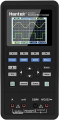
Hantek 2D42 is spec'd at 40MHz.
Hantek 2D72 is 70MHz.

1691589587597.png
 

cmartinez

Joined Jan 17, 2007
8,762
More competition

Aeroscope

Boulder, Colorado, U.S.A.

100mV, -40V to 40V
BW = 20MHz
Sampling rate = 100Msp
US$199

View attachment 300360

https://www.fabtolab.com/aeroscope-wireless-oscilloscope
That would be single channel, I assume? ... Still, 20 MHz is a very respectable bandwidth, for a device of such a size.

I honestly think that the best market would be one in which a device exploits as much computational power as possible from a smartphone or a tablet. What I don't get is why said devices tend to cost so much, considering what they do.
 
Top