the point I don't understand about signal systems

Thread Starter

circuit975

Joined Jun 13, 2024
43
i sincerely greet the entire community

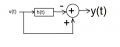
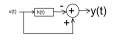
i have difficulty understanding the output of this system, i.e. y(t), I have difficulty understanding

y(t) = v(t) − h(t)*y(t)

I know this is the right output. but I need to understand the logic of how this happened.
actually, what I see is this: y(t) = v(t) - [v(t)*h(t)]
but if it is true, as I said above, y(t) = v(t) − h(t)*y(t)

if anyone knows what the logic of this is, I would be very glad if they would explain.
every answer given will be referred to with gratitude.


1751750084809.png
 

Attachments

WBahn

Joined Mar 31, 2012
32,703
In early FORTRAN, that line would mean Replace y(t) with the value of v(t) − h(t)*y(t)
So?

This isn't FORTRAN. It's a system block diagram that graphically represents the mathematical relationships between signals. The relationship that it depicts is

y(t) = v(t) - h(t)*v(t)

The TS needs to give move information on where y(t) = v(t) − h(t)*y(t) came from. Why does he think that that's what it's supposed to be? Is that the solution given in some example problem?

It's very likely just a simple typo. It's also possible that the TS misread a 'y' for a 'v' in that last term.

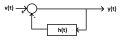
It's also possible that he's trying to force the equation for the typical feedback system to apply to this one.

1751773788462.png

Though this really isn't correct as h(t) would likely be the impulse response of the feedback network that must be convolved with the output. This signal diagram would usually be depicted in the frequency domain such that Y(s) is multiplied by the H(s), the frequency response of the feedback network.
 

MrAl

Joined Jun 17, 2014
13,667
i sincerely greet the entire community

i have difficulty understanding the output of this system, i.e. y(t), I have difficulty understanding

y(t) = v(t) − h(t)*y(t)

I know this is the right output. but I need to understand the logic of how this happened.
actually, what I see is this: y(t) = v(t) - [v(t)*h(t)]
but if it is true, as I said above, y(t) = v(t) − h(t)*y(t)

if anyone knows what the logic of this is, I would be very glad if they would explain.
every answer given will be referred to with gratitude.


View attachment 352253
Hi,

I think some of this has already been said but I'll just throw in a little more here ... assuming the asterisk represents a multiplication for now.

If you look at
y(t) = v(t) − h(t)*y(t)
as a sampled system then it could really be more like this:
y(n)=v(n)-h(n)*y(n-1)
and that would be very common.

If you view it as a linear system, also very common, then it would translate into:
y(t)=v(t)/(h(t)+1)
or reducing the symbols to just y, v, and h (all functions of 't'):
y=v/(h+1)
although this would make more sense if they were functions of 's':
y(s)=v(s)/(h(s)+1)

Of course with more context we may be able to be more specific about what the original authors intent was.
For example, does the asterisk '*' in the original equation represent multiplication or a convolution.
 

Thread Starter

circuit975

Joined Jun 13, 2024
43
In early FORTRAN, that line would mean Replace y(t) with the value of v(t) − h(t)*y(t)

1751781103232.png


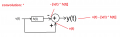
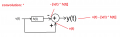
sir, I already know that's the answer, I'm telling you again how it happened. for example, I am also sending you what the shape I see is like. it needs logic in this way
 

Thread Starter

circuit975

Joined Jun 13, 2024
43
So?

This isn't FORTRAN. It's a system block diagram that graphically represents the mathematical relationships between signals. The relationship that it depicts is

y(t) = v(t) - h(t)*v(t)

The TS needs to give move information on where y(t) = v(t) − h(t)*y(t) came from. Why does he think that that's what it's supposed to be? Is that the solution given in some example problem?

It's very likely just a simple typo. It's also possible that the TS misread a 'y' for a 'v' in that last term.

It's also possible that he's trying to force the equation for the typical feedback system to apply to this one.

View attachment 352277

Though this really isn't correct as h(t) would likely be the impulse response of the feedback network that must be convolved with the output. This signal diagram would usually be depicted in the frequency domain such that Y(s) is multiplied by the H(s), the frequency response of the feedback network.

I didn't understand exactly what you wanted to say, could you make it shorter and clearer? how is the answer like this?
 

Thread Starter

circuit975

Joined Jun 13, 2024
43
Hi,

I think some of this has already been said but I'll just throw in a little more here ... assuming the asterisk represents a multiplication for now.

If you look at
y(t) = v(t) − h(t)*y(t)
as a sampled system then it could really be more like this:
y(n)=v(n)-h(n)*y(n-1)
and that would be very common.

If you view it as a linear system, also very common, then it would translate into:
y(t)=v(t)/(h(t)+1)
or reducing the symbols to just y, v, and h (all functions of 't'):
y=v/(h+1)
although this would make more sense if they were functions of 's':
y(s)=v(s)/(h(s)+1)

Of course with more context we may be able to be more specific about what the original authors intent was.
For example, does the asterisk '*' in the original equation represent multiplication or a convolution.
yes, the expression "* " means convolution, but unfortunately I can't understand what you're saying, you've written very confused
 

MrAl

Joined Jun 17, 2014
13,667
yes, the expression "* " means convolution, but unfortunately I can't understand what you're saying, you've written very confused
Hi,

What part did you not understand?
Was it the last part where an explicit equation was developed from your original statement equation?
That comes from solving the equation for an explicit result for y(t), which would be common in the frequency domain.

If it was the sampled system, that's just the way we look at things that have the same variable on both sides of the equal sign like for this simple example:
y=1+2*y
we usually think of 'y' as being sampled, so that there are different values of 'y' over time that come about with a change in the clock. We convert it to this:
y(n)=1+2*y(n-1)
or how it is more usually written:
y[n]=1+2*y[n-1]
Here, if y[n-1] was equal to 3, then y[n] would become equal to 1+2*3=6. That value of '6' would then become the value of y[n-1] at the next clock pulse, so then we would get:
y[n]=1+2*6=13

If this:
y=1+2*y
was a regular linear system (not sampled) then we could perhaps solve for 'y' using algebra:
y-y=1+2*y-y
0=1+y
y=-1

Since the asterisk is for convolution, it could be that they simply want you to take the Laplace Transform of everything and solve for Y(s).
We would need more info about this problem, such as what you did in previous exercises up to this point, or what book this came from and page snapshot.

If any of this or the previous is not clear, simply point out which part does not seem to make sense and I'll try to help.
 
Top