Connecting DC BUS (-V) of two VFDs at single point.

Thread Starter

Mussawar

Joined Oct 17, 2011
157
Hi,
I've two VFDs (400V Class). There DC bus voltage may rise up to 850V. I need to sense these voltage by a single circuit board for further use.
My question is: Can I connect DC Bus -V terminals of both VFDs together and further connect it to circuit board common GND?
I've already connected single VFD's -V terminal to circuit board common GND and there is no problem. But in case of two VFDs I'm not sure.
Please see attachment for more details.
Any help is really appreciated.
Thanks and Regards. :)
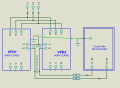
VFD.png
 

Pyrex

Joined Feb 16, 2022
501
Hi
The first point would be:
Are both VFDs turned on together?In other words, are they energized by the same switch?
If not, then measuring the DC buss voltage with the same PCB is not possible at all.

Second point - both VFDs have separate DC buss capacitor charging circuits, so their DC buss cannot be tied directly.

Also keep in mind that both VFDs have their own DC bus monitoring circuits, and it is unclear how they will react when the DC voltage does not match the motor operating mode
 

Thread Starter

Mussawar

Joined Oct 17, 2011
157
Thanks for reply.
Are both VFDs turned on together?In other words, are they energized by the same switch?
Both VFDs are energized by same switch as shown in diagram.
Second point - both VFDs have separate DC buss capacitor charging circuits, so their DC buss cannot be tied directly.
Both DC Bus are not intended to be connected in parallel. Only (-) terminals are required to be common.
Also keep in mind that both VFDs have their own DC bus monitoring circuits, and it is unclear how they will react when the DC voltage does not match the motor operating mode.
Is there any suggested solution that I can input both both voltage in a single circuit? Currently I'm using a resistor voltage divider network to scale down the voltage and input them to ADC for further processing.
It's working fine with single VFD, but now the second VFD is involved.

Regards.
 

Pyrex

Joined Feb 16, 2022
501
OK, I got it.
Do you have the schematics of these VFDs, I mean the power part? I'm interested in the schematic of the AC/DC rectifier, how the rectifier is made, and how the soft starter is made.(The soft starter limits the charging current of the DC buss capacitors)
 

MisterBill2

Joined Jan 23, 2018
27,164
Certainly the first step is for me to ask if they are the same model of the same brand . That would make the whole job a bit easier.
then the second step would be to measure the voltage between low-side to low-side, first with the motors stopped but the drives on, But you have already done that,and tied them together.. Also check the voltages between the high sides. with the motors running.
In many VFDs there are sections that are sort of separated, with the first section being the DC buss supply and the second section being the variable frequency switching circuit, which does both driving and braking. If the bus supply is not isolated then there might be a challenge. With the negative common already tied there might not be any problem. maybe. At this point I recommend contacting the drive manufacturer, or, possibly if they came from a seller with good customer support. Some sellers have great application engineers who have already done a lot. Some distributors lack that asset. A simple check will be to connect the positive bus terminals to a center point using two 10K half watt resistors. If the resistors do not burn up in a day then it could work out , if the resistors immediately burn up, then the job will be more complex.
Often, manufacturers have a lot of information as to how it can work. BALDOR used to provide a lot of information, 20 years ago, they did.
 

Thread Starter

Mussawar

Joined Oct 17, 2011
157
OK, I got it.
Do you have the schematics of these VFDs, I mean the power part? I'm interested in the schematic of the AC/DC rectifier, how the rectifier is made, and how the soft starter is made.(The soft starter limits the charging current of the DC buss capacitors)
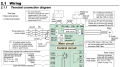
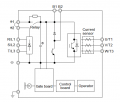
Unfortunately, system is built for general purpose; means different brands of VFDs might be used. Mostly Mitsubishi, Yaskawa and Schneider. As I check them inside, rectifier is a simple three phase bridge rectifier. Rectified DC is goes to capacitor bank and branched out as DC Bus for Brake Unit connection. Attached is a diagram of Mitsubishi and Yaskawa VFD.
Regards.

VFD Diagram.png VFD Diagram 2.png
 

Thread Starter

Mussawar

Joined Oct 17, 2011
157
Thanks for reply.
Certainly the first step is for me to ask if they are the same model of the same brand . That would make the whole job a bit easier.
Unfortunately VFDs might be different brands and models. Mostly Mitsubishi, Yaskawa and Schneider.
the second step would be to measure the voltage between low-side to low-side, first with the motors stopped but the drives on, But you have already done that,and tied them together
Measuring voltage between low-side to low-side is a good idea. If voltage difference is zero or extremly low then might be be safe. Difference in High side voltage is not a problem as both +V lines are processed separately in the circuit.
My main concern is that if I can tie both -V terminals of dc bus together?
In many VFDs there are sections that are sort of separated, with the first section being the DC buss supply and the second section being the variable frequency switching circuit, which does both driving and braking.
As I see three VFDs inside (Mitsubishi, Yaskawa and Schneider), Rectification and switching are separate. As shown diagram in above reply.
AC input is rectified by a simple three phase bridge rectifier and then fed to capacitor bank. This point bring out as DC Bus terminals for Braking unit connection. Capacitor bank line is fed to switching circuit via a relay. Until now, negative line is kept common.
Thanks and regards.
 

GetDeviceInfo

Joined Jun 7, 2009
2,270
VFDs will typically report their DC buss voltages through a readable parameter. I would not be tying busses together without manufacturer's provision, nor would I tap -V buss as a ground.
 

Pyrex

Joined Feb 16, 2022
501
If the schematics of both VFDs are as shown in post 6, then the negative DC buss poles can be connected together.
Of course, if there are no separate fuses or circuit breakers provided.
I would suggest connecting the negative poles through two equal resistors in series, and feeding the signal from the resistor connection point to the measurement PCB
 

Thread Starter

Mussawar

Joined Oct 17, 2011
157
If the schematics of both VFDs are as shown in post 6, then the negative DC buss poles can be connected together.
Of course, if there are no separate fuses or circuit breakers provided.
I would suggest connecting the negative poles through two equal resistors in series, and feeding the signal from the resistor connection point to the measurement PCB
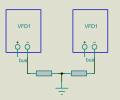
You mean the arrangement like this? If yes, what resistor values are recommended? Are they fuse resistors or some high value?
I can also insert a couple of 1Amp fuses for each VFD for additional safety.

COM BUS.pngThanks.
 

Pyrex

Joined Feb 16, 2022
501
Yes, your circuit diagram is correct.
Resistors are needed to limit the current if the AC/DC rectifier of one VFD fails, for example if one phase fails. If the resistors are relatively small, they will not affect the DC buss voltage measurements.If the impedance of the measuring PCB is, say, 1 MOhm, the resistors can be 10 kOhm each
 
Top