The Mystery of the Double Wien Bridge Oscillator

Thread Starter

andreeadumi

Joined May 5, 2025
4
Hi everyone,

I'm working on a project involving a double Wien bridge oscillator with variable frequencies on a TL072CP, and I've run into some issues that I hope you can help me with:

  1. Battery Setup: What batteries should I use for the dual voltage supply? I initially went with two 9V alkaline batteries and connected them correctly, but the oscillations are not starting. The circuit is designed to operate with as low as +/- 4.5/5V, thanks to the AGC. Would 4 batteries in series with 1.5V each work better?
  2. Schematic Check: I designed the schematics to show two Wien bridge oscillators using a dual TL072CP connected to dual potentiometers instead of fixed resistors for varying frequencies. There's also a potentiometer to lower the output peak-to-peak voltage like a volume knob. Do you see any issues with this setup? The LEDs after the supply are meant to signal if there is an error in the polarity of the voltage source.
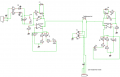
  3. 1746466355103.png
  4. PCB Concerns: Could my PCB design be faulty? The track width is 13 mils, accommodating up to 440mA for safety. Does this seem adequate?
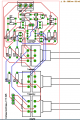
  5. 1746466313777.png
  6. Breadboard Observation: When testing on a breadboard, I didn't need a buffer stage before connecting my JBL 101 headphones with 16Ohms impedance. I expected the low impedance load to drop the peak-to-peak voltage, but that didn't happen. Any thoughts on why?
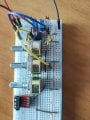
  7. breadboard_faza2.jpg

I appreciate any insights or advice you can offer. Thanks!
 

Ian0

Joined Aug 7, 2020
13,097
If you are measuring 3.64V peak to peak, then the oscillations ARE starting.
The TL072 needs at least 10V supply to operate. If you lose 2V through each LED and a bit more through the 220Ω resistors , then you need to start at more than 14V, so a total of ten AA cells would be required.
 

Alec_t

Joined Sep 17, 2013
15,101
[QUOTE="andreeadumi, post: 1981609, member: 1044850
The LEDs after the supply are meant to signal if there is an error in the polarity of the voltage source.
[/QUOTE]
Why do you have LEDs and their 220 Ohm resistors in series with the supply to the op-amps?
 

Thread Starter

andreeadumi

Joined May 5, 2025
4
If you are measuring 3.64V peak to peak, then the oscillations ARE starting.
The TL072 needs at least 10V supply to operate. If you lose 2V through each LED and a bit more through the 220Ω resistors , then you need to start at more than 14V, so a total of ten AA cells would be required.
Thank you for the tip about the voltage drop across the LEDs! To clarify, the 3.64V peak-to-peak measurement was taken at the opamp output while using the dual voltage supply of +9V AND -9V. However, when I used two 9V batteries, the output was only about 30mVpp, indicating that the oscillations are not starting. My goal is to achieve approximately 1.4Vpp at the output after passing through the voltage divider, as this will be connected to the headphones and is a comfortable volume for the user.
 

Ian0

Joined Aug 7, 2020
13,097
Don’t forget that the TL072 has a short circuit current limit of ±26mA, so 1.4V peak to peak into 32Ω may be achievable put it is pushing it. At that point the closed loop gain may fall below 3 at which point it will cease to oscillate.
 

Thread Starter

andreeadumi

Joined May 5, 2025
4
[QUOTE="andreeadumi, post: 1981609, member: 1044850
The LEDs after the supply are meant to signal if there is an error in the polarity of the voltage source.
Why do you have LEDs and their 220 Ohm resistors in series with the supply to the op-amps?
[/QUOTE]
Hello! The LEDs and their 220 Ohm resistors in series with the op-amp supply serve as a protective circuit. If the user mistakenly connects the negative supply where the positive supply should be, the LED will block the current, protecting the circuit. Additionally, LEDs provide visual feedback; they remain off in case of incorrect connections, alerting the user to the issue.

I'm also looking for feedback on the remaining issues with the circuit. Could you provide some insight on those?
 

Ian0

Joined Aug 7, 2020
13,097
Why do you have LEDs and their 220 Ohm resistors in series with the supply to the op-amps?
Hello! The LEDs and their 220 Ohm resistors in series with the op-amp supply serve as a protective circuit. If the user mistakenly connects the negative supply where the positive supply should be, the LED will block the current, protecting the circuit. Additionally, LEDs provide visual feedback; they remain off in case of incorrect connections, alerting the user to the issue.

I'm also looking for feedback on the remaining issues with the circuit. Could you provide some insight on those?
[/QUOTE]
Nice idea, but maybe not so good in practice. LEDs don’t block much voltage. A reverse connected Supply would avalanche the LED and it might fail. A 30V schottky in series with the LED would achieve your aims, but would drop another half a volt.
 
Top