hahaha, dont worry I already look for an ebay deal and i find it at 16.30usd (including transport) same thing as before. I wait a response first from the seller, also I waited for your answer, and then I will make the move. Thank you for your offer ! You are a good man.
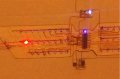
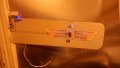
" I never saw any of the blue LEDs turn on. " - Pause the video and make it full screen. Look closely on your screen and you will see a little blue, very faint halo around each blue led. Its also the light in my room that is strong enough to make those lights look invisible, when in reality they are very dimly lit.
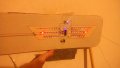
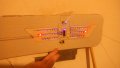
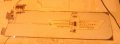
Here is a close up on them:
It is fully ON but with a strange error/interference because of the sensing circuit attached and the blue leds are lit but very faintly. Its like a low signal dictated by the sensing circuit and can not fluctuate, its freeze in that state. Its definitely the interference from the live wires inside the wall without grounding. I should ground something but I have no idea what. I did put a metal shield around the wire that comes from 220V to the relay, that is traversing diagonally the entire board from behind. I grounded that metal shield and tested on the wall, but absolutely no effect whatsoever. Same freeze,same ON state. I then tested it on my table, and is working fine, because everything there is grounded properly.
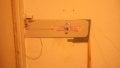
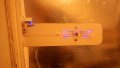
- Here I show you how I shielded that live wire and also ground it( its a green wire coming out of that shield in the middle of it); it's the first suspect it crossed my mind, (it's the only thing I can think to ground) but with no success; :
The only problem I can think of, are the wires inside the wall !!! We should concentrate on shielding them, somehow!
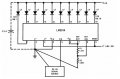
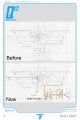
Here are the values you requested:
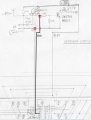
" What values are you using for the reference resistors? " - Both resistors are 1k (1.3k more precise). I re-measure them now, but is the same as in my schematic diagram >> https://www.deviantart.com/q12a/art/Q20201219-SCAN-Image-864540519
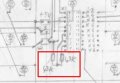
"What is the voltage on the signal pin when the LEDs are supposed to be on? " - It is 2.5V.
I marked with red squares the points I probe. I put it back on the wall and took the voltage you request. If i remember right, I can Not take this signal voltage while it is in normal function, because it will activate the sensor and I think you told me I need oscilloscope probes for it.
If this works... its project done ! I am a bit in extaz even if is not working, because I push it so far, near the end. I am happy of it as it is. It was a hard project to me and a great lesson. Oh boy.
Thank you very much for your help !
I just read this paper about shielding a cable:https://www.google.com/url?sa=t&rct=j&q=&esrc=s&source=web&cd=&ved=2ahUKEwiK98Lt_YXuAhXE2qQKHa9fAsgQFjAKegQIAxAC&url=http://eeeic.org/proc/papers/55.pdf&usg=AOvVaw1Aq5KvoDNLFk4nhz5Cpa0L
And my conclusions from it are the following:
-both ends of a metallic shield to be grounded
-multiple points to ground a metallic shield, from 5cm to 5cm for example.
-multiple shields, one over another
-At high frequencies resonance phenomena produce maximum induced voltages for a certain cable length
- At low frequencies for E-field excitation it is more efficient to ground both ends. (E=Electric)
I have 50Hz frequency to deal, which is low frequency category.
I need to shield the wall wires.
Simply put:
- In principle, if the wall wires are shielded in that switch area, say 1meter, then problem is solved. Correct?
Reformulated:
- In principle, taking down the cement over the live cables, exposing around 1 meter of cables, shielding them with an aluminium foil and grounding that shield, will solve the problem. Correct?
------
I know is extreme, but is a possible solution. I dont want to take out the cement and shield those wires. Im only thinking on the answer to the problem! Ideally I want something on the back of the board that will collect those interferences (like a sponge) and permit the normal functionality of the circuit that is in front of the board.
Try slipping a grounded sheet of metal between the wall and your device. If you don't have any, you can use aluminum foil. Cover it with something so it doesn't short anything.
Try slipping a grounded sheet of metal between the wall and your device. If you don't have any, you can use aluminum foil. Cover it with something so it doesn't short anything.
I've also find a very good forum thread about this issue : https://cr4.globalspec.com/thread/125033/Magnetic-Shielding-of-PCB-at-50Hz
with very good answers. Remember when I asked the same question: " how can i use metallic sheet to create eddy current to cancel the magnetic filed? " and the answer to it was: " 8. for conductive metal sheeting to perform well as magnetic shielding the thickness needs to be up to ~4 skin depths. At 50 hertz you're looking at some very thick copper (probably somewhere around 3/4" or 2 cm) or aluminum (probably somewhere around 1 7/8" or 4.75 cm) " - WOW, I didnt think of the thickness at all. He might be right. Imagine 5Kg of metal sheet on the back of my board, stick on the wall. HAHAHAaa. When that will fall, it will reach my neighbor under me, with a hole in its ceiling. Lool.
Try slipping a grounded sheet of metal between the wall and your device. If you don't have any, you can use aluminum foil. Cover it with something so it doesn't short anything.
Update #1 - progress!
I've moved the sheet metal more towards the sensing circuit , also the ground contact is more close to it.
Now I get this effect that i did not had it without the grounded sheet metal.
----
Here is me NOT touching the antenna; the blue leds are dim as before.
-----
Here I AM touching the antenna; the blue leds are brighter, but not at full intensity. The shielding is working.
We need more shield!
Update: I cut a piece of metal sheet (shield) at the board dimensions. Scotched the board to the shield. Put it on the wall, and the sensitivity antenna got a bit more higher than when I put the full 1 meter shield, but I adjusted down so its no problem anymore with this part.
The problem now is the [signal amplifier module] (opto + darlington module). I managed to burn another darlington. I was on the table, and I was checking it. When I touched the antena, I think, It just got super hot, and the power supply got to 700mA high just like that. I actually left it to see if its burning out, but it just stay hot and all the circuit stay ON all the time. What a disaster circuit I built here. I change it and all got to normal again.
I put it on the wall and is all trembling and bzzzing all the time, not switching correctly at all, the range is too little. The shield is grounded all the time so Im doing it corectly from this side. My impression is that the 50Hz interference is not only in the antena or the sensing circuit, but in ALL the board, to each module. I was touching the 555 in the latching circuit (on the plastic case) and then the condenser there, and all the leds reacted as I had touched the antena itself. It should not do that at all.
Im starting to get very tired of it. I cant figure out why on the table is working perfectly, and on the wall is all vibrating and not doing what I want. I manage for a very short time to make it behave as on the table , but on the wall; and after I touched its antena, it got crazy again. Its way too sensitive.
Options I'm thinking at this point:
1- to find another way to build the [signal amplifier module] - not to burn anymore darlingtons.
2- probably find another more efficient way of shielding
3- just call it done as it is now,not working as I intention, and thats it. I push it until this point, im proud of it even if it didnt work as I plan. It worked on the table, so that counts as success.
4- the theremin circuit. Is a very good idea, but is having a hell of a circuit by itself. Its a capacitive sensor so it should not get as much interference from the mains 50Hz as this one does. I think ... but Im speculating.
It just occur to me: is it possible that the 50hz to affect the gate of transistors? And in response, the relay will tremble and bzzzing all the time? Or... 50Hz to affect directly the relay perhaps? I dont believe it, but if it is? Or the darlington or even the 555 in the latching circuit? Or all of them a little bit and summed up will be an amplified effect? It might be. Better shield is the answer.
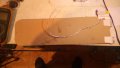
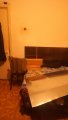
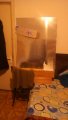
An update on how it looks right now :
Notice the metal shield behind the cardboard, cut to dimension.
I'll stop here with this one progress. It worked on the test bench, so it's a win for me. I also push it so far, so I count it also a win. I also learn a lot about wiring, so that is a win.
Even if is not finalized, mounted on the wall and working properly as I intended, I call this project done.
I will concentrate on other projects. Like the opamp project I started already and leave it behind.
We will see there if you have the pleasure and hopefully I'll get some good points from you about it.
Thank you for all your support so far, I really appreciate it !!!
- I was planning to make it on a final fiberglass board, when finished. But unfortunately, as you can read my last update, this project failed and is finished. I mean, it failed it's final destination, but in itself, is good and working fine. But still, I will not step further than it currently is. Another important point is that i literally don't produce any money for 8 years because im an artist and I live in a forgotten country who dont support losers like me (now when Im saying it, its a bit funny). I am not sure how expensive this kind of board is, but for sure it is a very interesting idea. I like it very much, but im afraid of it, to be too much expensive to my poor unproductive pockets. It is my impression, I should actually check the prices first before saying anything. Another important thing is that I only tested the shield with mild steel sheet and not with aluminium sheet. I am not sure if aluminium will have any effect as the mild steel had. I dont have such a large aluminium sheet as the board size, so its a bit impossible to me to try it just to see if it works or not. I am encouraging someone else to test it and give me the answer, if aluminium sheet will shield the 50hz in close proximity to mains wires.
- Thank you for your offer and the same to you as well, be safe.
I said I finished with it, but I still tried some more permutations.
Remember I said " to find another way to build the [signal amplifier module] - not to burn anymore darlingtons. " ?
It's the only good idea that I have so far, and I think it will make a difference !
If you dont understand something, just tell me and I'll clarify it for you.
I jumped directly to an opamp.
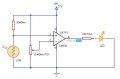
I tested this circuit
with my uA741 and worked great. So I adapted it to my circuit (A). It did not worked. It kind of worked, but the output on pin6, I put a led, and it was getting slightly dim, when I was fully activating the sensing circuit.
Then I realized the signal is too sensitive. So I tried the other versions (B and C). In B version, the transistor got very hot with a 10k in its base. Then I change it to 100k and it was stable, but the output was nothing in either cases. I even put 1k and still the output was nothing. Then I used my multimeter, a great deal of time, measuring that output, in all the cases there. And in all the cases, the output is a couple milivolts difference (around 60 or 80mV). What I need is a more serious voltage diference. From 0 to 5V, when the input is activated.
I think this is also the main cause the relays are trembling, because that very subtle input, amplified to actually tremble the relay. Is what I did before. Here is my problem for you to resolve or add an update to it to make it better. Thank you !

 Facebook
 Google
 GitHub
 Linkedin