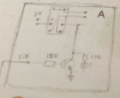
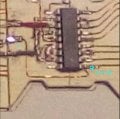
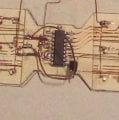
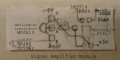
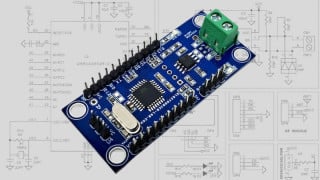
The LED's Wings Project and sensing circuit.

dl324

Joined Mar 30, 2015
18,393
A relay like this, direct connected to my PSU at 5V, it draw 400mA
What matters is the current in the transistor switching the relay coil. You can use any diode rated for that current.

If you want to take advantage of the specs, you need to determine if the current will decay fast enough to not damage the diode. A 1N4148 will withstand a 2A surge for 1uS.
1607879218138.png
 

Audioguru again

Joined Oct 21, 2019
6,826
It is impossible for the coil on the little relay to draw 400mA, which is 2W that would melt it.
Maybe its coil uses 400mW with a 80mA current?
Maybe its high voltage contacts are rated at 400mA?
Look at the datasheet for the relay.
 

Thread Starter

q12x

Joined Sep 25, 2015
2,227
What are the relays switching?
What other components will constrain you?
- I was just updating the progress, and complain a bit, but i am not in need right now of anything, just mentioned that it was slow and hard to plan and to figure out where to put the next parts of the circuit. Thank you !
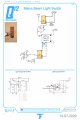
- It's the same old project idea. But instead of the beam light, it will be this LED wings + sensing circuit.
https://www.deviantart.com/q12a/art...es=1&ga_submit_new=10:1607870067&ga_type=edit
dBenzin100 ziuc 12a Mains Beam Light Switch copy 1.jpg
 

Thread Starter

q12x

Joined Sep 25, 2015
2,227
Mechanical relays can sometimes be replaced with solid state relays.
Yes, I'm aware of them as well. I dont have them, but someday i will, i hope. It's in plan to have, for some time. They are basically optocouplor but with a power transistor like a triac or mosfet that can drive power loads. Its an interesting thing indeed. But the thing im doing here, in my project, it involves that "click" sound. It adds to the magic of the circuit. Its a nice sound that I want it to be present. I actually thought to use transistors for output and a buzzer, but the passive one, that only click, without the frequency board in it, like the active buzzers have in them. But I think it would take more space so I remained with the relay option since is very reliable and tested in time as well. Though the buzzer it will be a bit more slimmer, but still too higher, but less high than the relay so thats why it was appealing for 0.0013 seconds.
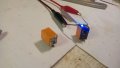
I had a problem (on the relay drivers) with an [orange] smd led in paralel with the transistor, like shown in the schreenshot. I lower its R to 200 ohm, even put it directly, without the resistor. And nothing, no light from it. And it was the correct polarity. If i tested it directly from 5V with normal 1K R,getting it with a wire, it was working fine. But not in paralel with the transistor. After some 20 tests I did and finally burn the led, I took a brake and tested with a white 3mm and worked fine, and then with a [blue] smd and also worked fine. I have (i call them) SF episodes like this sometimes, when I expect with absolute certainty something to work as it should and it doesnt. I was thinking maybe it was because 1N4148 in reverse biased on the relay? Who the hell knows. Maybe its the led itself? the way its made? because its orange? Maybe im cursed? I didnt try with other orange led from its lot. I should. But now is working very well with the blue one. What an adventure that cost me like 2h of trying and error. A break is gold !!! Remember that from mister Q12 here.
1607896169414.pngIMG_20201214_000943.jpg
 
Last edited:

Thread Starter

q12x

Joined Sep 25, 2015
2,227
Problem.
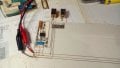
What i did so far: I made the wiring sketch - always be prepared. And I started the first relay wiring and test.
IMG_20201214_121006.jpgIMG_20201214_161354.jpg
But the test failed. It's a bit complicated what i did. I hope I will be short and to the point as much as i can.
Originally I took the signal from pin10 (or LED 10) from LM3914, and wire it to the 1k R in series with a led in series with the base of a npn transistor that will drive the relay.
Screenshot_5.jpg Screenshot_6.jpg
I did all the tests possible so far. In short, if I connect the S pad to the +5V, the led from transistor base lit fine and the relay works fine. If I bring the S (signal) wire from pin10, to the S pad, the led from transistor base will lit with a microscopic dot of light in it and the relay dont work. Yes, when I wave my hand over the sensor and actually activate the 10'th line of leds. Basically, when the 10'th line of leds from pin 10 are lit, that is the ON signal, if nothing is lit, then is OFF.
In the begining i didnt realize that the signal was too weak. I thought it is not working at all. Though I got a dim light in the led, but i thought maybe some error made that led light so I neglected it very quickly. Bad move from my part.
Then I started connecting everything to test the thing, and i did it so well, that pin10 and its line of leds are weakened now, severely, when is UNcoupled to anything. So that pin is busted, but partially. I think i might have to change the IC only for that last pin 10.
But until then i have to resolve the S (signal) problem. Then I thought, well, if that pin is busted, Ill take the next one, pin 9 as signal. I put it this time through a transistor with 1k in its base, but nothing happened, in the relay driver. Then... I thought harder and I realized that I should mount an optocoupler in series with pin 9, well the optocoupler led inside.
Here is a shot of the optocoupler in series with pin9:
(the red wire is +5V and the other middle pad is the S (signal))
IMG_20201214_161345 Copy.jpg
And is working... but on half capacity. Meaning, that the relay driver started to kick in. But it is very weak, visible in the led and also in the relay sound. I am sure the led inside the optocoupler is dim and is not fully activating the transistor inside it. At this point I realized that the first signal from pin 10, was 1-wrong and 2-weak.
- A possible solution is to add another transistor to the optocoupler output, and that transistor to fully signal the driver for relay.
- Another idea is to put a PNP transistor... somewhere on the pin9 line, between the leds and the pin itself. To lower the components count.
Your solution and help.
Thank you so much for walking with me so far with this project.
 
Last edited:

Thread Starter

q12x

Joined Sep 25, 2015
2,227
It is working now ... but is trembling a bit. Eh, I can live with it I suppose. I wished it would be a strong On/Off. Now is a bit trembling and with a slight delay.
This is what I made:
IMG_20201215_125924.jpg
But in the same time im thinking on an opamp implementation. With a simple role of a Voltage Comparator. But I feel i am complicating myself adding it to a much complicated already circuit, almost to be finished very soon.
What do you think?
Oh... I made a darlington transistor pair using 2 darlington transistors. IC3914 1 to 5 pins were active with leds lit , but the 6 to 9 were off. But my led from the relay driver and the relay itself got a VERY strong trembling/vibration and the led was 1/4- 1/3 lit. So I made the signal way more sensitive this way. Its interesting since I probably have to boost the sensing circuit once is installed on the wall, to customize the distance and feel, and this might help. I hope, but will see when I will get there. Oh boy. :)
 
Last edited:

dl324

Joined Mar 30, 2015
18,393
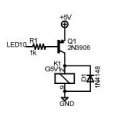
I was able to switch a relay with this circuit:
clipimage.jpg
When LED10 is off, that pin is at Vcc. When the LED is on, the voltage will be 1.5-2V below Vcc. I tried using 1k and 330 ohms for R1 and didn't hear a noticeable difference in click loudness. Coil resistance for my relay is 166 ohms, pickup voltage is 3.5V.
 

Thread Starter

q12x

Joined Sep 25, 2015
2,227
I was able to switch a relay with this circuit:
View attachment 225013
Ok, thank you for your try !
But is not good, because the design I have already... its more complicated. So I need a specific point to get the signal from.
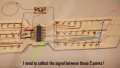
I draw it with different colors for you to follow the track more easily but is 1 track, the 10th track on which are the leds and connected to the pin of the IC like the rest of the other tracks. Now is disconnected in the picture since im working on it.
IMG_20201216_063437 copy 1.jpg
and that signal will fall on the base of another transistor npn from the relay driver:
IMG_20201213_183056.jpg
 
Last edited:

Thread Starter

q12x

Joined Sep 25, 2015
2,227
I made a quick test just now, even if i knew it will not work but i did it anyway. Because i didnt do it with a pnp before.
I used as in your schematic a pnp transistor but adapted to those green points. Sled= the end of the wire, pin10 is on the base, and Sout is to the relay driver base of a transistor.
But the signal is still too weak, and is not activating anything. We need more power on that Sout.
IMG_20201216_071128.jpg
 
Last edited:

Thread Starter

q12x

Joined Sep 25, 2015
2,227
Dont get me wrong, I KNOW your way (the last circuit with the transistor driving the relay) is the absolute correct way, and I should have done it from the start in this direction. But I also had to deal with the design and then the layers of wires which are way too many for my experience, but i learn a great deal from this project, and sharpen some skills and methods of doing things. Weird but practical. I should have been more careful on choosing the right or the safe way of doing things, as you clearly do. I risk too much and leave it after to be resolved, i suppose.
Here are some options i was thinking:
- you, or any of you here, should make this circuit from scratch and in the correct way. Its an idea, not an obligativity. Take it as a design challenge. Only if its challenging to you. Crayon on paper is recomanded but in software is also fine. Because there is a lot of wires and you have to keep with the [wings] design in the same time, thats why i recomand it on paper. I dont mind of the scale, just the shape.
A4 print ready : https://www.deviantart.com/q12a/art/q20201021-A4-print-ready-864228955
q20201021 - A paper b copy 1.jpg
- I think... my entire project (or only the wings with the leds-im not sure yet) may need more juice. More voltage. I am thinking to put everything to 10V or 12V. I will wait your feedback first, before doing anything, because im afraid of burning something and i worked so hard on this, I don't want to screw it up in the end. But I think this is the key for the entire project to behave normal, and not with so many trembling parts. Again, it's an idea, not something that I will actually do, yet. But i wanted to put it on the table.
 
Last edited:

dl324

Joined Mar 30, 2015
18,393
What is it that you're trying to do with the relay? If you're getting a weak click, it could be insufficient current in the coil. What is the coil resistance?
 

Thread Starter

q12x

Joined Sep 25, 2015
2,227
coil resistance = 64R
I'll make you a movie in which i will explain what every module is doing.
But it will take some time.
 

dl324

Joined Mar 30, 2015
18,393
coil resistance = 64R
That will require almost 80mA. Is the driving circuitry and wiring able to handle it?
I'll make you a movie in which i will explain what every module is doing.
But it will take some time.
Try explaining in words first.

What signal(s) do you want to activate the relay? How are you trying to drive the relay now?

A schematic will be easier to follow than this:
clipimage.jpg
 

Thread Starter

q12x

Joined Sep 25, 2015
2,227
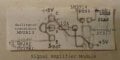
I made the [Signal Amplifier Module] board After talking with you and is working fine now.
Before, in the test phase it was trembling and having large delay, but now it seems very fine. I had good luck this time. But if the trouble will come back , I will announce you. I put a too larger resistor in the base of that darlington while testing. Now I put a smaller SMD resistor value of 1K, and is doing exceptionally fine. I cant believe it how fine is doing. Very slight delay, but manageable. Please watch the movie, I know is a bit long, take a meal while watching it, and see that I present other problems and also the current one that it got solved immediately after talking with you. Very strange that it works now. Sometimes I impress myself how good I am. To be sincere, I was desperate. See if you can come with a solution for the RANGE of the sensing circuit as I am showing at 09m50s of the movie. Thank you.
 

dl324

Joined Mar 30, 2015
18,393
See if you can come with a solution for the RANGE of the sensing circuit as I am showing at 09m50s of the movie.
Is the MOSFET you're using 2N7002? I ask because you show a P channel MOSFET, but I think the number is 2N7002.

What voltage do you have the gate biased to? Have you tried increasing it to the point just below where LEDs would start turning on?
 

Thread Starter

q12x

Joined Sep 25, 2015
2,227
- Yes, exactly, it is 2N7002 which is the smd equivalent of 2N7000. Before them, I had a schematic with very old models like BF245,BF256,TIS34, but i didnt had any of those in my stock, only the schematic. DL324 and Audioguru again told me to buy this new versions, which i listened and I did from ebay and i was unsure if to buy 1 or the other and i buy both 2N7000 and 2N7002, and both give me good results in tests with same range and same power in sensing.
- I didnt checked the voltage for the base of that 2N7002,ever. I am always presume and make some very rough calculations in my head, like half or a third or a little or quite a bit, but never with exact measurements. Its bad, i know, but i didnt get into habit of doing it which is very bad, but to be sincere, when im measuring i get quite the same result as my intuitive rough calculations in my head. So in time i start to trust my instinct, but my instinct is not always right and i know it is not right always and even if i know i can be wrong, i still believe my instinct. I should get more into measuring and make a habit of it. But when I am in front of a circuit and is a problem, a couple of solutions pop in my head and I want to try them all so i totally forget about measuring. I dont even know where to start measuring, haha, i mean to be sure i pinpoint the problem or that i am close to it. Though i watched many youtube electronics movies and i learned a lot from those guys and their explanations and experiences, i still see them doing it like me, from the head, and rarely with a measuring tool, that I and them use in absolute darkness, when we have absolutly no clue and we must rely on the tool because there is no other way. In a sense the tool is a last resort, and not as usual as it may seem. But for some circuits that i know already a couple of parameters and data about them, i say to my self, naaah, i know its that, or that, or that, so it will take 1 minute to check, and after i check and are none of them are resolving the problem, it pass weeks or months until i come with another idea to try, and this is the very bad downside of my trust in my instinct and my way of doing it. I am explaining my stupid routine, but i am not proud of it, just put it on the table, for you to see how i think, as bad as it is, because in a way it was always my goal to correct it, but i couldnt find any book or tutorial specific on this problem, or not insistent enough for me to get it and apply it.
- I test it right now, and the results are not good. Im afraid the probe is interfering with the correct function of the transistor. When I probe from its collector to its emitor i get 4.84 V or -4.84V if i reverse the probes. When I probe from its Base to either colector or emitor, i get 0 or a highly fluctuating reading. I tested it both cases, far enough from its antenna and close to antena that will triger all the leds.
- To respond to you last question, I did everything in test phase, and what i get now is the most efficient calibration from those tests i did. Official ! But sometimes or most of the times in test phase, if i see a result, i stop any further tests and experiments and label it as working and move on to the next phase of the project.
I will measure it and give you a response in a minute.
 

dl324

Joined Mar 30, 2015
18,393
So in time i start to trust my instinct,
That's definitely a problem with MOSFETs. Manufacturers can't control the threshold voltage very well, so you either need to design for worst case values or you need to measure the threshold voltage for the device you're using.

The transconductance (gain) of a MOSFET is mhos (they changed the term to siemens, but I prefer to think of it as mhos because it's easier to spell and that's what they called it when I learned it in school. The range for 2N7002 is 80-320+ mS. If the gain from a one stage amplifier is insufficient, you can add another stage.

Another term for what you and others you've seen are doing is guessing.
i watched many youtube electronics movies and i learned a lot from those guys and their explanations and experiences, i still see them doing it like me, from the head, and rarely with a measuring tool,
I wouldn't consider YouTube to be a good source of reliable information. Many of the videos members have referenced are, to put it bluntly, crap. Most of those people post long videos to monetize the time you spend watching their babbling. You'll get better information from a site like AAC where it's usually peer reviewed.
When I probe from its collector to its emitor i get 4.84 V or -4.84V if i reverse the probes. When I probe from its Base to either colector or emitor, i get 0 or a highly fluctuating reading.
If you're close enough to the device to make measurements, you're probably introducing some signal, so you need an oscilloscope to take measurements.

The terminals on a MOSFET are source, drain, and gate. They're analogous to BJT terminal names. To avoid confusion, you should use the correct terminology. When I say mhos, most will know what I mean because that was the original term for transconductance.
 
Last edited:

Thread Starter

q12x

Joined Sep 25, 2015
2,227
I wouldn't consider YouTube to be a good source of reliable information. Many of the videos members have referenced are, to put it bluntly, crap. Most of those people post long videos to monetize the time you spend watching their babbling. You'll get better information from a site like AAC where it's usually peer reviewed.
It can be. Depends what channel you watch on youtube!!! I find great guys there but I usually as a rule of thumb, stay away from indian movies, because those are real garbage indeed. My usual guys im looking and learn a thing or two from them and i consider them very good are: bigclivedotcom, eevblog, greatscott, Julian Ilett, w2aew, Tech Ingredients to name a few and a few more others that i forget their names but with very in depth content. Every one finds or not, something from everyone as much as he can. In a sense you are also right, many are doing it for stars or money there, but there are some sincere folks that are actually teaching, explaining and showing the real deal as best as they can and know. I do understand how bad and good stuff works. For me is a great learning tool mister youtube. It helped me. And is free ! And if you are careful, you can find gold here and there. But you must look with patience and open mind and clarity, as much as you can permit. It's how i think.
I just made a search now on youtube afte you guys and i find you there as well. I just subscribed and I will tell you my opinion in time after watching a couple. I didnt think to search for you until now. What an idiot i am, but i cant search for everything in my defense. Heh. Awesome !
If you're close enough to the device to make measurements, you're probably introducing some signal, so you need an oscilloscope to take measurements.
The terminals on a MOSFET are source, drain, and gate. They're analogous to BJT terminal names. To avoid confusion, you should use the correct terminology. When I say mhos, most will know what I mean because that was the original term for transconductance.
I still wait for my osciloscope to arrive. It didnt so far. Sad.
I completly forget about source drain and gate. Sorry. I will get use in time to propper name him and its pins. For some reason i am not accustom that well with it. But i will.
So what now? What i can do? You think for me because you have more experience than me with these devices and phenomenas, and as you said, think on the worst case scenarios, and give me a solution to upgrade its sensing power. What you will do in my situation and with my shitty tools? (except throwing myself from the window because life is crap, with no proper tools, no money, no youth, nothing but existence). He he.
 
Top