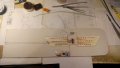
The LED's Wings Project and sensing circuit.

Thread Starter

q12x

Joined Sep 25, 2015
2,227
This measures 3.5 inch far from the table.
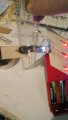
IMG_20201114_084539.jpg
And is perfectly off at this distance im from it.

IMG_20201114_084600.jpg
and here is how far my hand should go into it to fully open it.

IMG_20201114_084648.jpg
I think I must make this circuit board larger again and insert that match stick in it after all. I got much better results with that one than with this one here. It was worth to try, since my goal here was to miniaturize it, but it failed. I better stick with what is working best for now. Size matters, in this case !
In the start i try it with a metalic box, and i thought, "oooh, its working" but then i get it's the distance and not the cage. It really needs to be earthed. I also try it with a big plate but unearthed is just another big antenna. And I dont have earthing disponible. So, i fail again.
 

Thread Starter

q12x

Joined Sep 25, 2015
2,227
This should be a short discussion, since it can get very complicated very fast, and the main focus is on other stuff.
My wiring in my room is a bit awkward. I just tested the cable that is entering my room, into a master socket. First I inspect it for the 3rd wire and it is having it. It was left aside and bent and under a tape isolation. Good. I was worrying not having the third wire on that cable and making plans to buy a very expensive 3 wire cable from the local (thieves) depot. Another very good aspect of the wire is its thick wire copper and not stranded wires. That is the best cable to have. You can weld with that wire and have no worries melting it.
Then I had 2 options, to go down in the basement from where the cable is linked and stop everything in my room, and check if that earth wire is connected to the earth plug there, OR make a simple device for measuring it from my room, from that master socket, without shutting down anything.
I made this little circuit in 10 minutes + the case and wires and probes. Tested the normal 220Vac, and the led was brightly lit.
IMG_20201114_175018.jpg
I then go to the master socket and with a strong tongs, I linked 1 probe to the earth wire that was in air. And with the other probe i inserted into the sockets of normal 220Vac in both holes; (one hole at the time, not at once) And in both holes, I got a very dimmed led brightness. My best guess at this point for the dimmed led, is because it was running on half of the sine wave, and it was brightly lit when it was connected to both live wires(mains).
- My question to you is this: - if i got this dimmed led on both holes, then the ground is active, Right? If I did not got any light brightness, then the ground was not connected. Right?
I had to look on youtube(i didnt get any answer) and other websites(from them i got it) until i got this answer, but they said that the connection should be between 1 lead of the mains to ground and not the other lead to ground. But mine are both connecting, surging, which is very good. Right? Im not that proficient in this area of electrical wiring, i know some basics but thats it.
Thank you.
 
Last edited:

dl324

Joined Mar 30, 2015
18,393
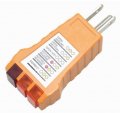
Do you have these type of testers in your area?
clipimage.jpg
I don't know about the wiring codes in your area. In mine, hot and neutral on the outlets are polarized and this tester checks outlet wiring. Neutral is connected to earth ground at the breaker panel.
 

Thread Starter

q12x

Joined Sep 25, 2015
2,227
Do you have these type of testers in your area?
I dont think so, and to be sincere, i didnt search for this kind of stuff. Probably there are out there some testers like these. But i only use them once in a decade or longer. All i needed was a quick and dirty way to figure it out without powering down my pc only for a simple check up. If you didnt told me anything i just did there was wrong, then i deduce i did it right and the results are ok that i got. ;) Thank you for your indirect answer. :) Heh.
I might make an artpage with this method of testing that i just did. Thats why i verify through you first before making too many mistakes.
 

dl324

Joined Mar 30, 2015
18,393
My question to you is this: - if i got this dimmed led on both holes, then the ground is active, Right? If I did not got any light brightness, then the ground was not connected. Right?
If you didnt told me anything i just did there was wrong, then i deduce i did it right and the results are ok that i got. ;) Thank you for your indirect answer.
My lack of an answer wasn't an answer one way or the other. I don't know enough about your electrical codes to answer.

EDIT: In my area, electrical code requires line neutral to be connected to earth ground at the breaker panel. So we measure line voltage between hot and neutral or earth ground.

Since you're doing tests with LEDs or lights, does that mean you don't have a voltmeter?
 
Last edited:

Thread Starter

q12x

Joined Sep 25, 2015
2,227
As I said, it gets very complicated very quickly. But you deserve my attention.
I Have a voltmeter and i test with it in the first place but I got (if i remember right), something like 7milivolts I suppose (it was turned up to 750Vac the dial, but only for 1 mains wire and gnd, but not for the other mains wire and gnd. That made me think to build my little quick and dirty apparatus.
Sorry for not taking your first hint about color codes for wires. My mistake of thinking too way ahead.
http://internationalconfig.com/power-cords-for-romania-ac-power-cords.asp
I did a quick search for you and found this very comprehensive and straight to the point webpage that also confirms my knowledge about the subject. Usually we have 2 wires for 220V alternating current marked as blue and brown and 1 gnd wire marked as green or green&yellow stripes. Just read the intro on the page, that is containing every important detail you must know.
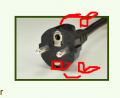
The picture does not show it but those horizontal metal bands are the ground terminals and they are also bent UP, towards the cable, to make a lateral connection as well. That hole is weird there, usually is just flat. We dont have a pin for the ground as wrongfully suggested by the image, but 2 lateral bands arched that contact the laterals of the plug. I hope it make sense.
I also made real life pictures of my plugs and power cord sockets, see in the pictures, below. I also have an exact plug as this picture here. Ithink that hole is for other types of plugs, something like compatibility between us and some other countries or types. Is my best educated guess.
1605378533504.png
Usually, what i know about my electrical mains, what every child knows actually, is that on a wire we get 1 wave and on the other wire we got the other wave. So in combination of the 2 we have 220V. So, on a wire comes 110V and on the other one another 110V and together make 220V when are probed or used. I probed them to be sure and made also a picture for you to see it.
Actually NOW we have 230-240V. But i remained to 220V from some while ago when it was like that, and only recently... probably from 2015 "recent", they change it up. I dont know why or how and where and when, its their monkey bizniz.
I made some pictures to show you.
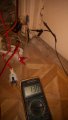
I am showing you measuring from both mains to the ground. I did it in the first place like this, but i didnt get these values for some reason. Very weird. I think my voltmeter is dying, i see it misbehave for some resistors readings before. He have like more than 15 years of usage. Well, i dont keep it running all the time, but i definetly give him some shocks a couple of times and now... is old and giving errors. I think !!! im not super sure. I wish I could repair it or at least diagnose it. Or the wire I put my probe into was oxidated or i didnt touch it right in the first place...though i remember switching both holes... And now is working, making me look like an idiot.
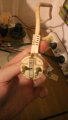
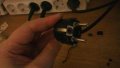
Check out the pictures, the white plug is the original romanian plug, with no holes in the ground. And pay atention to the wire strips for gnd that come out from the sockets where you put the plug into, they are springy so making good contact.
IMG_20201114_204113.jpgIMG_20201114_204123.jpgIMG_20201114_204821.jpgIMG_20201114_204748.jpg
 
Last edited:

dl324

Joined Mar 30, 2015
18,393
If you're measuring both voltages with respect to earth ground, then your ground connection is good.

Do you have devices that run on half of your line voltage so that the voltage on each line can be different?

I don't know how you can work with 220VAC. It scares me. Even 120VAC gives me pause. Bad experience 35 years ago with a scope ground connected to line voltage because something was wired wrong.
 

Thread Starter

q12x

Joined Sep 25, 2015
2,227
yes its a good idea to have a device that runs on half a wave ! I never thought of that. Unfortunatly i never heard or seen one device that can run on half of my line voltage. For sure may exist but i didnt encounter and didnt look for one.
About 220VAC ... i got shocked so many times in my life that now is just "normal". The trick is to know when to jump out of the shock contact. I have some good reflexes in this part, and i learn to imagine the worst, before starting anything, so im on the jump every time. Im not afraid of it since i have pretty good experience so far and im confident on what i know. But... sometimes i get confused by instruments , like the bastard one that gave me eroneous reading in the begining. I kept a mental note of it being damaged (for measuring resistances) but now it seems is all over the place. Probably its processor is faulty... who knows. I like it, it was a strong build and it kept me long time. Ill may have to buy another one... that cost money, ghhh.
Ill have to remake a larger sensing circuit board, similar with what was before and worked well.
And probably ill have to link all my power cables with their ground wire as well, but that is secondary.
 

dl324

Joined Mar 30, 2015
18,393
its a good idea to have a device that runs on half a wave ! I never thought of that
Your appliances are designed to operate on 220VAC.

Most of our electrical appliances are designed for 120VAC. Only the large appliances (ovens, stoves, air conditioners, water heaters, big heaters, well pumps, some tools) operate on 240VAC.

The service that comes to our homes is 240VAC and loads on each 120VAC line are balanced (sort of) to keep each side about the same voltage. It doesn't always work out that way, but that's the theory.

My air compressor is about the biggest that I can run on 120VAC. Some tools, like my table saw, can be wired to operate from 120VAC or 240VAC. A lot of my test equipment can be switched to 240VAC, but we don't have many 240VAC outlets wired in our homes.

I keep thinking that 50Hz is less dangerous than 60Hz because 120VAC is often just an uncomfortable buzz, but I've seen touching 240VAC knock people on their behind.
 

dl324

Joined Mar 30, 2015
18,393
Are you able to block interference with the shield ungrounded? It should work because the wavelength for 50Hz is pretty large and the openings just need to be smaller than the wavelengths you're trying to block.

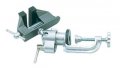
This is my new favorite vise:
clipimage.jpg
I've had it for years but just started using it.
 

Thread Starter

q12x

Joined Sep 25, 2015
2,227
I have your model vise as well. It's too fragile for my standards. Its also made from an stronger alloy of aluminium but still, weaker than full cast iron like is mine. You know these things are very subjective and we are accustom and adapted to them, so maybe yours is better than mine, and i got very used to mine, it very much be like it. But i strongly believe in the toughness of mother russia products and german fatherland products as well. Also my romanian products are surprisingly strong and massive sometimes, that they serve you not 1 but 2 life times. Eh well... Way away of the subject. :)
With the shield ungrounded I could Not block the interferences, you see in the video when the red head was uncoupling by itself from time to time, the circuit went to full power, with all leds on. Actually that ungrounded shield is "another antena" for the antena in the circuit. An amplification. I think. I was really hopping it will work without grounding... and it didn't.
As you can see, I remade the circuit with the full length match stick in it, in the hope it will behave better than the experimental one with the diode. It did not ! so I'll have to make another one with the diode in it, back. I expect to be exactly the same both of them. I was sincerely believing one is behaving different from the other, but from what i observed so far, they seem the same, maybe subtle differences. Your help with the grounding was VERY good ! I could not think of myself to do it without you. I know some stuff, but i don't trust them 100% all the time, and as you can tell, is hard enough to experiment all the time. Experiments take a lot of time and brain power and psychological stress that you must simply deal with until it passes, like i just went through.
 

Thread Starter

q12x

Joined Sep 25, 2015
2,227
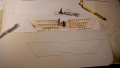
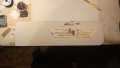
Im showing you my progress, not only for bragging, but also for perspective. And the perspective is that the antenna wire will [most probably] have the shape of the contour of this board. So it will go around it, meaning, following it. I've also thought on making it like a single layer under the wings circuit but that will add to its high, which is already too much. Remember, the plan was to make it paper thin from the start, but here in this prototype i make it as thin as I could possible with the materials and technology i have at my disposal (also the money that i dont have from 7years, since art is not paying at All, and neither electronics, which sucks very much). Other things that dont pay at ALL are programming, and mechanics which i know them well enough to brag about them as well. And I close my little parenthesis.
Also, the 3d version is to make the antena, on its own board, next or inline to these boards here. But on the same big board space. Just simply showing on as an important component (that will take some space as well). So it's a composing challenge this way. I'll have to choose which version.
You are welcome to come with any thought you may have about antena position/shape.
IMG_20201120_063448.jpgIMG_20201120_063555.jpg
I think this is starting to look interesting... I can't wait to see it on the wall. Uuuuh. But so many little things to resolve first.
-Thank you- as always !
 

dl324

Joined Mar 30, 2015
18,393

Thread Starter

q12x

Joined Sep 25, 2015
2,227
@q12x Did you end up buying any of those boards?
No. No money for trivialities. Haha. I got to my local electronics shops, and they dont have any kind of blank electronic boards, not full covered ones and not with holes ones. Nothing. I was curious about the price. Eh, well. I'll stick with my usual way. Though I have in mind to transfer this Wings prototype to a electronic full board (not with holes) - the clasic ones. Ehee.. until then, Ill have to finish the prototype first.
- Update on my progress so far, I think it passed a week(or more), on specifically dealing with the 3'd wire, the ground, to put on all my multi sockets + plugs. Also Ive added leds on 220V to them, as indicators. I had to buy some multi sockets , very cheap in price, but also very cheap in quality, so I had to fight with their cheapness as well, when disassembled and reasembled. But it worked. I also buy a 10Meter cable with 3 wires, with 2.5mm copper stranded diameter. That was the only model they had. And it barely, at limit, fit to everything I have in my room. I think now, after all the work, that cable it might be an industrial rated cable as well. But i like big and secure stuff.
Exactly 1h ago I just finished the second to last multi socket leds to add. The 3'd wire was added some days ago.
All I have left to do now, is to link the ground to my iron table and to my last (on the working table) multi socket. What a crazy week. If you are bored and with no plans in the near future, try add the 3d wire (ground) to your multi sockets in your room. :) hahaha. It will snap you, like that, into reality.
- A parallel story : Ive also buy some cheapest cheap multimeters from bazaar, which they didnt sell for decades i guess. The lady was all jumpy around me, happy she get rid of them. I took 3 for 70 lei. While in the specialized shop only one cost 70lei and is the cheapest there. The rest are around 100lei and a good one is at 120lei(in the shop). 70 lei to usd = 17.42$ and 100 lei to usd = 24.89$. Back to the bazaar, 2 of them were very cheap and relatively new (probably 1 to 3 years old), in their own (new looking) box, and the third, without box, beaten by extreme cold and extreme heat, with the transparent plastic cover deformed. I replace it at home with a clear transparent cover from my stock, cut to dimension and press fit. It looks better than a new one. Hahaha. It was a bitch to open and close it back though. But its good now. I took them 3 as back up. My VERY OLD multimeter, gives signs of dying. I thought on the road, that SOME apparatus are behaving erroneously, giving you false impression they are broken, simply from a dying batery in them. So I bought a new batery to my old multimeter as well. The old batery was 8V and the new one is 9.6V. I was surprised at 8V to misbehave like that if it was indeed the batery cause. SO I bought the other 3 multimeters as a backup. Now I still use my OLD one, but at the first sign of eroneous output... Ill switch it as a reserve and use the newer ones. I still believe he can still do it. I punch it one time, and it go to displaying 6666 on all its screen, whatever location I was turning the knob, and indiferent of turning it off or on, he was still showing 6666. Then I punch it back and it behave ok-ish , reading only specific thngs that he liked, and giving me some weird readings for other things. Now, today he was like new, giving me perfect readings for everything. Probably because I changed its battery, is behaving so good now? We will see in time. I am curious though, what component in it might got old and creating problems. I still believe its the batery. Its the first diagnosis measure i can think of. The most basic one. That's it with the parallel story.
Thank you for reading.
 

Thread Starter

q12x

Joined Sep 25, 2015
2,227
I finished all the wiring, through all the multi sockets. And now my iron table is grounded properly. I also tested the wings circuit directly on the table and is working as it should, with no interference. I discover this way that the antena is too short and I have to get very close to her to activate the circuit. It is short because it was hipersensitive from interfering with the table and all ungrounded iron machines I keep around my working space.
Next, is to add the latch circuit, and the switch for the mains 220V (all in one circuit).
And after that to add a permanent power source.
And mount +a final test directly on the wall + it's necessary calibrations, most probably for the antenna range and feel.
 

Thread Starter

q12x

Joined Sep 25, 2015
2,227
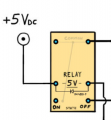
For a 5V 40mA relay (yellow case).
Can I put 1N4148 protection diode? (instead of 1N4001-7)
1607869543742.png
 
Last edited:

Thread Starter

q12x

Joined Sep 25, 2015
2,227
If the coil current is under a few hundred mA - yes.
Thank you. A relay like this, direct connected to my PSU at 5V, it draw 400mA, when I look at the screen of my PSU.
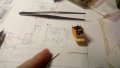
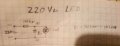
I took a picture of the current relay + its driver circuit ; you can see its drawing on the paper next to it. I am working on it just now, and I have to make 2 of them. This is the first and unfinished yet.
You can also see the 1n4148 diode directly on the pins of the relay (something red there).
IMG_20201213_183056.jpg
 

Thread Starter

q12x

Joined Sep 25, 2015
2,227
I didnt do much for long time for multiple reasons. Mostly depression. But also decisions for where to put what.
So yesterday I start positioning the latching circuit. The problem I face is the thickness of the projek. My original envision was to make it as thick as paper. That is a cardboard and multiple other cardboards so its a sandwich of them and is not even near to my original idea. But, is good enough, giving the materials and technology and tools I work with. So im somewhat satisfied of the final product (not finished yet).
So the problem is the thickness, ok? Now... like everything in life, its impossible to plan EveryThing from start, I did actually plan a ton of little details in the start, i got to even where the wires will bent, so detailed i was imagining before laying down anything. But I couldnt imagine everything. So now I face with the relay thickness. I was planning to make a perpendicular circuit board - like a T on this big one, with the relays in the back of it. I started this layout you see here, yesterday. But i realized there are way too much wires going behind. So i re-layout it. Believe it or not, layout-ing and planning, and imagining is like 90% of the time and effort in this kind of projects. The actual electronics and soldering is the rest of 10% which is very fast to make and do. Well, sometimes the wiring will kill your soul, and it will be time consuming and patience to make them, specifically in this projekt... but i plan the shit out of it in the start.
IMG_20201212_145630.jpg
I was not sure i can make it this far, to be sincere, I left some unresolved issues to resolve them on the way, or "later".
I rethink the layout to be a bit more practical and also to respect my original wish with the thickness. The latching circuit goes to the left top corner now, I re-wired the signal circuit and i have the middle long wire as the signal to the margin of the board, that will command the relays and latch. The relays will stay on top, as i position them on the table. On their separate cardboard, glued to the big one. But they will be "outside" of the main "slim" big board.
Its very hard to get good layout ideas, and alone is more time consuming and harder. Eh well, but is peaceful.
I know is not much, but is going to be finish soon enough.
IMG_20201213_183242.jpg
 
Top