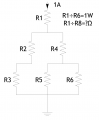
The christmas tree circuit

Thread Starter

prof.marco

Joined Dec 21, 2022
3
Power Source is 6V becouse equivalent total resistence is 6W=6Vx1A. R1 is 1 Ohm, VR1 is 1V therfore VR2=VR3=2.5V I23=0.4A, R2=R3=6.25 Ohm. I4=I1-I23=0.6A V4=1.67A R4=2.78 Ohm. I5=I6=I4/2=0.3A . R5=R6=1W / I5^2=11.1 Ohm
 

WBahn

Joined Mar 31, 2012
32,702
The notation makes no sense. R1 divided by R6 is a dimensionless number. It is not a power.

And if, somehow, R1 divided by R6 is a power, how can R1 divided by R8 now somehow be a resistance?

You don't even show an R8.

Please explain what any of this means and what the problem is that you are trying to solve.
 

WBahn

Joined Mar 31, 2012
32,702
Power Source is 6V becouse equivalent total resistence is 6W=6Vx1A.
Huh?

How is a resistance 6 W?

And where is the 6 W figure coming from?

R1 is 1 Ohm, VR1 is 1V therfore VR2=VR3=2.5V I23=0.4A, R2=R3=6.25 Ohm. I4=I1-I23=0.6A V4=1.67A R4=2.78 Ohm. I5=I6=I4/2=0.3A . R5=R6=1W / I5^2=11.1 Ohm
I have some inkling of what the underlying problem is, namely find the values of the six resistors such that each resistor is dissipating 1 W, but I'm not in the mood to guess or, more to the point, to do anything with just a guess.
 

Thread Starter

prof.marco

Joined Dec 21, 2022
3
The notation makes no sense. R1 divided by R6 is a dimensionless number. It is not a power.

And if, somehow, R1 divided by R6 is a power, how can R1 divided by R8 now somehow be a resistance?

You don't even show an R8.

Please explain what any of this means and what the problem is that you are trying to solve.
In the picture the simbols means: Resistence from R1 to R6 dissipate all 1W each. Find resistence values from R1 to R6 (R8 is a mistake sorry!)
 

WBahn

Joined Mar 31, 2012
32,702
Power Source is 6V becouse equivalent total resistence is 6W=6Vx1A. R1 is 1 Ohm, VR1 is 1V therfore VR2=VR3=2.5V I23=0.4A, R2=R3=6.25 Ohm. I4=I1-I23=0.6A V4=1.67A R4=2.78 Ohm. I5=I6=I4/2=0.3A . R5=R6=1W / I5^2=11.1 Ohm
Even if your results are correct, the reasoning you use is not adequately supported (though I suspect your reasoning itself was adequate).

You state, without justification, that VR2 = VR3. But since these are in series, there is no fundamental reason why they have the same voltage across them, only that their sum is 5 V. But the constraints of the problem make this conclusion possible.

Since R2 and R3 have the same power dissipation (1 W) and the same current, they must have the same resistance and, hence, the same voltage drop across them.

You then just give I23 = 0.4 A with no indication of where this comes from.

If I were grading this, I would take off quite a few points since it relies on me having to reverse engineer your results to guess at how you arrived at them. It might seem reasonable, on the surface, to just give the benefit of the doubt and assume that if the results are correct the work done to arrive at them must be correct. But experience has shown that this is often just not the case. Take the voltage across R2 and R3 as an example. I've seen way two many times when someone has just assumed that the voltage is equally distributed across series elements (or current in parallel paths) for me to be willing to assume that they didn't make that same mistake here and just happened to end up with the correct result. If they did that, then giving them credit is doing them a disservice because it only reinforces their belief that the wrong approach they used was actually correct. So, in general, unsupported answers get little or no credit.

There are a number of ways to tackle this problem, so I will just give the one that comes to my mind first.

R1:
We are given that R1 is dissipating 1 W and that it has 1 A of current through it, therefore:
R1 = (1 W) / (1 A)^2 = 1 Ω

The voltage across R1 is VR1 = (1 A)(1 Ω) = 1 V and the voltage across both the {R2, R3} and the {R4, R5, R6} combinations is therefore 5 V.

R2, R3:
By symmetry, R2 = R3 since both have the same current and both are dissipating the same power.
The total resistance of the two is then 2R2 and the power dissipated by the combination is 2 W with 5 V applied.

2*R2 = (5 V)^2 / (2 W)

R2 = R3 = 6.25 Ω

R4, R5, R6:
The voltage across R1 is VR1 = (1 A)(1 Ω) = 1 V and the voltage across the R4, R5, R6 combination is therefore 5 V.
Since each resistor is dissipating 1 W, the total dissipation in these three resistors is 3 W, therefore the total current, which is also the current in R4, is

IR4 = (3 W) / (5 V) = 600 mA

From this, we can directly get the value of R4.

R4 = (1 W) / (600 mA)^2 = 2.78 Ω

By symmetry, since R5 and R6 have the same voltage across them and are dissipating the same power, R5 = R6 and the current in each is IR4/2.

At half the current, the resistance has to be four times as much to dissipate the same power, so

R5 = R6 = 4*R4 = 11.11 Ω

RESULTS:
R1 = 1 Ω
R2 = R3 = 6.25 Ω
R4 = 2.78 Ω
R5 = R6 = 11.11 Ω

CHECKS:
IR1 = 1 A => PR1 = (1 A)^2 * (1 Ω) = 1 W √
IR2 = IR3 = 400 mA => PR2 = PR3 = (400 mA)^2 * (6.25 Ω) = 1 W √
IR4 = 600 mA => PR4 = (600 mA)^2 * (2.78 Ω) = 1.001 W √
IR5 = IR6 = 300 mA => PR5 = PR6 = (300 mA)^2 * (11.11 Ω) = 1.000 W √

VR2 = VR3 = (400 mA)(6.25 Ω) = 2.5 V √
VR4 = (600 mA)(2.78 Ω) = 1.668 V
VR5 = VR6 = (300 mA)(11.11 Ω) = 3.33 V
VR4 + VR5 = 1.668 V + 3.33 V = 5.00 V √

With this level of detail, the grader can almost certainly see exactly where a mistake was made and determine whether it was a misunderstanding of the problem, a lack of comprehension of the skills being assessed, or a silly math error.

Also, by providing checks on the results, not only can the grader see that the person is being diligent in their work, but the likelihood of a mistake going uncaught by the student drop enormously.

As a teacher, one of the things that I am supposed to be teaching is the ability to communicate engineering work effectively; just giving a bunch of final results or only partially-supported work doesn't do this.
 
Top