Rebuilding Christmas tree circuit

Thread Starter

Gottria

Joined Dec 13, 2016
9
Not sure if this is the correct place for this but here goes. I't been 20 years since I played with circuits and need help, I have a 20 foot lighted Christmas tree in my yard and this year it didn't turn on. Took the controller apart and a lot of components on the board were blown, looking at the board it's got a 22v ac input passed through 4 diodes to convert it to 24v DC. So I cut all the wires off, figured out what's ground and rewired it with a cheap 24v power supply. It's working but I want to add in a SmartThings strip light controller, this is where I need help. The tree lights, 24 strings of LEDs, in groups of 6 with the grounds all tied together and then a 24v DC line goes to each string, pretty straight forward. Now my smart controller is the opposite, it runs a 24v dc VCC and each channel is then grounded when active, I need another "switching circuit" for when the controller grounds a line it sends 24v to the LED string. I thought about running 4 micro relays but think there is a better solution.
 

GopherT

Joined Nov 23, 2012
8,009
Not sure if this is the correct place for this but here goes. I't been 20 years since I played with circuits and need help, I have a 20 foot lighted Christmas tree in my yard and this year it didn't turn on. Took the controller apart and a lot of components on the board were blown, looking at the board it's got a 22v ac input passed through 4 diodes to convert it to 24v DC. So I cut all the wires off, figured out what's ground and rewired it with a cheap 24v power supply. It's working but I want to add in a SmartThings strip light controller, this is where I need help. The tree lights, 24 strings of LEDs, in groups of 6 with the grounds all tied together and then a 24v DC line goes to each string, pretty straight forward. Now my smart controller is the opposite, it runs a 24v dc VCC and each channel is then grounded when active, I need another "switching circuit" for when the controller grounds a line it sends 24v to the LED string. I thought about running 4 micro relays but think there is a better solution.

Could you draw out the two circuits on a pice of paper and post a photo of that.
 

Thread Starter

Gottria

Joined Dec 13, 2016
9
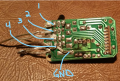
Working on a better one tomorrow, here is a quick one. 1,2,3,4 are the 24v DC lines out.


Here is the controller I'm using. Yea it says RGBWW but I'm just using those as channels and not colors. VCC is 24VDC and RGBW1W2 float till they are activated then they go to ground completing the circuit.


GopherT

Joined Nov 23, 2012
8,009
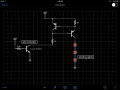
Ok, you could add two resistors and two transistor's (PNP) to each string of lights. Connect the 10k from each strand to the r, g, b or w input on the wifi controller.

The 33 ohm resistor sets the current for the string (no matter how many LEDs you have - it is a constant current source. The 33 ohm sets the output to about 20 mA per strand of lights.


Note, the "wifi controller" is your existing low-side switch wifi box. The NPN is just there because that is how your switch works inside.

Where in the world are you located?

image.png
 

Thread Starter

Gottria

Joined Dec 13, 2016
9
Thanks GopherT, I'm located in the San Francisco Bay Area. I'll start getting my parts list and prototype board together and see how it turns out. Any specific transistors?

Also there is 5 strings of lights per load with only 17 LEDs per string.
 
Last edited:

GopherT

Joined Nov 23, 2012
8,009
Thanks GopherT, I'm located in the San Francisco Bay Area. I'll start getting my parts list and prototype board together and see how it turns out. Any specific transistors?

Transistors depend on the amps required for each string. If the LEDs look like standard 5mm indicator LEDs, then 20 mA is fine per each string (assuming the strings are in series) and a cheap 2N3906 is plenty (100 mA max) or BC327-25 (600 mA). These are two of the cheapest out there. Sounds like you will need quite a few.

I just suggested this circuit with constant current because you didn't say how many LEds are in each series, you may be able to get away with a much simpler circuit. One Transistor and One Resistor per WIFI controller port and another Resistor per string of lights to limit current. Post the details and we can help calculate a simpler circuit.

Also, your DC power supply will not simply be 24V DC as a direct translation of your 24VAC.
It will actually be (1.41 x 24V) - 1.4V. The --1.4V is because of your diode rectifier. The 24 vAC is RMS voltage so peak voltage will be higher after a full wave rectifier (4-diode as you posted).
 

Thread Starter

Gottria

Joined Dec 13, 2016
9
Here is the PS I'm using, left over from an old project some years ago. All the lights are running off this right now, I'll take a current measurement of one of the legs of the lights to see where I'm at.


Here is a picture of one of the bulbs, I assume there is an LED in there as the bulbs produce no noticeable heat.
 

GopherT

Joined Nov 23, 2012
8,009
Here is the PS I'm using, left over from an old project some years ago. All the lights are running off this right now, I'll take a current measurement of one of the legs of the lights to see where I'm at.


Here is a picture of one of the bulbs, I assume there is an LED in there as the bulbs produce no noticeable heat.
Don't run it with just the power supply. A strand of LEDs needs current limiting. Without current limiting, the red LEDs will look orange or yellow and die soon. That is the whole point of the circuit I posted, constant current.

So, measure the voltage of your power supply (24VDC?).

Count the number of LEDs in each strand. Assuming they are all red, use 2V per LED. Lets say you have 10.

That makes a voltage drop (forward voltage) across the string of 10 in series to be 20V. The power supply is 24 volts so you have 4 volts left over to dissipate with a resistor and limit the current. Using Ohms law, that 4 volts can be dropped a resistor of (4V / 20 mA = 4V/0.020 A = 200 ohms). 200 ohm resistors are available in the market but common values are 180 or 220 ohms. Either will work because these LEDs typically are rated for 30 mA and you'll be well within the margin of any tolerance errors.

If you have a different number of LEDs per stand, do the calculation again with your own values. Do not run the LEDs without a current limiting resistor or your currents will be higher than spec and their lives will be short.
 

Thread Starter

Gottria

Joined Dec 13, 2016
9
I have 16 LEDs per string and there are 5 strings per circuit for a total of 80 LEDs per circuit. Mixed green, red, and yellow. At 2v per LED that puts me at 32v per string.
 

GopherT

Joined Nov 23, 2012
8,009
I have 16 LEDs per string and there are 5 strings per circuit for a total of 80 LEDs per circuit. Mixed green, red, and yellow. At 2v per LED that puts me at 32v per string.

It looks like there are three wires coming down the bulb shown. Is each strand a series-parallel segment? That would mean 8 bulbs in series in two segments (double current but half the voltage = 16 volts at 40 mA). Look closely how each strand is wired.

upload_2016-12-14_13-9-49.png
 

Thread Starter

Gottria

Joined Dec 13, 2016
9
Good catch, I'll check tonight. I though the 3rd wire was to ensure if 1 burns out you don't lose the whole string. Here is a little better shot?
 

Thread Starter

Gottria

Joined Dec 13, 2016
9
I'm pulling 590 mA for the whole tree, each circuit is pulling about 145 mA each plus the star at 17 mA. Here is the first light in the string, not sure hoe they are wired.


And then the next one inline.
 

Thread Starter

Gottria

Joined Dec 13, 2016
9
The logic or "brains" is that vertical board to the left of the capacitor, it controls all the different lighting effects. I was tempted to remove it and rebuild the entire circuit from scratch on a board with better components. Only reason I was trying to use the WiFi was to get the different lighting patterns. Then I thought about "maybe an arduino of some sorts to create it" but don't know where to start with that.
 
Top