Facebook
 Google
 GitHub
 Linkedin

Why do all the lights in a string burn out more quickly when one lamp goes out?
Or more precisely, how does the shunt across the filament work?
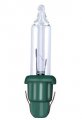
Each bulb is rated at 0.5 W, 0.2 A @ 2.5 V.
The measured cold resistance is 2 to 3Ω. While on, the bulb takes about 140 mA @ 2.5 V, which makes it effectively 17 Ω.
The measured cold shunt resistance is about 0.4 Ω.
With 50 bulbs in a string, that makes the total resistance 850 Ω. This would draw about 140 mA from 120 VAC line voltage.
A string with 100 bulbs would have two strings of 50 bulbs in parallel. With 240 VAC voltage, there are 100 bulbs in series.
With a cold shunt resistance of 0.4 Ω, how does the filament ever turn on?
The shunt wire has a conductive coating. When wrapped around the filament support wires, the shunt exhibits a higher resistance than the filament. When the filament blows, the current causes the shunt to heat up which melts the coating on the shunt wire, reducing its resistance. The shunt acts as a fuse in reverse. It behaves as an almost open circuit and becomes a short circuit when it blows, similar to the operation of an MOV (metal oxide resistor).
When a bulb blows, the series current increases which shortens the life time of all the other bulbs. The weakest one goes next, causing a cascading event until all the bulbs blow, or one of the shunt blows.
Bottom line: replace a blown bulb soon when it blows. Check the entire string for blown bulbs before hanging on the tree. You can buy the bare bulbs in quantity. Check the voltage and wattage rating. Save and reuse the green plastic bases of the bulbs. Each string and make is different.
(Edit: My wife just bought new strings of 100 lights. The price was a quarter the price of 100 replacement bulbs. Go figure!)
Or more precisely, how does the shunt across the filament work?
Each bulb is rated at 0.5 W, 0.2 A @ 2.5 V.
The measured cold resistance is 2 to 3Ω. While on, the bulb takes about 140 mA @ 2.5 V, which makes it effectively 17 Ω.
The measured cold shunt resistance is about 0.4 Ω.
With 50 bulbs in a string, that makes the total resistance 850 Ω. This would draw about 140 mA from 120 VAC line voltage.
A string with 100 bulbs would have two strings of 50 bulbs in parallel. With 240 VAC voltage, there are 100 bulbs in series.
With a cold shunt resistance of 0.4 Ω, how does the filament ever turn on?
The shunt wire has a conductive coating. When wrapped around the filament support wires, the shunt exhibits a higher resistance than the filament. When the filament blows, the current causes the shunt to heat up which melts the coating on the shunt wire, reducing its resistance. The shunt acts as a fuse in reverse. It behaves as an almost open circuit and becomes a short circuit when it blows, similar to the operation of an MOV (metal oxide resistor).
When a bulb blows, the series current increases which shortens the life time of all the other bulbs. The weakest one goes next, causing a cascading event until all the bulbs blow, or one of the shunt blows.
Bottom line: replace a blown bulb soon when it blows. Check the entire string for blown bulbs before hanging on the tree. You can buy the bare bulbs in quantity. Check the voltage and wattage rating. Save and reuse the green plastic bases of the bulbs. Each string and make is different.
(Edit: My wife just bought new strings of 100 lights. The price was a quarter the price of 100 replacement bulbs. Go figure!)