Testing AC Line Quality with an Oscilloscope - Generator power quality

Andrei Suditu

Joined Jul 27, 2016
52
First...transformers are inductors.They will have a different impedance with frequency....they deform non sinusoidal signals.
About direct probe....check your probes max voltage rating and also your scopes max input rating.
Also note that there might be spikes so it's a good idea to have room.
Ex:if your scope is 100V pk-pk(peak to peak) you can measure up to 1000V with an x10 probe....if the probe rating is adequate (>=1000V).
I'd play it safe and make a voltage divider and then hook up the x10 probe on that.
Also check your power rating for resistors.
Try a x10 divider made with 1M and 100k resistor.Measure voltage across the 100k resistor.
 

Reloadron

Joined Jan 15, 2015
7,893
Actually since you have 10:1 scope probe you really don't need to make a divider but if you did I don't quite see the above working well. This is a good read in the forum library on making your own scope probe. Figure 5 in the link has a basic scope probe schematic.

Try a x10 divider made with 1M and 100k resistor.Measure voltage across the 100k resistor.
Don't we need to consider the input impedance of the scope which is typically 1 Meg Ohm shunted by about 20 pf? That resistance will parallel your 100K resistance in the above example. Using a scope with a 1 Meg Ohm input impedance using the above resistors the Vout for 120 V RMS applied would be about 10 V RMS and not the expected 12 V RMS. Placing 9 Meg in series with the scopes 1 Meg vertical input impedance will result in a 10:1 division ratio. That is how I see it anyway.

Ron

Since you have a 10:1 probe I doubt it matters.
 

Andrei Suditu

Joined Jul 27, 2016
52
Actually since you have 10:1 scope probe you really don't need to make a divider but if you did I don't quite see the above working well. This is a good read in the forum library on making your own scope probe. Figure 5 in the link has a basic scope probe schematic.


Don't we need to consider the input impedance of the scope which is typically 1 Meg Ohm shunted by about 20 pf? That resistance will parallel your 100K resistance in the above example. Using a scope with a 1 Meg Ohm input impedance using the above resistors the Vout for 120 V RMS applied would be about 10 V RMS and not the expected 12 V RMS. Placing 9 Meg in series with the scopes 1 Meg vertical input impedance will result in a 10:1 division ratio. That is how I see it anyway.

Ron

Since you have a 10:1 probe I doubt it matters.
True forgot to take that in consideration.Again if the scope can handle some voltage he could try to reduce the 100k resistor.If he makes it say 1K that 1M impedance of the scope will matter less and he will have a 1000:1 probe.I'd say accurate enough since at 400V input he will get ~400mV out and if we put in consideration the 1M impedance(without cap into account) it will be a 1001:1 probe.Anyway i don't like scope probes on AC lines since if you have an old fridge or whatever you could get spikes......better be safe ....especialy if you are using stock probes.
 
Last edited by a moderator:

Reloadron

Joined Jan 15, 2015
7,893
True forgot to take that in consideration.Again if the scope can handle some voltage he could try to reduce the 100k resistor.If he makes it say 1K that 1M impedance of the scope will matter less and he will have a 1000:1 probe.I'd say accurate enough since at 400V input he will get ~400mV out and if we put in consideration the 1M impedance(without cap into account) it will be a 1001:1 probe.Anyway i don't like scope probes on AC lines since if you have an old fridge or whatever you could get spikes......better be safe ....especialy if you are using stock probes.
I agree but the Original Poster did mention, I believe, he has 10:1 probes. I would use them in a differential mode and be done with it. No clue exactly what he wants to find as to line quality from a generator and I assume older non-inverter type generator.

Ron
 

Thread Starter

Lumenosity

Joined Mar 1, 2017
614
I agree but the Original Poster did mention, I believe, he has 10:1 probes. I would use them in a differential mode and be done with it. No clue exactly what he wants to find as to line quality from a generator and I assume older non-inverter type generator.

Ron
Yes, the probes are set at 10:1 (to be safe in case of spikes)

As for the line quality, I want to see how close to a pure sine waveform the different generators produce.

I have a non inverter generator and a few inverter generators.
 

Thread Starter

Lumenosity

Joined Mar 1, 2017
614
I noticed that with my scope (Hitachi V-1050F), both the waveforms from the A channel and the B channel look identical when viewed separately.

Why do I need to use 2 channels when I can see the exact same sine wave using just one probe?

Is it possible the waveforms could be different in some situations? Why wouldn't the waveform of the Neutral = the waveform of the Line (Hot)
 

Andrei Suditu

Joined Jul 27, 2016
52
I agree but the Original Poster did mention, I believe, he has 10:1 probes. I would use them in a differential mode and be done with it. No clue exactly what he wants to find as to line quality from a generator and I assume older non-inverter type generator.

Ron
My scope came with x10 probes but they are not rated for AC line voltages...at least where i live.230 x sqrt(2) gives 300ish volts.My scope get in 100V pk pk so i could go theoretically to 1KV but the probes are much lower rated.
If he has good x10 rated enough...then he can plug them straight in...tho note that probe GND is conected to earth...so if you do this on mains be carefull.
 

Thread Starter

Lumenosity

Joined Mar 1, 2017
614
OK,
Touching the probe directly to the metal inside the outlet made almost no difference.
I could barely see a VERY slight increase in magnitude (maybe 2%) but the waveform shape did not change at all
outside of that VERY slight change in magnitude.

I was expecting something very easy to see. A substantial change (smoothing) of the waveform but that did not occur.

I have no explanation for this.
 

Thread Starter

Lumenosity

Joined Mar 1, 2017
614
I'm wondering if maybe my Oscilloscope is working properly? I can't seem to get any clean Sine waves from house AC or Inverter generators.
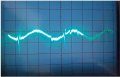
Here's what I got when connected single channel to a Honda EU2000i inverter generator.
Notice that scary looking spike.....and the really noisy looking curve.....looks like a 240v spike?
I find it hard to believe I actually have such noisy home AC and my Honda inverter generator is producing that ugly AC.
Kinda thinking these new (cheap, ebay) probes I'm using are as cheap in quality as their price ($12.00)

Does anyone else think the problem could be these new probes?

Honda eu2000i inverter Generator - Those spikes are pretty serious, no?
HondaEu2000is_Capture.JPG


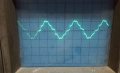
And here's what I got from a single channel probe of House AC current using single channel....
sinewave1.jpg

The probes were advertised as compatible with any 100mHz Oscilloscope. My V1050F is a 100mHz scope.
 
Last edited:

Thread Starter

Lumenosity

Joined Mar 1, 2017
614
P6100 2PCS Digital Oscilloscope Probe 100MHz BNC Test Lead for Fluke Tektronix


Features and specifications:

Adjustable oscilloscope probe that is compatible with the BNC interface, digital oscilloscopes, virtual oscilloscopes, handheld oscilloscopes, etc.

Model: P6100
Bandwidth: DC-100MHz
Rise time: 3.5ns
Attenuation ratio: 1X/10X
Input resistance: 1MΩ/10MΩ±2%
Input capacitance: 1X:70pF-120pF, 10X:13pF-18pF
Maximum input: 1X-200 working voltage (Vp-p),
10X-600 working voltage (Vp-p)
Compensation range: 14 - 35pF
Operation environment: 0-50℃ ,0-80%RH
Storage environment: -20-60℃ ,0-90%RH
Size:110 ± 2cm
Weight: About 130g/set
 

Reloadron

Joined Jan 15, 2015
7,893
I left you a reply in the other forum but to keep this current: :)

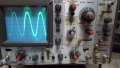
A few things aren't right or at least look peculiar. The last images you posted your scope looks like it is in a delayed sweep mode.
From your scope's user manual:
INTEN Although the sweep on the screen is A sweep it indicates B sweep (delay time sweep) by intensity modulation.

The image sort of reflects an intensified portion. Not sure why that is.

Both images should have a much, much cleaner sine wave, similar to the image I posted.

I have never looked at the output of an inverter type generator but like your house mains voltage I can't believe it would be that bad. Since they use an inverter I would expect a little noise but not to that extent.

This should be your scope's user manual.

If you look at pages 27 and 28 they cover modes:
o CHI Only the input signal applied to CHI is displayed.
o CH2, I X-YI Only the input signal applied to CH2 is displayed.
o ALT CHI and CH2 signals are displayed alternately on consecutive sweeps.
o CHOP CHI and CH2 signals are displayed simultaneously by switching between channels at about 250 kHz rate.
o ADD Displays the algebraic sum of the channel I and channel 2 input signals. If the channel 2 display is inverted (press CH2 display results. CH2 INV), an CHI minus
CH2 INV Inverts the polarity of the channel 2. Useful to comparison of two signals of opposite polarities, and observation of a differential signal of CHI and CH2 along with ADD mode.

Those last few are what we have been getting at. Since the outer shell of your BNC vertical input connectors are at chassis ground using both vertical channels displayed as a single channel can help eliminate a potential shock hazard.

Also page 34 of the linked manual:

CAL O.5V Output terminal of calibration square wave of about 1kHz and O.5V. It has a tip terminal. It is used to calibrate the probe combination .

You may want to try your probes on that since it should be a known signal and see how the display looks. Something isn't right and that needs solved before we worry about looking at signals. Something else to consider is a generator output really only needs to be as good as its intended use or application. I use a few UPS (Uninterruptible Power Supply) which have a less than stellar MSW (Modified Sine Wave) output. Their only purpose is to maintain several electronic devices for a 30 second period until the backup generator is online. Despite the ugly output waveform the supported electronics do fine.

Ron

To add a little, if I am not mistaken you are in the US so looking at 120 VAC RMS 60 Hz. Since your scope displays a peak to peak signal that would be 120 * 1.414 = 169.68 Volts Peak so twice that is a 339.3 Volt Peak to Peak signal. So you are within the working volatge limits of your probes.

Maximum input: 1X-200 working voltage (Vp-p),
10X-600 working voltage (Vp-p)
 

DickCappels

Joined Aug 21, 2008
10,661
If your probe is not properly compensatef you might see high frequency garbage as being higher in amplitude than it really is. Adjust the frequency response of your probes using that 1 kHz square wave that Reloadron wrote of in the post above.

"Low-frequency compensation(LFC) involves tweaking the frequency response of the x10 probe in the kHz region. ... Cp is the stray capacitance of the probe tip itself. R1 is an in-series 9 MΩ resistor used to isolate the capacitance of the cable and input of the scope from the device under test."
 

Thread Starter

Lumenosity

Joined Mar 1, 2017
614
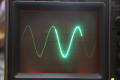
Finally got a decent SineWave thanks to ReloadRon and many of you kind enough and patient enough to guide me.
Thank you!

Probe Ground directly connected to Neutral
Probe Tip directly connected to Hot

Here is the much better sine wave I finally got. The settings puzzle me a bit however....
VARIABLE Volts/Div setting at 2
TIME/DIV setting at 5ms
PROBE set at 10X
OScope_Sinewave_1A_20190901_140437.jpg
 

Reloadron

Joined Jan 15, 2015
7,893
Now that looks much better. Just a few quick thoughts.
Your variable Volts/Div you really want set at the Cal position. Normally you feel a slight detente on most scopes. Looks to be rotated fully clockwise for your scope. The little inner red knob. I would make sure your variable is set to Cal and the main vertical gain knob set for 5 Volts/Div so with a 10:1 probe you have 50 Volt/Div.Your 120 VAC RMS will then cover about 6 divisions vertically.
Looks like your main time base "A" is set to 5 mSec/Div but the "B" or delaying time base is set to a faster sweep speed. When doing basic measurements like we are doing here set the inner and outer knobs both for the same sweep. I think this is why your trace has an intensified section. I noticed this before in your images. Just over 4 divisions in to the right your trace seems intensified.

Just a matter of getting more familiar with the scope and how to get the most out of it when using it. Anyway, nice difference.

Ron
 

Thread Starter

Lumenosity

Joined Mar 1, 2017
614
Now that looks much better. Just a few quick thoughts.
Your variable Volts/Div you really want set at the Cal position. Normally you feel a slight detente on most scopes. Looks to be rotated fully clockwise for your scope. The little inner red knob. I would make sure your variable is set to Cal and the main vertical gain knob set for 5 Volts/Div so with a 10:1 probe you have 50 Volt/Div.Your 120 VAC RMS will then cover about 6 divisions vertically.
Looks like your main time base "A" is set to 5 mSec/Div but the "B" or delaying time base is set to a faster sweep speed. When doing basic measurements like we are doing here set the inner and outer knobs both for the same sweep. I think this is why your trace has an intensified section. I noticed this before in your images. Just over 4 divisions in to the right your trace seems intensified.

Just a matter of getting more familiar with the scope and how to get the most out of it when using it. Anyway, nice difference.

Ron
This is so helpful.
Thank you very much sir.
 

Reloadron

Joined Jan 15, 2015
7,893
Well between the two forums I believe you have a good idea of what is going on. I took a few pictures today and played with mt shutter speed. I never would have thought the impact shutter speed would have. Most of the images I take of my scopes I just shoot auto mode on a Canon EOS 7D.
Scope Intensified.png

Live and learn. Most of my previous shots were done at 1/60 Sec so with stable triggering on the scope the slower shutter times make sense.

Also keep in mind between the two forums you will get a wide range of answers. See what works for you and what you are comfortable with as to a setup.

Ron
 

Thread Starter

Lumenosity

Joined Mar 1, 2017
614
Yes, Nigel on the other forum has me concerned since he says the way I connected to the House AC "should" have blown circuit breakers....but it didn't. I have no way of knowing who visits what forums so naturally, I posted at both.

As for the photos.......
I've been trying to use a cellphone camera but it's been difficult due to a lack of control over shutter speed etc.

Yesterday I ordered a Digital Camera that has FAR better capabilities especially as far as shutter speed is concerned.
It'll be here next week. I probably coulda used my Sony Handicam and got even better pics but I don't really want to expose the Handicam to that environment with the cables, cords and generators etc. Too easy for an accident. It was too expensive and the camera was not.

I need to learn the correlation between the O-Scopes display timing and the camera shutter speed.
However, outside of testing motorcycle and automotive alternators, the O-Scope will probably go back to sleep on the shelf for a while after this round of measurements. Electronics fascinates me, but I don't learn as easily as I once did.

Your help has been great. Thanks for your time <thumbsup>
 

Reloadron

Joined Jan 15, 2015
7,893
I am assuming you are in the US or on the N. American continent. I also read Nigel's concerns and have no idea why he seems to thing a circuit breaker or GFCI breaker should have tripped. I assume US or Canada only because of reference to 120 VAC.

The large concern in any online electrical/electronic forum is always going to come down to safety. I left a post last night in the other forum explaining my views on all of that.

As to the oscilloscope display. On an analog scope a trace is triggered and moves across the screen left to right, after completing the sweep the Z axis (intensity) is blanked and a snap back happens and the process repeats. So with a horizontal sweep time set for example 5 m/Sec per division the trace will take at least 50 m/Sec to cross the screen. Since we have no idea where the trace is when the shutter opens we want the shutter open long enough to make sure we get an entire sweep.

Sometimes with threads involving mains voltage or mains voltage generators everyone tends to go ballistic about safety which is fine but at least reply with good data. My last post in the other forum I asked they please provide a method. While I still do not see using a scope as a really good solution to look at power quality at least you can get a rough idea of what the power looks like. Earlier in this thread a few members opposed the use of a transformer and said why. Now in the other forum I see where a transformer is suggested. Yes, it can get confusing.

Personally I am comfortable working with AC mains power including poly phase of 480 VAC and 4160 VAC which are pretty standard in the US. If you are not comfortable with any setup then I suggest avoiding it. There is only so much that can be said. Like Clint Eastwood said, a man has to know his limitations. :)

Ron
 

Thread Starter

Lumenosity

Joined Mar 1, 2017
614
Yes, I believe he said connecting Probe ground to Neutral and Probe Tip to Hot was a "very" bad idea because Neutral would be bonded to Ground, and since the Oscilloscope does have a Ground pin, the scope should be grounded, if I understood correctly.
I got no smoke and no spark......but a slightly different waveform than expected.
The waveform I got from this test on my House AC showed a minor flat spot on the peaks and I'm wondering if this indicates the condition he spoke of where the peaks of the sine wave has possibly been chopped a bit from voltage loss due to his concern......I'm not sure but it seems plausible to me.

I suppose what I need to do is test to see if the Neutral in my home is in fact bonded to Ground (which I believe it should be, unlike my generators).

I have a power transfer switch in my home I should mention which allows me to disconnect the house AC from the outside Line for connecting a generator, so this could complicate things a bit.

I think I'll pull the outside main power connector for that test.

As far as 480VAC.....one has to know EXACTLY what they're doing around that no doubt. 120v is all I feel comfortable around except that I know 240v is always lurking in the panel box.

The only line I can remember from Clint Eastwood is Dirty Harry...."Go ahead punk, make my day" :)
 
Top