test resistance without a multimeter

djsfantasi

Joined Apr 11, 2010
9,237
You can use an Arduino Nano or Uno to program ATTINY, they are << $ 5. Or the SparkFun @ $ 15. Or AVRisp....


Regards, Dana.
@Kardo22

Dana and I always have this friendly back and forth on this topic.

He’s right in that an Arduino may be less expensive. It requires skills in more software and wiring the Arduino and ATTiny up in order to program.

I’m right in that for $10 bucks, you get a simpler solution. Plug it into a laptop or computer. Add one driver library to the IDE. Program the chip.

If you’re experienced in programming microprocessors and can’t afford $10, go with his suggestion.

If you think that your time is worth $10, go with the SparkFun programmer.

Just wanted to compare the two solutions.
 

Wolframore

Joined Jan 21, 2019
2,619
Cal is done at programming and constant can be stored in eeprom. Or you can adjust your math to compensate for the actual measured band gap on your particular chip. Once this 10% manufacturing tolerance is accounted for you will get very little drift in your measurement. It should be within 0.5% no matter what VCC or temperature in that huge range.
 
Last edited:

KE4KTO

Joined Dec 6, 2015
2
For sure answer is yes. Question for you is Rx in circuit and you have to measure it ?
Or is it isolated, such that one could drive it with a current source and measure the V
drop across it ?


Do you want circuit ideas to develop, can you write code for a micro, or use Scratch
language and an Arduino ?


Regards, Dana.
 

KE4KTO

Joined Dec 6, 2015
2
The answer is absolutely YES... I am not going to tell you HOW to solve this simple problem, but I will POINT you back to the basics...
Remember OHM's Law? Your answer lies there. If you know the current and the voltage drop, then you know (or can simply calculate) the resistance.

This is simply basic electricity 101.
John
 

bob91343

Joined May 29, 2019
16
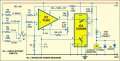
This is the circuit of the one that I built. It is from a circuit on www but I can't find it - there are many designs there.
It lights the green LED and sounds the buzzer for very low resistances. For higher resistances it lights the red LED (no buzzer). I don't remember the resistance limits.
View attachment 181477
I have a couple of instruments that can do that. One is an LCR bridge and the other a digital voltohmmeter. You can set resistance limits such that it will indicate if a resistor is within any particular tolerance you choose.

However I suspect you want a standalone circuit. An unbalanced bridge can do the job. Or put a calibrated current through the unknown and if the voltage is below some amount it can trip a relay, same if it's above.
 

Danko

Joined Nov 22, 2017
2,169
Is it possible to make a circuit that could be used to asses a resistance (not too accurate needed). F.e. if resistance is under 5ohm or is 50-100ohm.
I'm thinking something that would light up a LED if the resistance is in the range (0-5ohm and 50-100ohm).
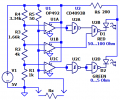
Exactly what you asked:
upload_2019-7-31_3-14-18.png
 

Danko

Joined Nov 22, 2017
2,169
From OP492 specifications:
Output Short-Circuit Duration______Unlimited
Short-Circuit Current Limit________8...10.5 mA

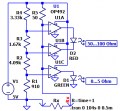
So, I simplified circuit.
Now it contains 1 chip, 2 LEDs and 5 resistors:
upload_2019-8-1_20-48-27.png
upload_2019-8-1_20-51-55.png
 

Attachments

AlbertHall

Joined Jun 4, 2014
12,625
From OP492 specifications:
So, I simplified circuit.
Now it contains 1 chip, 2 LEDs and 5 resistors:
That circuit puts a lot of voltage and current across/through RX - 5V max and 100mA max.
This will also turn on semiconductors on the board confusing the reading.
 

Danko

Joined Nov 22, 2017
2,169
That circuit puts a lot of voltage and current across/through RX - 5V max and 100mA max.
This will also turn on semiconductors on the board confusing the reading.
Are you sure?
Did you read TS specifications?
It is easy to decrease, for example, V to 0.5V and I to 10mA, by adding 1 resistor, but...
It's isolated.
Not a resistor actually but PCB with a mesh. I have 2 types (one should be below 5ohm, other 50-100 ohm), so 2 different measurement circuits.
TS tests conductors only. Usually, for it they use probe with battery 4.5V and lamp 300mA (inrush current 3A).
Bigger current - better test.
 
Last edited:
Top