test resistance without a multimeter

Thread Starter

Kardo22

Joined Mar 12, 2014
51
Is it possible to make a circuit that could be used to asses a resistance (not too accurate needed). F.e. if resistance is under 5ohm or is 50-100ohm.
I'm thinking something that would light up a LED if the resistance is in the range (0-5ohm and 50-100ohm).

I'm really not sure how this could be possible but perhaps some experienced engineers here know.
 

danadak

Joined Mar 10, 2018
4,057
For sure answer is yes. Question for you is Rx in circuit and you have to measure it ?
Or is it isolated, such that one could drive it with a current source and measure the V
drop across it ?


Do you want circuit ideas to develop, can you write code for a micro, or use Scratch
language and an Arduino ?


Regards, Dana.
 

AlbertHall

Joined Jun 4, 2014
12,623
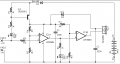
This is the circuit of the one that I built. It is from a circuit on www but I can't find it - there are many designs there.
It lights the green LED and sounds the buzzer for very low resistances. For higher resistances it lights the red LED (no buzzer). I don't remember the resistance limits.
upload_2019-7-11_12-23-59.png
 

Thread Starter

Kardo22

Joined Mar 12, 2014
51
For sure answer is yes. Question for you is Rx in circuit and you have to measure it ?
Or is it isolated, such that one could drive it with a current source and measure the V
drop across it ?


Do you want circuit ideas to develop, can you write code for a micro, or use Scratch
language and an Arduino ?


Regards, Dana.
Thanks. I was hoping to not use a microcontroller but might have to if the other idea won't pan out.

This is the circuit of the one that I built. It is from a circuit on www but I can't find it - there are many designs there.
It lights the green LED and sounds the buzzer for very low resistances. For higher resistances it lights the red LED (no buzzer). I don't remember the resistance limits.
View attachment 181477
Thanks. I'll have to look into it. I'll see if I can find what resistors to change to get desired results.
 

danadak

Joined Mar 10, 2018
4,057
Question for you is Rx in circuit and you have to measure it ? Or is it isolated, such that
one could drive it with a current source and measure the V drop across it ?

Just 1 LED turn on for R in either range ?


Regards, Dana.
 

AlbertHall

Joined Jun 4, 2014
12,623
Question for you is Rx in circuit and you have to measure it ? Or is it isolated, such that
one could drive it with a current source and measure the V drop across it ?

Just 1 LED turn on for R in either range ?


Regards, Dana.
If the resistor is in circuit then whatever you measure it with you risk an incorrect measurement because of other components on the board.
For very low resistances it lights both LEDs and the buzzer, for higher values only the red LED lights.
The voltage across Rx is very low if the buzzer sounds (about 45mV) so external semiconductors will not be turned on. On the other hand it will test LEDs by lighting them if they are connected the right way round.

[EDIT] Also it needs no on/off switch as there is only a very low leakage current if nothing is connected to the test leads.

[EDIT2] Just been trying it with resistors. The buzzer sounds for 5Ω but not for 10Ω. The red LED brightness varies depending on the resistance and is just barely visible with a 330k resistor but that is going to very dependent on the particular LED. You could tune that to a lower resistance by putting a resistor in parallel with the red LED.
 
Last edited:

danadak

Joined Mar 10, 2018
4,057
Question for you Kardo22 is Rx in circuit and you have to measure it ? Or is it isolated, such that
one could drive it with a current source and measure the V drop across it ?

Just 1 LED turn on for R in either range ?


Regards, Dana.
 

Thread Starter

Kardo22

Joined Mar 12, 2014
51
Question for you Kardo22 is Rx in circuit and you have to measure it ? Or is it isolated, such that
one could drive it with a current source and measure the V drop across it ?

Just 1 LED turn on for R in either range ?


Regards, Dana.
It's isolated.
Not a resistor actually but PCB with a mesh. I have 2 types (one should be below 5ohm, other 50-100 ohm), so 2 different measurement circuits.
 

danadak

Joined Mar 10, 2018
4,057
Here is an approach using a micro, Arduino, but not programming in the conventional sense.

Using Scratch block language where you drag and drop blocks which are then converted to Arduino
code for you. This particular language is mBlock. Note the C code in right window
generated by mBlock from the graphical blocks assembled by user in middle pane.

This assumes you use a current source like LM334 to drive the Rx or use Rx in a divider. The values
tested for will be determine by the approach of converting Rx to a voltage to feed to onboard A/D.

I think this will fit on ATTINY85, so all you would need is it, a cap to bypass the ATTINY85, LM334 to
drive known current into Rx, and a transistor and a couple of Rs to drive buzzer, unless its a logic
level buzzer, in that case processor pin just connects straight into buzzer. Programming ATTINY85 a
little more involved, you need an Arduino board to do that.


Keep this in mind for future projects to see just how easy it can be to do simple projects.

Note the ATTINY85 has multiple channels for A/D so it can handle 2 measurements.

The question about accuracy needed, your answer, determines if this is workable
with Arduino, ATTINY85, as onboard reference not all that great.

Done with mBlock 5.01. Project attached in case you want to look at it. I did the
code for just one channel.


Regards, Dana.
 

Attachments

Last edited:

Wolframore

Joined Jan 21, 2019
2,619
The question about accuracy needed, your answer, determines if this is workable
at Arduino, ATTINY85 onboard reference not all that great.
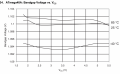
The ATTINY has an internal 1.1V band gap reference which can be extremely accurate and stable once it's calibrated

upload_2019-7-12_10-32-31.png
 

djsfantasi

Joined Apr 11, 2010
9,237
Programming ATTINY85 [is] a little more involved, you need an Arduino board to do that.

Keep this in mind for future projects to see just how easy it can be to do simple projects.
If mBlock can output its C code directly, you don’t need an Arduino to program the code onto the ATTiny85. SparkFun makes an USB programmer for the ATTiny family that uses the free Arduino IDE.
 

Wolframore

Joined Jan 21, 2019
2,619
the datasheet shows the 10% tolerance on the bandgap from manfacturing process... they do not calibrate in the factory... there are manufactures that do this but I'm sure it's a higher cost.

after calibration go to the chart and select VCC supply. @5V you are looking at 1.101 - 1.095V from 85C - minus 40C... that's flat enough for me. Also note how stable it is even accross the supply voltage.

Let me see what I can find for the calibration... I forget, it's been a while, It's a offset constant added to correct the actual measured bandgap voltage. When the 1.1V internal reference is selected you can measure this on AREF pin. I deal with this rarely because usually the ratiometric reading is usually all I need and doesn't need cal.
 

danadak

Joined Mar 10, 2018
4,057
the datasheet shows the 10% tolerance on the bandgap from manfacturing process... they do not calibrate in the factory... there are manufactures that do this but I'm sure it's a higher cost.

after calibration go to the chart and select VCC supply. @5V you are looking at 1.101 - 1.095V from 85C - minus 40C... that's flat enough for me. Also note how stable it is even accross the supply voltage.

Let me see what I can find for the calibration... I forget, it's been a while, It's a offset constant added to correct the actual measured bandgap voltage. When the 1.1V internal reference is selected you can measure this on AREF pin. I deal with this rarely because usually the ratiometric reading is usually all I need and doesn't need cal.
This application is for absolute value (or so I think), so I was struck by the initial tolerance being
so poor. There are parts out there 1% same price range as ATTINY. I see the cal is at time of
board manufacture/programming, beyond the scope of this design I think. But am
glad you pointed out curve and ratiometric, will store that between the empty void
between my ears :)


Regards, Dana.
 
Top