Technics SU-VX800 amplifier

MrChips

Joined Oct 2, 2009
34,829
Do your transistors have insulated tabs or bare metal tabs?

Are you installing the transistors to the heat sink with proper mica washers, insulating mounting hardware and thermal paste?
 

JoeJester

Joined Apr 26, 2005
4,390
Okey... i just thought it was strange the trace suddenly started to jump...also under the "center" line.. did you see the video?
Yes, I saw the video. I think that is more of a function of the time base you selected. That frequency is much greater than the 1.2 mS of your full display. You would have to increase the time base a couple of steps higher to see more of that signal.

This only seems like a never ending story ... that being said ... the new clue was it happened at a higher volume level, assuming you installed all the transistors properly.

Time ... and increased volume.

I don't think we tested the "volume" when the diodes were installed as the emitter-base junction.

I trust there were no unusual noise or such at the time of failure?


Once those transistors short, that 2A fuse is history.
 
Last edited:

Thread Starter

Marius83

Joined Dec 28, 2017
423
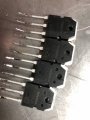
Power transistors at the LEFT side was this time from Digikey, all tested ok. See picture.

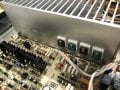
Transistors were mounted with ceramic insulators without pasta at the moment.
See picture of the insulators on the RIGHT side.

As mentioned two of the power transistors at the left side was a little hot to touch and i decided to turn down the volume.
I don’t believe it was hot enough to fail because of the heat.

Hard to explain but when i turned down the volume it came some noise and the sound dissapeared right before it blew the fuse.
But this happened when i turned the volume up too..
 

Attachments

JoeJester

Joined Apr 26, 2005
4,390
I'll assume they failed by E-C short again.

Are they the proper size insulators? They look a lot thicker then I've seen before.
 

Technics44

Joined Jun 18, 2020
17
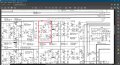
Check the condition of the component welds in the area indicated in red on the attached capture.
A break in the link could cause the amplifier to "excite" and lead to the destruction of the output transistors.


SU-VX800.JPG
 

Thread Starter

Marius83

Joined Dec 28, 2017
423
Check the condition of the component welds in the area indicated in red on the attached capture.
A break in the link could cause the amplifier to "excite" and lead to the destruction of the output transistors.
Thanks, i will check the area.


Could a faulty volume potentiometer make this happen?
 

Thread Starter

Marius83

Joined Dec 28, 2017
423
Here are the measurement on the power transistors at LEFT channel this time:

Q507
Red to B

Black to E: .003 V
Black to C: .003 V

Black to B
Red to E: .003 V
Red to C: .003 V

Red to E
Black to C: .003 V

Black to E
Red to C: .003 V

Q509
Red to B

Black to E: .886 V
Black to C: 003 V

Black to B
Red to E: .886 V
Red to C: .003 V

Red to E
Black to C: .883 V

Black to E
Red to C: .880 V

Q515
Red to B

Black to E: .003 V
Black to C: .003 V

Black to B
Red to E: .003 V
Red to C: .003 V

Red to E
Black to C: .003 V

Black to E
Red to C: .003 V

Q517
Red to B

Black to E: .003 V
Black to C: .003 V

Black to B
Red to E: .003 V
Red to C: .003 V

Red to E
Black to C: .003 V

Black to E
Red to C: .003 V
 

Thread Starter

Marius83

Joined Dec 28, 2017
423
I've searched the area you mentioned @Technics44, but i couldn't find anything wrong.. :(

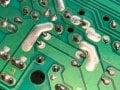
I found some other bad solder points though.... at J209,J210 and J212..
Looks cracked or they have been hot..
The picture doesn't do justice.. too low resolution.

I don't know if they would have anything with the case to do, but i will fix them.

What other things could make all four power transistors blow suddenly like this?

Should i try to replace Q503/Q505 ....... and by the way... Q501 has never been replaced...
Just thinking loud...


solder.jpg
 

JoeJester

Joined Apr 26, 2005
4,390
Thanks .... that confirmed what we assumed.

Here's a hint for checking the boards for cracks. Connect your ohmmeter to both ends of the run., it should be zero. then flex the board a little from both sides and make sure the meter remains at zero. It's easier to see with an analog meter than a digital unless you apply the pressure flexing the board for a long enough time for the DMM to react. By flexing the board, I don't mean bending it more than a mm or two. Of course if the ends reveal an open, you can move one meter lead closer along the run to find the break. Typically, due to excessive or improper desoldering of a component, the break will be right at the eyelet. The visual way will require a better eyes than mine ... I did find ax5 to x1000 blue tooth microscope (at Amazon) that is on my Christmas list to aid this old man. LOL


Question:

Was the speaker selector switch turned to OFF when you set the ICQ?
 

JoeJester

Joined Apr 26, 2005
4,390
Ok, I'll assume the volume control was down to minimum when you did the ICQ adjustment and long tests which were successful. The problem arose when you added volume (and audio).
 

Thread Starter

Marius83

Joined Dec 28, 2017
423
Yes. Volume to minimum and speaker selector to off at all earlier tests.

First time it flew a little peace off Q515 when i adjusted VR403.
Q515 and Q517 shorted.

So i replaced Q515 and Q517 and tried again.
Then it blew all four power transistors in the same way, a couple of minutes after adjusted VR403, just idling.

Then i tried with new transistors from Digikey, played music with Q507/Q509 installed.
Then installed the other two Q515/Q517, and played music on loud volume over half an hour.. when i was turning down the volume, a little noise came and the sound dissapeared and came back, then went silent, blowing all four power transistors.

I’m wondering.. could a bad contact to the volume pcb do this?
I’m thinking about installing the front pcb back in the front cover, so it will be stable as it should be....
 

JoeJester

Joined Apr 26, 2005
4,390
Do you have contact cleaner to clean the volume and other variable potentiometers in the set? I would pursue that.

Do you have a 3.5mm jack to RCA jack cable? That could connect your phone to the CD input or other line level input and you can use a signal generator app tp generate a continuous tone for testing. Testing with music, may or may not produce visible results on the oscilloscope. The app is free.

I'd prefer not to destroy another set of transistors.

Do you have an analog meter? You could test the potentiometer between the wiper and another leg, The meter should go from zero to the resistance value smoothly. If you came across a bad spot, the meter would be jittery. Jittery is not easily discerned with a DMM.
 

Thread Starter

Marius83

Joined Dec 28, 2017
423
I do have contact cleaner... but i don't know if i get to open the volume potentiometer.. i will check it out.
EDIT: I can't see any way of opening the potentiometer to check it.. it seems really solid and pretty tight...

I do have tone generator and that cable, so i can generate frequency to measure.

I also have two sets of new power transistors, so i guess we just have to try again.
Should i check Q503/Q505 before powering up with new power transistors?

I don't have an analog meter.... i guess i could try to borrow one... how would i connect it to check the volume potentiometer?


EDIT: I have checked the front PCB very closely for bad solder points, and i did found quite a few that did look bad/cracked, it might not help the case but it can't be worse...
 
Last edited:

JoeJester

Joined Apr 26, 2005
4,390
I'll recommend the following using the attached "cropped" version of the Volume Control board from the schematic.

Unplug the set.


Adjust the signal generator for a 2 volt peak to peak signal on your oscilloscope. It may change depending on the connection especially with the right side of the schematic diagram ....

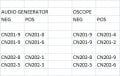
Make connections per the table ...

Adjust the potentiometer from minimum to maximum while observing the oscilloscope.

Here's the schematic ....

VOL-POT.jpg

Here's the testing plan ...

TEST-MATRIX.jpg

and finally ...

A video about testing potentiometers .... you will see an overload condition using the DMM ... which may have been when there was a ranging issue..... the analog and dmm tests were ohm meter testing.

 
Last edited:
Top