TDR pulse generator

Thread Starter

Halfpint786

Joined Feb 19, 2018
109
Recently built a high voltage setup to avalanche transistors for testing bandwidth of scopes, ringing tanks, etc. I want to use this for TDR.

How can i "latch" a sub-nanosecond pulse for x duration into a square wave or pulse width signal so the rise time can be used in conjunction with a step response for easier TDR testing of coax cables?
 

Papabravo

Joined Feb 24, 2006
22,082
I re-read your post five times and I cannot for the life of me figure out what you are talking about. As I used a TDR for testing coax, I have a low duty cycle pulse generator, that repeats at such a rate that the wavform can reflect between 8 and 15 times so the effects of the later reflections are greatly attenuated. The other end is open, or short, or mismatched, or terminated properly. Each condition gives a characteristic behavior. The advantage of this technique is that you don't need a storage scope or a DSO to capture single shot events. Of course with a DSO you can do other interesting things.

http://users.tpg.com.au/adslsymb/VK6AAL/Links/steinbaugh.pdf
 

Thread Starter

Halfpint786

Joined Feb 19, 2018
109
I re-read your post five times and I cannot for the life of me figure out what you are talking about. As I used a TDR for testing coax, I have a low duty cycle pulse generator, that repeats at such a rate that the wavform can reflect between 8 and 15 times so the effects of the later reflections are greatly attenuated. The other end is open, or short, or mismatched, or terminated properly. Each condition gives a characteristic behavior. The advantage of this technique is that you don't need a storage scope or a DSO to capture single shot events. Of course with a DSO you can do other interesting things.

http://users.tpg.com.au/adslsymb/VK6AAL/Links/steinbaugh.pdf
So instead of a square wave generator (ideal for tdr step resopnse), mine is a pulse that rises to 38v in 6 ns (currently) and tapers off to zero within 10ns or so. I can control the frequency but i want the pulse to latch positive without falling back down. The slew rate on most transistors is horrible and my junk box has nothing fast.
 

DickCappels

Joined Aug 21, 2008
10,661
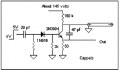
To get a longer pulse just replace the storage capacitor with a length of unterminated transmission line. The pulse width will be approximately the the cable length divided by the propagation velocity of the transmission line.

upload_2018-2-20_11-45-8.png

In the case of the configuration above, the 47 pf capacitor is the one that is to be replaced with the transmission line. The 47 pf is to assure that avalanche starts.
 

Thread Starter

Halfpint786

Joined Feb 19, 2018
109
To get a longer pulse just replace the storage capacitor with a length of unterminated transmission line. The pulse width will be approximately the the cable length divided by the propagation velocity of the transmission.

View attachment 146473


In the case of the configuration above, the100 pf capacitor is the one that is to be replaced with the transmission line. The 47 pf is to assure that avalance starts.
I like the idea but im concerned its not viable... a typical tdr square wave at 6khz is positive for 83.3 microseconds. In coax of vf=86 i need 21,485m of coax. This much coax (which i dont have) would have enough capacitance to cook any transistor on avalanche and would require lethal currents to charge fast enough.

Obviously 6khz is not an option with coax so i need an alternative. Even 100khz id be happy...
 

Thread Starter

Halfpint786

Joined Feb 19, 2018
109
It is not clear why you need a latch. Maybe if you sketched the desired waveform we can come up with some ideas.
I wanted the pulse to latch positive because i have never used impulse response with tdr. I bought a rigexpert, aa-170, loved it, then realized how slow and inaccurate it is. Im only familiar with the step response a square wave provides. Maybe i could add a capacitor across the emitter resistor to save some of the pulse and then take from that after limiting its voltage with a zener diode...
 

DickCappels

Joined Aug 21, 2008
10,661
That looks pretty good. Be aware of the effects of the resistor and the lcapacitance of the Zener might have on risetime.

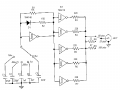
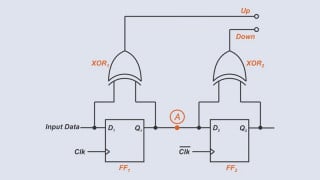
Since you will loose the sharp edge out of the avalanching transistor anyway you might want to try something like the circuit below.

upload_2018-2-20_13-31-49.png
 

Thread Starter

Halfpint786

Joined Feb 19, 2018
109
That looks pretty good. Be aware of the effects of the resistor and the lcapacitance of the Zener might have on risetime.

Since you will loose the sharp edge out of the avalanching transistor anyway you might want to try something like the circuit below.


View attachment 146476
Yep, i think thats best. Im going to shop for schmidt triggers. Im going to see how sharp i can make this tomorrow anyhow. Thanks for the help! 73! KE0KOY
 

Thread Starter

Halfpint786

Joined Feb 19, 2018
109
That looks pretty good. Be aware of the effects of the resistor and the lcapacitance of the Zener might have on risetime.

Since you will loose the sharp edge out of the avalanching transistor anyway you might want to try something like the circuit below.

View attachment 146476
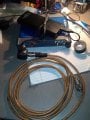
I finally got my hands on some 74AC14 schmidt triggers. I mistakenly ordered surface mount but it worked out as the whole circuit fits in a repurposed vhf cellwave filter housing. Ugly tape is just keeping the power wire from wiggling at the grommet. I am getting a fairly nice rise time, 3.5ns (90%) for 0v to 4v at about 50 ohm. I was expecting a bit faster but its gonna work for all my needs! The celwave housing even had a nice adjustable capacitor but doesnt quite have the range to rid all the ringing. Figured the ringing makes a good reference point so... mission complete! Thanks for all the help!
73! KE0KOY
20180429_202350.jpg 20180429_202522.jpg
 
Top