Switch mode Power Supply noise plus Filtering Practice Vs Linear

WBahn

Joined Mar 31, 2012
32,823
actually that is not milli Hertz either,...
units that have names based on real people (scientists who worked in related fields) are always capitalized.
writing it any other way is disrespectful to greats that allowed us to live modern lives and enjoy technology.

so milli Hertz is mHz and not mhz.
milli-Amper is mA, not ma,
micfo Farad is uF not uf,....
milli Henry is mH and not mh.

units not named after people are usually lower case.... like
meter (m),
inch (in),
hour (h),
second (s)
pound (lb) etc...
While the abbreviations of units named after people are capitalized, the spelled-out units are not. The only exception (in SI) is degrees Celsius. There is no dishonor in this, it is merely following the protocols laid out in internationally-recognized standards.

So 1 A is one ampere.

Something that takes a thousand seconds to complete one cycle has a frequency of one millihertz, or 1 mHz. If it does it at a million times a second, it is one megahertz, or 1 MHz.

There is no hyphen or space between the scaling prefix and the base unit name, but there is a space between the numerical value and the unit abbreviation, so it is not 3µF, but rather 3 µF or three microfarads.
 

Thread Starter

DJ_AA

Joined Aug 6, 2021
490
Thank you for your replies, and I apologise for my late response.

From my understanding, I need to simply calculate the voltage and current ripple and use an LC filter to minimise the fluctuations as much as possible before the signal goes into my LDO.

If I am correct, Linear Tech has its own SPICE tool that I can experiment with.

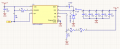
My apologies, I noticed that I included a screenshot of the wrong design. The design I intended to share is below, which involves stepping down from my 12V battery.

I have designed multiple power modules, which I tend to reuse. I think I will go ahead with this, but with an additional LC filter circuit.

1729766451210.png
 

Thread Starter

DJ_AA

Joined Aug 6, 2021
490
You need to estimate (or simulate) the current ripple and the voltage ripple from the reference design. OTOH if you actually followed the design procedure based on your specifications then you would be able to answer the question. One of the problems with reference designs is that don't tell you what the requirements are. If you don't know what the requirements are, then you can't do a new design.

For Example: Let's say I want an output current of 250 mA with 20% current ripple. This will allow the selection of a switching frequency and an inductor. Let's further say that we want and output of 4.2 Volts with a 1% Voltage ripple, This, will allow us to pick a capacitor value to meet that objective. Now we have a condition for the linear regulator that we can create and evaluate its response.

ETA: I just checked the LTC3124 and it is a boost converter. It converts a lower voltage like +5V to a higher voltage like +12V. I was under the impression that you were going from a higher voltage to a lower voltage. So, which is it?

View attachment 334132
I would know my voltage and estimate on my current requirement, but how would i work out what the ripple be? If i am correct this would need to be small as possible?
 

Thread Starter

DJ_AA

Joined Aug 6, 2021
490
Just out of curiosity, in addition to the LC filter circuit, is it a good idea to also use a ferrite bead or simply a ferrite by itself?
 

Papabravo

Joined Feb 24, 2006
22,082
I would know my voltage and estimate on my current requirement, but how would i work out what the ripple be? If i am correct this would need to be small as possible?
Like everything else there are costs and limits. To get a factor of 10 improvement in ripple as a percentage of output voltage may cost more than you are willing to pay. Since there are many orders of magnitude below "small" that are indistinguishable the job of an engineer is to know how small is good enough. If the calculation requires a capacitor with a value that does not exist, then you'll have to be satisfied with what you can acquire, or you will have to make a custom capacitor. Making a custom capacitor will be expensive if it is even possible.
 

Papabravo

Joined Feb 24, 2006
22,082
Just out of curiosity, in addition to the LC filter circuit, is it a good idea to also use a ferrite bead or simply a ferrite by itself?
The answer to that is conditional. If the improvement in performance is worth the cost in dollars or board area, then yes. Throwing components at a problem without understanding what you get for what you pay is generally not a good idea.
 

WBahn

Joined Mar 31, 2012
32,823
The answer to that is conditional. If the improvement in performance is worth the cost in dollars or board area, then yes. Throwing components at a problem without understanding what you get for what you pay is generally not a good idea.
And, piggybacking on what Papabravo says, part of the consideration is the cost of figuring out whether or not it is worth the cost.

With experience, you will gain a feel for the kinds of things that will improve performance for the kinds of things that you do. You may find that you sometimes need to be pretty aggressive with your use of decade-tiered power-supply bypass capacitors near your digital components in order to keep the noise out of your analog circuits. But you probably don't need to be that aggressive in every design you do. So, should you take the time and effort to determine whether it is needed for each individual design, or simply decide that, for you, it is "best practice" to just always use them (unless something about a specific design argues otherwise)? If the cost of including them is less than the cost of figuring out whether you need them, then just include them and move on. But if this is a design that is going into high-volume production, then it is probably worth a considerable amount of time and effort to determine if they are actually needed.
 

schmitt trigger

Joined Jul 12, 2010
2,085
I once saw a photomultiplier tube’s power supply for a military application.
PMTs require over 1000 volts to operate, but the acceptable ripple voltage is in the few millivolts range.

To achieve that, in addition to a resonant switching topology, the filter section was really elaborated and complex. It actually had filters tuned to the actual switching frequency, which were hand tuned.

So, it can be done. It will cost an arm and a leg, though.
 

Papabravo

Joined Feb 24, 2006
22,082
Doing a few "back-of-the-envelope" calculations and simulation provides a cross check on the results of building and testing a circuit. The results should indicate if reality and theory are in "close enough" agreement. If not, then you need to find the error. This is a whole lot easier if you have an understanding of what you are doing. There is nothing worse than trying to debug somebody else's disaster.
 

Thread Starter

DJ_AA

Joined Aug 6, 2021
490
Thanks, i think a little ripple should not be a problem, but it reducing switching noise which is concern.

I think I will download the LTspice and do some simulations to see the results.

In regards to cost, I think adding an additional inductor and capacitor should not be that costly.
 

sparky 1

Joined Nov 3, 2018
1,218
It is generally thought that a smart ars is cleverly sarcastic while the dumb ars lacks good sense, However in gain analysis
if the input signal is too weak, increasing the gain can boost its level and make it audible or usable. Conversely, if the input signal is too strong, decreasing the gain can prevent distortion or clipping in the output signal. The circuit that is always stubborn is often referred to as the output port located at the back half of a horse. The differential gain was set beyond limitations and latch up occurs because an adjustment (tweaking) should not have been made. If the entire circuit was disclosed it would be too embarrassing. The system gain should be recalibrated and left alone within the design specifications. This is different than just having a disproportionate number of Bozos with broken circuits.
 
Last edited:
Top