Switch mode Power Supply noise plus Filtering Practice Vs Linear

Thread Starter

DJ_AA

Joined Aug 6, 2021
490
Hi All,
I need a little advice on best practices.

I am working on a circuit that requires as low noise as possible (AD5941BCPZ), so I am considering potential options.

The powering of this device and the sensor would preferably need to be done by a linear power regulator (low noise) instead of a switch-mode power supply, but my power source will be a 12V battery. Therefore, I need to bring 12V down to 3.3V, which, in theory, is achievable but would result in some energy loss due to heat. However, the current requirements are fairly low, so the heat produced might not be much of an issue, though I could be wrong.

The options I am considering are:

  1. 12V to 3.3V (Linear power supply)
  2. 12V to 5V (Switch-mode) ---> 3.3V (Linear power supply)
  3. 12V to 3.3V (Switch-mode)
What would you recommend? Should I consider any additional filtering or do you have any suggestions for the best approach?
 

Papabravo

Joined Feb 24, 2006
22,065
Hi All,
I need a little advice on best practices.

I am working on a circuit that requires as low noise as possible (AD5941BCPZ), so I am considering potential options.

The powering of this device and the sensor would preferably need to be done by a linear power regulator (low noise) instead of a switch-mode power supply, but my power source will be a 12V battery. Therefore, I need to bring 12V down to 3.3V, which, in theory, is achievable but would result in some energy loss due to heat. However, the current requirements are fairly low, so the heat produced might not be much of an issue, though I could be wrong.

The options I am considering are:

  1. 12V to 3.3V (Linear power supply)
  2. 12V to 5V (Switch-mode) ---> 3.3V (Linear power supply)
  3. 12V to 3.3V (Switch-mode)
What would you recommend? Should I consider any additional filtering or do you have any suggestions for the best approach?
If you are designing the SMPS from scratch, you can specify the current ripple and voltage ripple to meet specific circumstances and select the main components, e.g. the inductor and filer capacitor, accordingly. You also have a wide choice of switching frequencies if you have space constraints. If you are trying to purchase an SMPS to reduce the voltage to something more than the dropout of an LDO regulator, that might provide an easier way to customize the design with low risk. The major risk would be doing a full SMPS design without having done one before.
 

Thread Starter

DJ_AA

Joined Aug 6, 2021
490
@Papabravo

Well, till now, I have followed the datasheet examples,but i guess that would be more of a general usage For example of the switch mode is recently used.

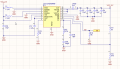
But if the output VCC_4V2 was now to go into low noise LDO, would that adequatly filter any noise from this switch mode supply?

1729539796813.png
 

Papabravo

Joined Feb 24, 2006
22,065
You need to estimate (or simulate) the current ripple and the voltage ripple from the reference design. OTOH if you actually followed the design procedure based on your specifications then you would be able to answer the question. One of the problems with reference designs is that don't tell you what the requirements are. If you don't know what the requirements are, then you can't do a new design.

For Example: Let's say I want an output current of 250 mA with 20% current ripple. This will allow the selection of a switching frequency and an inductor. Let's further say that we want and output of 4.2 Volts with a 1% Voltage ripple, This, will allow us to pick a capacitor value to meet that objective. Now we have a condition for the linear regulator that we can create and evaluate its response.

ETA: I just checked the LTC3124 and it is a boost converter. It converts a lower voltage like +5V to a higher voltage like +12V. I was under the impression that you were going from a higher voltage to a lower voltage. So, which is it?

1729549702333.png
 
Last edited:

ronsimpson

Joined Oct 7, 2019
4,660
Your PWM is complicated. I use 5,6,8 pin buck supplies. You can get them with the voltage setting resistors inside the IC. I often use a PWM that has Cin, Cout, inductor.
To reduce the noise you can add a LC on the output to get much less switching noise.
1729550088485.png
I think LDO regulators are not the best at regulating.
1) 12V PWM 4.2V LDO to 3.3V
2) 12V PWM 5.0V linear regulator to 3.3V (better for noise)

The PCB layout is very important.
 

Papabravo

Joined Feb 24, 2006
22,065
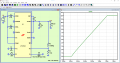
Here is a prototype design for a +12V to 4.2V 250 mA unregulated SMPS. L & C values can be computed for any combination of input voltage, output voltage, current ripple, voltage ripple and switching frequency.

1729556250342.png
 

Papabravo

Joined Feb 24, 2006
22,065
C1 could be 33uF. That will help the ripple. 1/10 the ripple.
Add a L C filter to the output. Big difference.
This example just represents a starting point. If you want 0.1% ripple in place of 1% ripple for a given inductor and switching frequency you can do that. You can also always add an LC section to the output, but you probably should not choose the values arbitrarily.
 

schmitt trigger

Joined Jul 12, 2010
2,056
Analog Devices has a line of switching regulators, with a Silent Switcher architecture, designed specifically for very low noise.
Example….Check out the LT8608S, which may solve your application.
 

WBahn

Joined Mar 31, 2012
32,753
In the early days of switchers, they were atrociously noisy and unsuitable for many analog applications, and so were primarily seen in digital applications. But, like most things, over time a lot of effort has been put into making them quieter and quieter in order to expand the range of applications where a switcher (at least a high-end switcher) are viable options. We've come a long way. There are still applications where the switching noise is unacceptable, but those have gotten a lot fewer and further between. For something like audio, you can't just use any switcher and expect it to be quiet enough, but it is not difficult to find a switcher that is not too expensive and that is quiet enough.
 

ronsimpson

Joined Oct 7, 2019
4,660
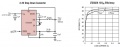
Texas Instruments has similar devices.
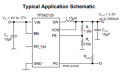
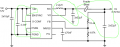
Cinput is two 10uF and 2.2nF very close to the Vin and Pgnd pins.
First filter is 2.2uf & three 22uF.
Second filter is Bead & two 22uF. Add this to any PWM will help.
1729615881656.png
The frequency is 900khz to 2.4mhz. This makes the small inductors work better. There is less need for large capacitors.

Most linear regulators do not reduce 1mhz noise will! Look at their data sheets before picking one.
 

Ian0

Joined Aug 7, 2020
13,112
I always use LMR38010 followed by LP2951, because I also have things that need 5V.
Layout is probably at least as important as choice of device, and you can also keep the 3.3V quiet by putting switching things (such as LEDs, bargraphs etc.) on the 5V supply.
 

Papabravo

Joined Feb 24, 2006
22,065
Cinput is two 10uF and 2.2nF very close to the Vin and Pgnd pins.
First filter is 2.2uf & three 22uF.
Second filter is Bead & two 22uF. Add this to any PWM will help.
View attachment 334164
The frequency is 900khz to 2.4mhz. This makes the small inductors work better. There is less need for large capacitors.

Most linear regulators do not reduce 1mhz noise will! Look at their data sheets before picking one.
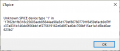
Too bad they decided to encrypt the pSpice model. That limits the number of platforms a user has to evaluate the part in simulation. I was not terribly impressed with WEBBENCH the last time I tried it, but maybe they improved it while I wasn't looking.

I did try creating a symbol and finding the operating point, but LTspice throws the following error:

1729620220661.png

Dealing with encrypted models can be a pain.
 

Papabravo

Joined Feb 24, 2006
22,065
So, I tried to use WEBENCH and it was as clunky as I remember it. You can select the part you want to try to use, and you can get a reference design. You can also export the design to TINA-TI for further investigation. I'll use it if I have to, but I would prefer an alternative.
 

ronsimpson

Joined Oct 7, 2019
4,660
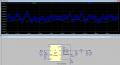
If you want a part that works with LTspice. Here is a 1mhz and 2mhz PWM that you can play with.
1729631891334.png
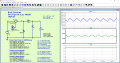
15V to 3.3V Blue is output without L2, C4 and Green is with L2. It removes the 2mhz noise.
Making C2=47uF helps the noise.
1729632339863.png
 

Attachments

Last edited:

Papabravo

Joined Feb 24, 2006
22,065
Well I have no particular need for a part that is useable with LTspice, especially one that is encapsulated in a binary file. At least the TI part had enough text to be able to create a symbol. Also, the LT3502 could hardly be considered a "new" part. That might be OK if that allows a reduction in price.

The only reason I posted ANYTHING at all was to demonstrate the ability of a basic design to achieve a goal in the output voltage ripple. Such a design should begin with the selection of a switching frequency, an inductor value, and a capacitor value. After gaining that level of understanding, using a chip to do that should be far less mysterious.

One more thing. The abbreviation for Megahertz is not "mhz". That abbreviation is for "millihertz". I know what you meant but some readers of these posts might be confused at least temporarily.
 

panic mode

Joined Oct 10, 2011
4,931
actually that is not milli Hertz either,...
units that have names based on real people (scientists who worked in related fields) are always capitalized.
writing it any other way is disrespectful to greats that allowed us to live modern lives and enjoy technology.

so milli Hertz is mHz and not mhz.
milli-Amper is mA, not ma,
micfo Farad is uF not uf,....
milli Henry is mH and not mh.

units not named after people are usually lower case.... like
meter (m),
inch (in),
hour (h),
second (s)
pound (lb) etc...
 
Top